Zero shipping errors, end to end
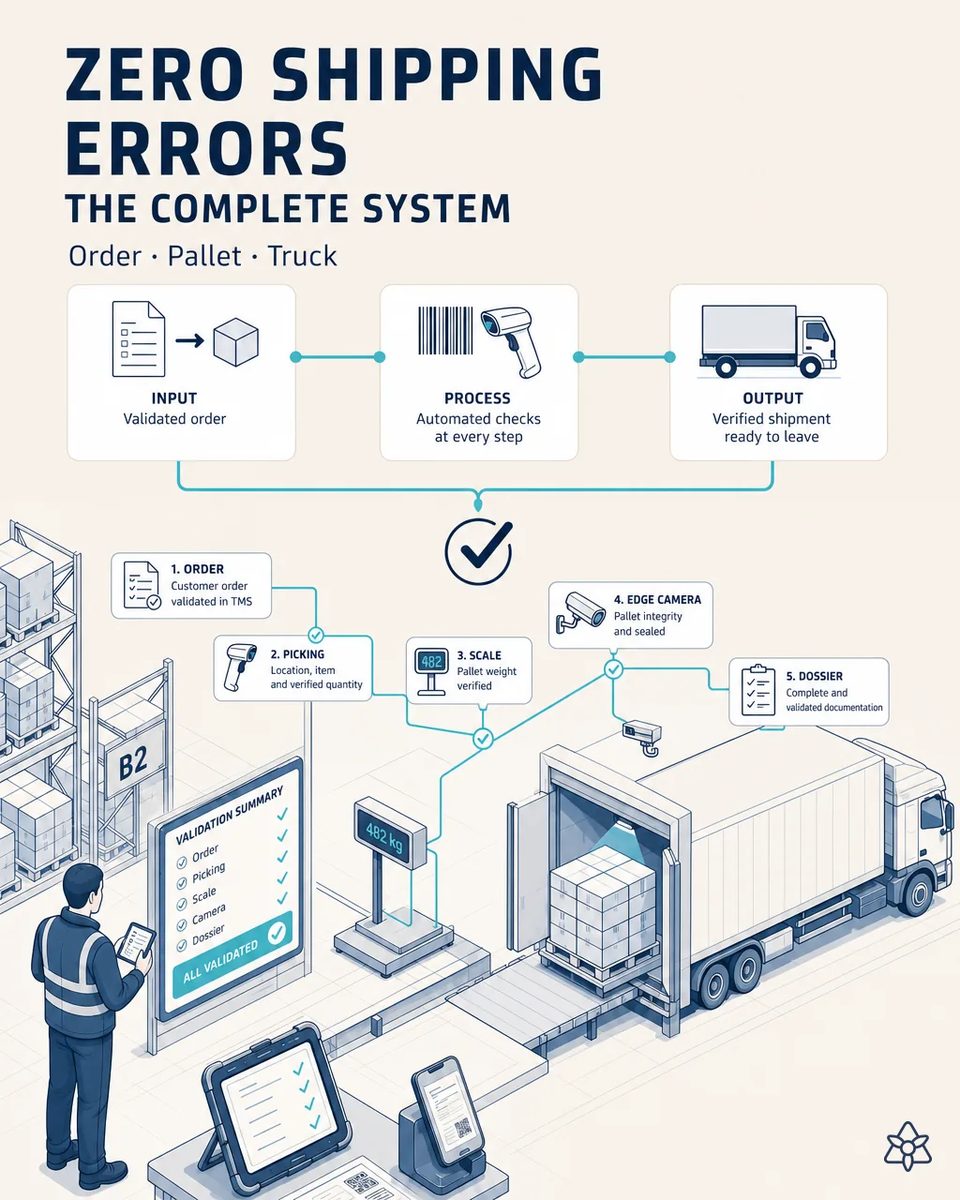
Zero shipping errors: wrong pallet, wrong lot or expiry date, or goods delivered to the wrong client. With a food or medical client, an incident triggers a formal complaint and, in the worst case, loses the contract to a competitor. The ERP/WMS order, the photographed picking sheet, the scale-confirmed weight, the dock's Edge camera, and the evidence-pack dossier — all cross-checked against each other.
A shipping error is almost never a single mistake.
With a food or medical client, an incident triggers a formal complaint and, in the worst case, loses the contract to a competitor. The ERP/WMS order, the photographed picking sheet, the scale-confirmed weight, the dock's Edge camera, and the evidence-pack dossier — all cross-checked against each other.
- Zero shipping errors means no wrong pallet, no wrong lot or expiry date and no goods delivered to the wrong client, on every truck that leaves the dock.
- With a food or medical client, one incident triggers a formal complaint and, in the worst case, the contract goes to a competitor at the next tender.
- Each check exists today in some form, but separately: the order in the ERP/WMS, the picking sheet, the dock scale, the dock team's eye, the paperwork in a binder.
- Each one alone looks fine, and the error passes between them. A correct weight on the wrong order, a sound pallet with the wrong lot: it is caught when the checks are crossed, not one by one.
Six rings that cross-check — the previous eleven cases, orchestrated by Agents.
JIDOKA AI blocks the load right at the dock, not later, once it's already a client complaint. That way, coordinating all the rings doesn't cost loading productivity.
No single ring solves the problem: each already exists today in some form and the wrong pallet still leaves. The strength is in the cross-check, and in JIDOKA AI stopping the load at the dock instead of in the client's complaint. A pallet that agrees across order, pick, weight and camera loads as it does today; only the one that disagrees waits.
The six rings, and what each one stops at the dock
| Ring | Cases it draws on | What it stops |
|---|---|---|
| 1 · Order | Client email (3) + stock spreadsheet (6) | Shipping an order the client already changed |
| 2 · Receiving | Delivery note and lot labels (7) | A wrong lot or expiry born at the inbound dock |
| 3 · Picking | Picking sheet (1) + dock validation (5) | Wrong reference, location or client |
| 4 · Weight | Dock scale (2) | A short or over-weight shipment |
| 5 · Pallet | Damaged pallet (9) + ADR segregation (10) | A damaged or badly segregated load |
| 6 · Evidence | Evidence pack (11) + fleet GPS (8) | A delivery nobody can prove |
Before: a shipping error is discovered in the client's complaint, risking the account. After: the verification rings stop it right at the dock.
Impact estimate — to be validated with your numbers.
The block below is an estimate to be validated against your plant's actual data. We put it forward so the committee has an order of magnitude; we refine it during the assessment.
- Estimated payback 6-12 months, measured against the first serious incident avoided.
- Protection against anything from a one-off contractual penalty to the complete loss of a major account.
- The error is caught at the dock, not in the client's complaint, when correcting it still costs minutes and not a redelivery.
- And coordinating all the rings does not cost loading productivity, because each check runs where the work already happens and only a real discrepancy holds a pallet.
Payback 6-12 months · zero shipping errors against the first serious incident avoided. It protects against anything from a one-off contractual penalty to the complete loss of a major account, catching it right at the dock instead of in the client's complaint.
And the fair question from the production manager
“Do we have to deploy all twelve cases before we see anything?” — no, and framing it that way would be the way never to start. The rings are built in layers and each case pays on its own. And JIDOKA AI stops on a verifiable discrepancy between sources, such as a weight that does not match the order, not on model uncertainty: the captures behind it are anchored tasks, where the best models drop below 1.5% error [1]. When the doubt is the model's rather than a discrepancy, the case is escalated to a person instead of blocking the truck.
[1] OpenAI paper "Why Language Models Hallucinate", 2025 — on the reliability of AI in anchored tasks.
What people ask about zero shipping errors end to end
Which rings should a warehouse build first?
The picking sheet and the dock scale: they are quick to deploy and already give rings 3 and 4, which is where most wrong-pallet errors are caught before loading. The rest are added in the order that matches your incidents, not in a fixed sequence.
Does blocking the load slow down the dock?
Only when there is a real discrepancy. A pallet that agrees across order, pick, weight and camera loads exactly as it does today, at the same pace. When a pallet is held, the screen says which ring disagrees and why, so it is resolved in minutes.
What does the cross-check catch that single checks do not?
The error that passes each check separately: a correct weight on the wrong order, a sound pallet with the wrong lot, a right pick for a client who changed the order an hour ago. Those are exactly the incidents that end in a complaint from a food or medical client.
Does it replace our WMS or TMS?
No. Ring 1 rests on the order being the truth. iLEAN checks the systems against each other and against what actually happens at the dock, without replacing any of them. It works on top of the systems you already run, through their interfaces.
How do we size the return before committing?
With last year's shipping incidents, the claims and credit notes they generated and the value of the accounts at risk, the return per layer is estimated before deciding the order of deployment. That estimate is what decides which ring goes first in your warehouses.
More cases from this series
- The customer alert that arrives before it's too lateiLEAN silently reads customer alerts and cross-checks them against the live order, with a concrete…
- The delivery note that doesn't waitOne photo of the delivery note and lot labels digitizes receiving in seconds. Up to -70% on…
- The scale that finally talks to the central systemAn external camera digitizes the dock scale reading. Every shipment's weight gets traced without…
- Hands-free between aisles, knowledge that doesn't get lostThe supervisor dictates issues while walking between warehouses and docks. iLEAN listens, structures and…
- The spreadsheet that stops being copied by handiLEAN reads the stock and location spreadsheet in real time and, after validation, pushes it into the…
- GPS stitched to the ERP: the ETA that updates itselfEvery truck's position and ETA flow automatically from the GPS into the ERP and the customer portal,…
Tell us what your last serious shipping error cost you, with the client and in money.
We work on your plant's real data, not ours. Assessment with no commitment.
Request estimated ROI within 48h ‹ See all cases of warehousing and transport See logistics