The evidence pack that builds itself, ready for the auditor
A client's IFS Logistics audit arrives, or an ADR inspection — and someone has to reconstruct the period's receiving, segregation and shipping trail. Records are spread out, some on paper, others in different spreadsheets per warehouse — reconstructing it is slow and prone to gaps. The result is a non-conformity that could have been avoided if the evidence had existed from the start.
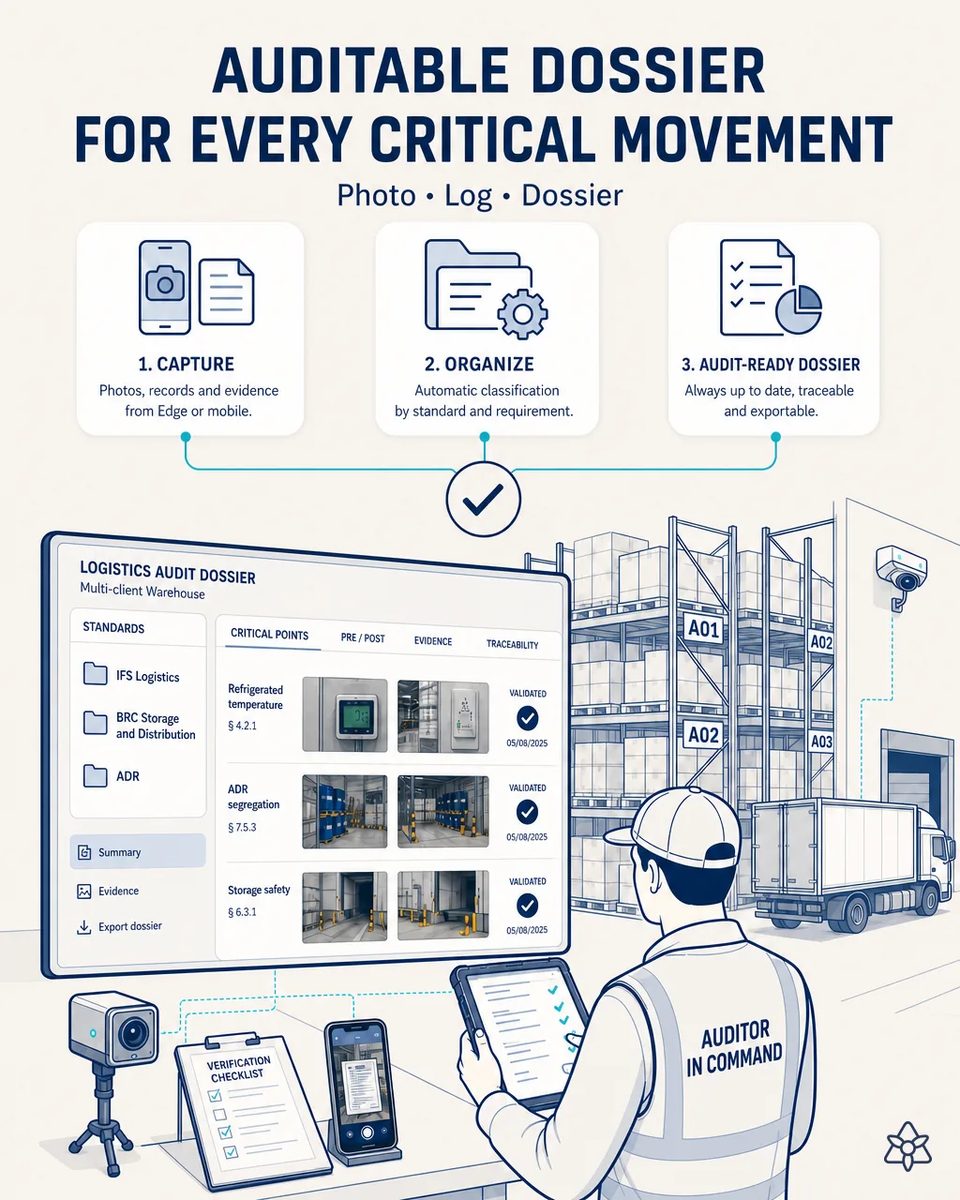
Before every audit, someone rebuilds the trail by hand.
Records are spread out, some on paper, others in different spreadsheets per warehouse — reconstructing it is slow and prone to gaps. The result is a non-conformity that could have been avoided if the evidence had existed from the start.
- An IFS Logistics or BRC Storage & Distribution audit is coming, or an ADR inspection, and someone has to rebuild the period's receiving, segregation and shipping trail.
- Records are scattered: some on paper, others in a different spreadsheet per warehouse, others in the WMS and a few only in someone's memory. Each warehouse keeps them its own way, so the same movement looks different depending on where it happened.
- Rebuilding them is slow and prone to gaps, and the gaps are found by the auditor, not by you. The same records are rebuilt again for every standard and every client that audits.
- The result is a non-conformity that could have been avoided if the evidence had existed from the start, and a corrective action plan that keeps the team busy for weeks. And the client who audits next month will ask for the same trail, filtered by their own goods.
Edge captures each critical movement as it happens — the dossier assembles itself.
Every critical movement — receiving, ADR segregation, shipping to a sensitive client — generates a pre/post photo, a timestamped decision log, and sign-offs. IFS Logistics, BRC Storage & Distribution, ADR — each with its own folder, ready to download.
A dossier rebuilt afterwards inherits every gap of whatever nobody wrote down. One built at the moment of the movement has no such gaps, because the photo, the decision and the signature are taken together. When the audit is announced, the work is reviewing a pack that already exists, not hunting for one. For a multi-client operator the effect multiplies, because the same receiving can be evidence for IFS Logistics, for an ADR inspection and for the food client whose goods were involved.
Rebuilding for the audit versus a dossier already built
| Aspect | Today | With iLEAN Edge |
|---|---|---|
| Pre-audit preparation | Days of scattered work | Zero manual reconstruction |
| Evidence per movement | Whatever was written down | Pre/post photo, log and sign-off |
| Organization | One spreadsheet per warehouse | By standard and by warehouse |
| IFS Logistics, BRC, ADR | Same records, rebuilt three times | One folder per standard |
| Auditor's access | Binders and screens | Downloads the period's pack |
| Missing record | Found by the auditor | Visible when it happens |
Before: days of scattered work reconstructing traceability before every audit. After: the dossier builds itself, organized by standard and by warehouse.
Impact estimate — to be validated with your numbers.
The block below is an estimate to be validated against your plant's actual data. We put it forward so the committee has an order of magnitude; we refine it during the assessment.
- Estimated payback 6-12 months, depending on the number of standards, warehouses and client audits per year.
- Zero manual pre-audit reconstruction: the dossier is already built when the audit is announced.
- The auditor downloads the period's evidence pack without anyone at the operator spending hours preparing it.
- And the non-conformities caused by gaps in records stop appearing, because the gap is visible on the day it happens and can be closed then.
Payback 6-12 months · zero manual pre-audit reconstruction. The auditor logs into the site and downloads the period's evidence pack without anyone at the operator spending hours reconstructing anything.
And the fair question from the production manager
“Is this just another document repository?” — no: a repository stores what someone decides to upload afterwards. Here each movement leaves its own evidence at the moment it happens, and tagging that evidence by standard, warehouse and client is an anchored task, where the best models drop below 1.5% error [1]. The decision log keeps who signed off each movement, so the record has a responsible person, not just a file. And a missing photo or signature is flagged when it should have been generated, not discovered on the auditor's day.
[1] OpenAI paper "Why Language Models Hallucinate", 2025 — on the reliability of AI in anchored tasks.
What people ask about the logistics audit dossier
Which standards does it organize evidence for?
IFS Logistics, BRC Storage & Distribution and ADR, each with its own folder, plus any client-specific requirement you add for a food or medical account. The same evidence is indexed against each scheme, so it is captured once and shown three times.
Which movements generate evidence?
Receivings, ADR segregations and shipments to sensitive clients, each with a pre/post photo, a timestamped decision log and the sign-offs of whoever approved it. The critical movements are agreed with your quality team before deployment.
How does the auditor access the pack?
Through a view limited to the period and scope of their audit. They filter by warehouse or standard and download, without entering your WMS or ERP. Access expires at the end of the audit window and is logged like any other access.
Can a food client audit only their own goods?
Yes. Because every movement is tagged by client, a client auditor can be shown only the evidence that concerns their goods, and nothing about the other clients in the warehouse. That is what a multi-client warehouse needs, because each client has the right to see only its own goods.
Do we need to load the last audit period first?
No. The dossier builds from the first day forward. Older records stay where they are, and bringing them in is optional. Most operators see the difference at the first audit after deployment, when the period is already covered.
More cases from this series
- The customer alert that arrives before it's too lateiLEAN silently reads customer alerts and cross-checks them against the live order, with a concrete…
- The delivery note that doesn't waitOne photo of the delivery note and lot labels digitizes receiving in seconds. Up to -70% on…
- The scale that finally talks to the central systemAn external camera digitizes the dock scale reading. Every shipment's weight gets traced without…
- Hands-free between aisles, knowledge that doesn't get lostThe supervisor dictates issues while walking between warehouses and docks. iLEAN listens, structures and…
- The spreadsheet that stops being copied by handiLEAN reads the stock and location spreadsheet in real time and, after validation, pushes it into the…
- GPS stitched to the ERP: the ETA that updates itselfEvery truck's position and ETA flow automatically from the GPS into the ERP and the customer portal,…
Tell us how many days your team spends rebuilding records before each audit.
We work on your plant's real data, not ours. Assessment with no commitment.
Request estimated ROI within 48h ‹ See all cases of warehousing and transport See logistics