The pallet gets checked before loading, not after
At the shipping dock, several trucks load in parallel and the pace doesn't let up. A torn wrap, ripped film, or a leaning pallet that could topple in transit are easy to miss under time pressure. It generates a complaint, a return, and if the client is in food or medical, it can add a quality incident on top of the logistics one.
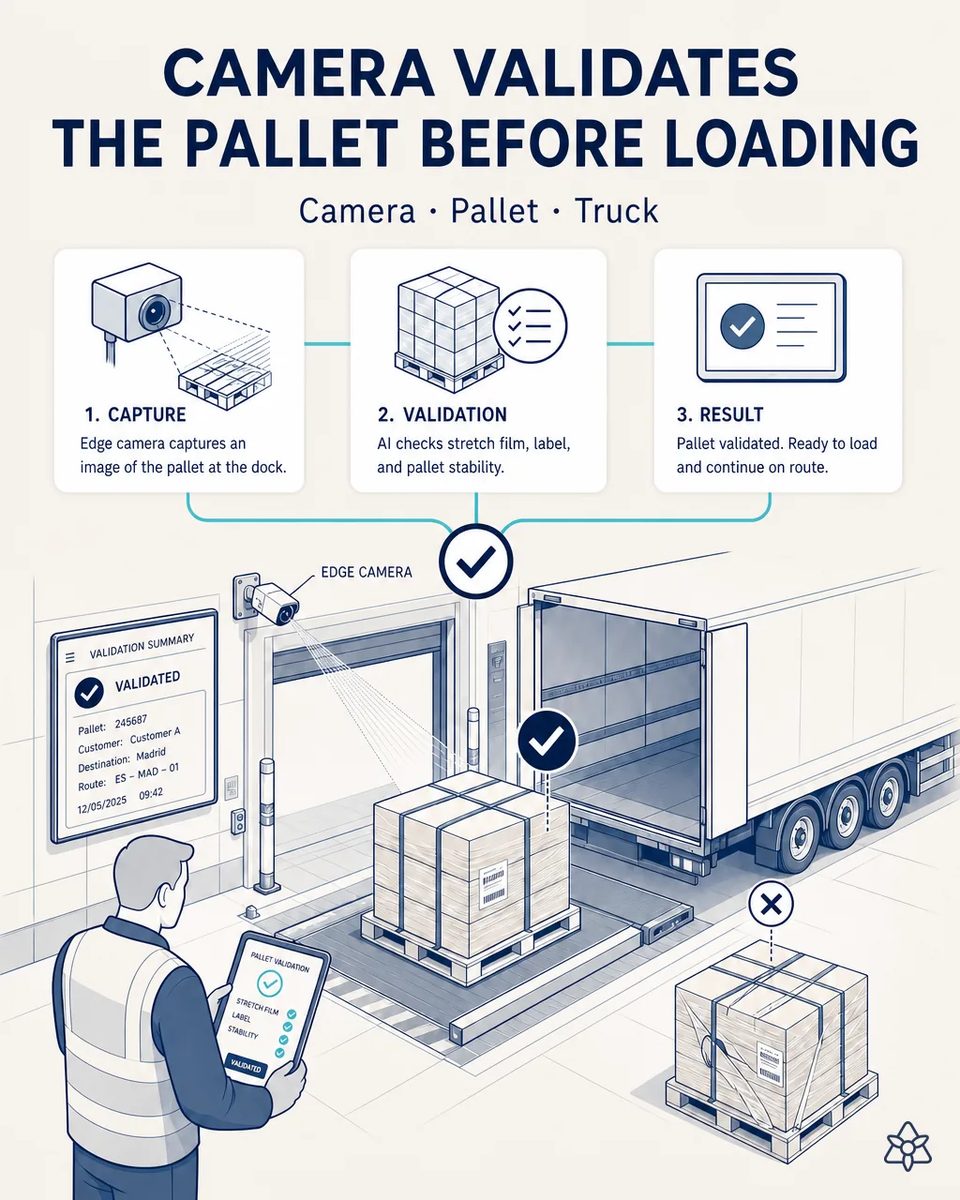
At loading pace, a damaged pallet looks like any other.
A torn wrap, ripped film, or a leaning pallet that could topple in transit are easy to miss under time pressure. It generates a complaint, a return, and if the client is in food or medical, it can add a quality incident on top of the logistics one.
- At the shipping dock several trucks load in parallel and the pace does not let up, especially in the last hour before the departure slots.
- Torn wrap, ripped film or a pallet leaning enough to topple in transit are easy to miss under time pressure, and occasional sampling only catches a few of them.
- The damaged pallet becomes a claim, a return and a replacement shipment, and nobody can prove whether it left the dock damaged or was damaged on the road.
- If the client is in food or medical, a logistics incident becomes a quality incident on top, with its own report and its own questions at the next audit.
Edge — local vision on every pallet, milliseconds, before loading.
It infers in milliseconds per pallet with local CNN vision, with no need to send the image to the cloud. The model is trained on the pallet-handling defects typical of this kind of operation.
The point is not to replace the dock team's eye but to cover what it cannot at peak: every pallet, every truck, every shift. The camera never gets tired at the end of the afternoon, which is when the leaning pallet tends to go through. And every pallet leaves an image of its condition at the dock door, which settles the argument about where the damage happened. For a food or medical client, that image is also part of the evidence that the wrap and packaging were intact when it left the warehouse.
Today's loading check versus Edge at the dock
| Aspect | Today | With iLEAN Edge |
|---|---|---|
| Coverage | Occasional visual sampling | 100% of loaded pallets |
| Torn wrap or ripped film | Seen if someone looks | Detected before loading |
| Leaning pallet | Topples in transit | Stopped at the dock door |
| Where the image is processed in the warehouse | — | Locally, no cloud |
| Proof of condition at loading | None | An image per pallet |
| Borderline case | Loaded anyway | Escalated to the shipping lead |
Before: occasional visual sampling lets damaged pallets slip through to the client. After: 100% inspection of every pallet before it loads onto the truck.
Impact estimate — to be validated with your numbers.
The block below is an estimate to be validated against your plant's actual data. We put it forward so the committee has an order of magnitude; we refine it during the assessment.
- Estimated payback 5-12 months, depending on the volume shipped and last year's damage claims.
- Lower cost of claims and replacement shipments, which are usually paid twice: the goods and the second delivery.
- From occasional sampling to 100% inspection of everything that loads, on every dock and every shift.
- And an image per pallet that shows its condition when it left the dock, useful when a carrier or client disputes where the damage happened.
Payback 5-12 months · 100% inspection of every loaded pallet. It cuts the cost of claims and replacements, moving from occasional sampling to 100% inspection of everything that loads.
And the fair question from the production manager
“What if it stops good pallets and slows loading down?” — classifying wrap, film and lean on a pallet in a fixed position at the dock door is an anchored task, where the best models drop below 1.5% error [1], and the model is trained on the pallet defects of this kind of operation. A doubtful pallet is not silently rejected: it is escalated to the shipping lead, who decides in seconds. And every decision the shipping lead makes on a doubtful pallet feeds back into the model, so borderline cases become fewer over time.
[1] OpenAI paper "Why Language Models Hallucinate", 2025 — on the reliability of AI in anchored tasks.
What people ask about inspecting pallets at the dock
Does it slow down loading?
No. Inference runs locally in milliseconds per pallet, while the forklift is already on its way to the trailer. Only a pallet with a visible defect is held. The shipping lead decides on that one while the rest keep moving.
Does the image go to the cloud?
No. The model runs at the edge, on the dock, so it does not depend on the warehouse network or an internet connection to decide. Only the images you choose to keep are stored centrally, with the order they belong to.
What does the camera look for on each pallet?
Torn wrap, ripped or missing stretch film, a damaged pallet base, a missing shipping label and a lean that risks toppling in transit. The defect list is set with your dock team at commissioning, based on the claims you actually receive.
Does it work with pallets from different clients and sizes?
Yes. The model is trained on the pallet formats you actually ship, so a mixed multi-client dock with euro and industrial pallets is the normal case, not an exception. A new pallet format is added with a short set of real examples from your own docks.
Can the images be used in a claim against a carrier?
Yes. Each pallet's image is stored with time, dock and order, which shows its condition at the moment it was handed over to the truck. It also helps internally, when the question is whether the damage happened in the warehouse or on the road.
More cases from this series
- The customer alert that arrives before it's too lateiLEAN silently reads customer alerts and cross-checks them against the live order, with a concrete…
- The delivery note that doesn't waitOne photo of the delivery note and lot labels digitizes receiving in seconds. Up to -70% on…
- The scale that finally talks to the central systemAn external camera digitizes the dock scale reading. Every shipment's weight gets traced without…
- Hands-free between aisles, knowledge that doesn't get lostThe supervisor dictates issues while walking between warehouses and docks. iLEAN listens, structures and…
- The spreadsheet that stops being copied by handiLEAN reads the stock and location spreadsheet in real time and, after validation, pushes it into the…
- GPS stitched to the ERP: the ETA that updates itselfEvery truck's position and ETA flow automatically from the GPS into the ERP and the customer portal,…
Tell us how many damaged-pallet claims you received last year and from which clients.
We work on your plant's real data, not ours. Assessment with no commitment.
Request estimated ROI within 48h ‹ See all cases of warehousing and transport See logistics