ADR segregation verified by camera, not by eye
Many operators hold a license to store dangerous goods (ADR), and that license coexists in the same facilities as food-sector clients — two very different kinds of goods under one roof. Regulation demands it before an ADR receiving and a food receiving share physical space. With no objective evidence — a lapse isn't just a fine, it's the kind of incident that makes a large food client reconsider the contract.
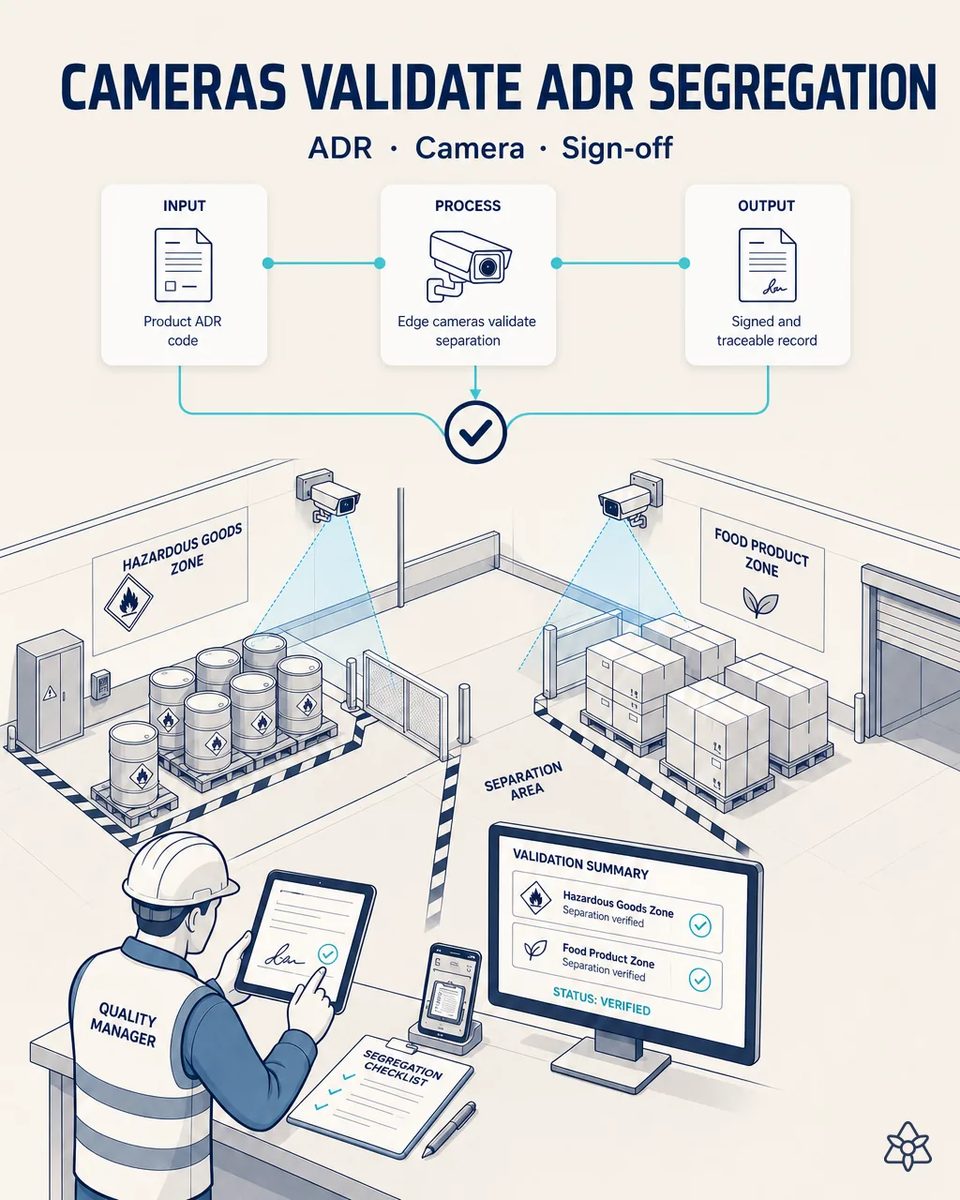
Segregation is required by regulation and confirmed by eye.
Regulation demands segregation before an ADR receiving and a food receiving share physical space. With no objective evidence — a lapse isn't just a fine, it's the kind of incident that makes a large food client reconsider the contract.
- The operator holds an ADR license and, under the same roof, stores goods for food-sector clients: two very different kinds of goods sharing docks, aisles and staging areas.
- Regulation requires correct segregation before an ADR receiving and a food receiving share physical space, and the moments of risk are the busy ones, when both arrive close together.
- Today a supervisor confirms it by eye, under time pressure, and no objective evidence is left of what the zone looked like when the operation started.
- A lapse is not just a fine. It is the kind of incident that makes a large food client reconsider the contract, and the kind an ADR inspection does not forgive.
Edge with JIDOKA AI — the joint operation does not start without visual OK and a signature.
At the critical segregation points, the camera checks whether the current state matches "correct segregation". The joint operation doesn't start until every camera confirms OK and the manager signs off based on visual evidence.
The camera does not sign: it checks each critical point against the reference image of correct segregation, and the manager signs on that evidence. What changes is not who decides, but what the decision rests on. And the image of each check stays with the operation, so the next inspector or food client auditor sees proof instead of a procedure.
Segregation by eye versus segregation by camera
| Aspect | Today | With iLEAN Edge |
|---|---|---|
| How segregation is confirmed | A supervisor looks | Every critical point checked by camera |
| Evidence left behind | None | Image per point, timestamped |
| Start of the joint operation | When someone says OK | Blocked until all cameras confirm |
| Who signs | Whoever is around | The manager, on visual evidence |
| ADR inspection | Your word | The image record |
| A food client's audit | Explaining the procedure | Showing the proof |
Before: segregation depends on a supervisor confirming it by eye, with no objective evidence. After: Edge cameras confirm OK at every critical point before operations proceed.
Impact estimate — to be validated with your numbers.
The block below is an estimate to be validated against your plant's actual data. We put it forward so the committee has an order of magnitude; we refine it during the assessment.
- Payback scales with ADR volume: we do not fix a range because it depends on how many ADR movements share space with food goods in your warehouses.
- It protects the ADR license, which for a logistics operator is a business line in itself and a reason clients choose you.
- It protects contracts with risk-sensitive clients, whose portfolio value can be considerable.
- And it turns segregation from a verbal assurance into evidence that can be shown to an inspector or a client auditor on the same day they ask.
Payback scales with ADR volume · protects the license and sensitive contracts. It protects the ADR license and contracts with risk-sensitive clients, whose portfolio value can be considerable.
And the fair question from the production manager
“What if the camera blocks a receiving for no reason?” — checking whether a zone matches its reference state of correct segregation is an anchored task, where the best models drop below 1.5% error [1]. It stops on a visible discrepancy, such as a food pallet inside the ADR area or a missing barrier, not on model uncertainty; in case of doubt it escalates to the manager, who decides on the image. Every image and every signature stay with the operation, ready for the ADR file and for the next food client audit.
[1] OpenAI paper "Why Language Models Hallucinate", 2025 — on the reliability of AI in anchored tasks.
What people ask about camera-verified ADR segregation
Which areas of the warehouse get a camera?
The critical ones defined with your dangerous goods safety adviser: shared docks, staging areas, aisle boundaries and the separation zones between hazardous and food goods. Cameras are placed where the joint operation actually happens, not across the whole building.
Does it read the hazard class of each package?
It checks that the goods in each zone match what that zone is allowed to hold, using the ADR placards and labels visible on the packages and the expected contents from the WMS. A package whose placard cannot be read is flagged for the manager, not assumed to be correct.
Does it replace the dangerous goods safety adviser?
No. The adviser defines the segregation rules; the cameras check that they are being met at the moment of the operation, every time, not only on the day of the visit. When the rules change, the reference images are updated with the adviser, not reinvented.
Can an exception be made under time pressure?
An exception requires the manager's signature and is recorded as such. What cannot happen is a joint operation with no trace of who allowed it. That record is also what an inspector asks for when something goes wrong.
Does it apply to ADR goods we only store and never open?
Yes. It applies to any ADR goods sharing physical space with food. The check is about where things are and what is next to them, not about what is done to them. Storage alone is enough to require segregation from food goods under the same roof.
More cases from this series
- The customer alert that arrives before it's too lateiLEAN silently reads customer alerts and cross-checks them against the live order, with a concrete…
- The delivery note that doesn't waitOne photo of the delivery note and lot labels digitizes receiving in seconds. Up to -70% on…
- The scale that finally talks to the central systemAn external camera digitizes the dock scale reading. Every shipment's weight gets traced without…
- Hands-free between aisles, knowledge that doesn't get lostThe supervisor dictates issues while walking between warehouses and docks. iLEAN listens, structures and…
- The spreadsheet that stops being copied by handiLEAN reads the stock and location spreadsheet in real time and, after validation, pushes it into the…
- GPS stitched to the ERP: the ETA that updates itselfEvery truck's position and ETA flow automatically from the GPS into the ERP and the customer portal,…
Tell us how many times a week ADR and food goods share a dock in your warehouse.
We work on your plant's real data, not ours. Assessment with no commitment.
Request estimated ROI within 48h ‹ See all cases of warehousing and transport See logistics