Zero warranty returns from origin defects
The capital pain of an exporting white-goods plant: a warranty return or safety recall from an origin defect. The iLEAN flagship coordinates 4 cross-checking verification rings.
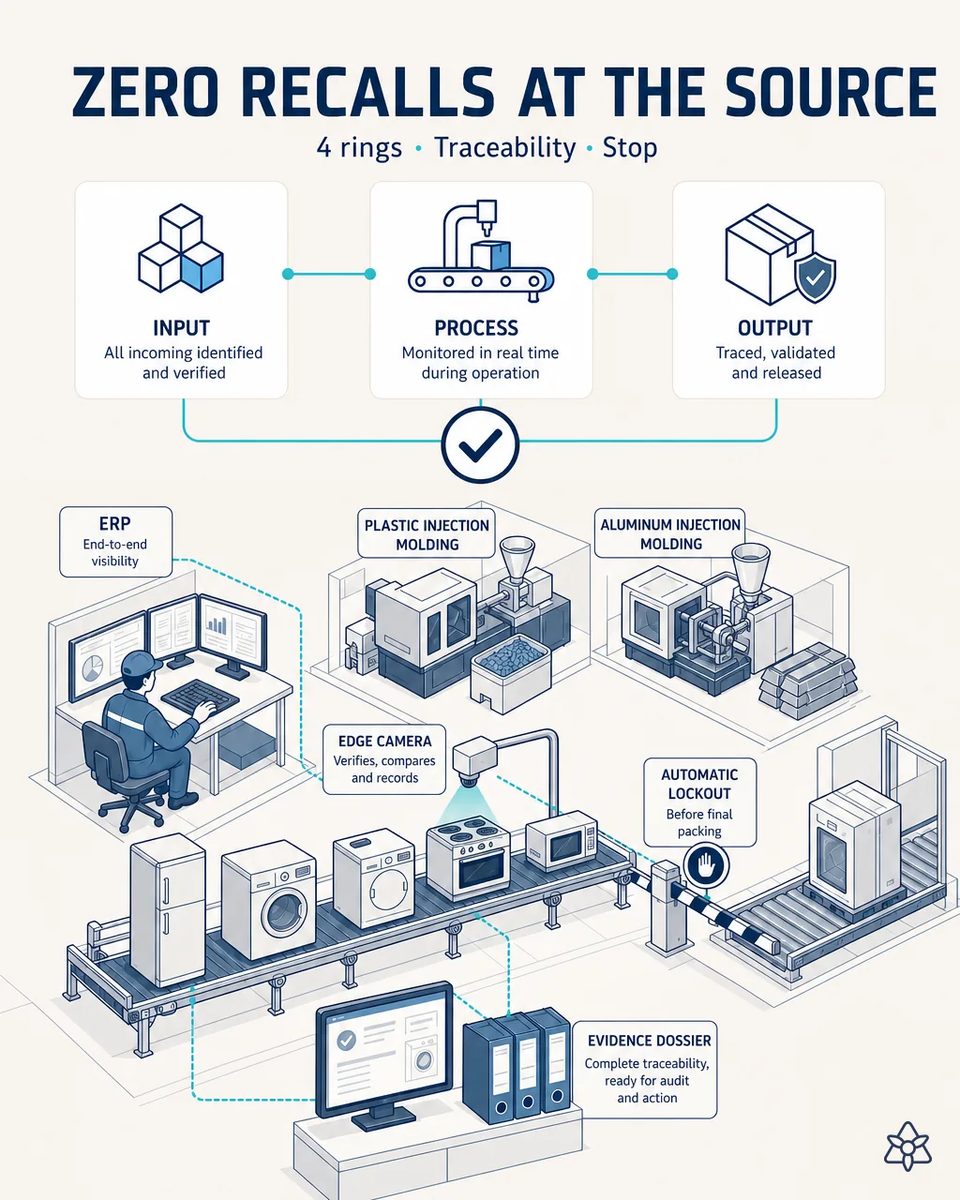
A safety recall costs far more than the retrieval.
A safety recall isn't just the direct cost of the retrieval: it's the distributor relationship, regulatory exposure and brand reputation in demanding export markets.
- The capital pain of an exporting white-goods plant is a warranty return wave or a safety recall caused by an origin defect: a wrong compressor batch, a mislabeled serial range, an assembly error nobody saw. In a washer or a stove, an origin defect can also become a safety issue in the customer's home.
- The direct cost of retrieving units is only the start. Then come the distributor relationship, regulatory exposure and brand reputation in demanding export markets.
- Each individual control already exists in some form, and each one passes the unit on its own, because each one only checks itself.
- What fails is that no one checks the controls against each other before the appliance is packed and shipped. That cross-check is what the flagship adds on top of the cases it coordinates.
Four rings that cross-check — coordinated by Agents, with a human in command.
Ring 1 (ERP: critical-component batch) + Ring 2 (labeler: serial number with no typing) + Ring 3 (Edge: visual reading cross-checked against the order, JIDOKA AI locks the line on mismatch) + Ring 4 (evidence pack: dossier with final test and sign-off). SMED AI keeps changeover speed intact.
No single ring prevents the recall; each already exists in some form today. The protection comes from the cross-check: when the ERP batch, the label, what the camera sees and the test record stop agreeing, the unit does not ship. And a person in quality decides what happens next. The algorithm never releases a unit on its own.
The four rings, and what each one secures
| Ring | What it checks | What it secures |
|---|---|---|
| 1 · ERP | Critical-component batch per order | Which compressor or motor went into each unit |
| 2 · Labeler | Serial number with no typing | The serial range matches the order |
| 3 · Edge | Visual reading against the order | JIDOKA AI locks the line on mismatch |
| 4 · Evidence pack | Final test and sign-off | A dossier per unit for any claim |
| Changeovers in white goods | SMED AI | Speed kept while the rings run |
| Final decision | Human in command | Quality releases, not the algorithm |
Latent untraceable recall risk → in-line discrepancy detection, before the product leaves the plant.
Impact estimate — to be validated with your numbers.
The block below is an estimate to be validated against your plant's actual data. We put it forward so the committee has an order of magnitude; we refine it during the assessment.
- Estimated payback 6-12 months, measured against the first incident avoided — to be validated with quality and Operations.
- From a latent, untraceable recall risk to in-line discrepancy detection, before the product leaves the plant.
- If a claim does arrive, the affected serial range is bounded by query instead of widened by precaution.
- And protection of the distributor relationship and of the brand in export markets, which no single control secures on its own. Each avoided incident also protects the next export contract.
Estimated payback 6-12 months against the first incident avoided. *Estimate to validate* with quality and Operations.
And the fair question from the production manager
"Will the rings stop the line every hour?" — JIDOKA AI stops on a verifiable mismatch between sources — the label says one model, the camera reads another — not on model doubt. Reading a label or a model plate is an anchored task, where the best models drop below 1.5% error [1]; when the camera is unsure, the unit is escalated to a person instead of locking the line. Stops are rare and justified, and each one is recorded with the evidence that caused it.
[1] OpenAI paper "Why Language Models Hallucinate", 2025 — on the reliability of AI in anchored tasks.
What people ask about the zero-recall flagship
Do we need all twelve cases before starting?
No. The rings are built in layers, and each underlying case pays on its own. The ERP batch capture and the wired labeler already give you rings 1 and 2. The Edge camera and the evidence pack close rings 3 and 4 when the line is ready.
Why can each control pass a unit that should not ship?
Because each one checks only itself. A correct label on the wrong model passes the labeler; a correct model with the wrong compressor batch passes the camera. Only the cross-check between rings catches the combination.
Does it slow down model changeovers?
No. SMED AI is part of the design precisely so the cross-checks do not cost changeover speed on a high-mix appliance line. A model change still takes the minutes it takes today.
Who decides when a ring flags a mismatch?
A person in quality. The line is locked on the mismatch, and the unit is released or held by a human decision that is recorded with its reason. That record is what you show a distributor or a regulator if they ever ask.
How is the return estimated before committing?
With your real warranty figures, the cost of the last recall or return wave and your exported volume, layer by layer, before deciding the order. The first layers usually justify themselves before the flagship is complete. Calibration is done with quality and Operations, not by us alone.
More cases from this series
- A photo of the Work Order at line startupThe line lead photographs the Work Order and the startup checklist; the assembly batch exists in the…
- The delivery note that reaches the ERP with a photo and a tapPhoto the delivery note and the resin or component batch labels; iLEAN digitizes them and pushes them to…
- The line lead's knowledge that no longer gets lostThe line lead dictates while walking between molders and assembly; iLEAN listens, structures the issue…
- The lab test spreadsheet that no longer lives on its owniLEAN absorbs the leak-tightness and vibration test spreadsheet in real time and pushes it to the ERP…
- Verify in two taps, before the data crosses into the ERPNothing iLEAN captures enters the ERP without a human confirming it with two taps. Seconds of latency,…
- The supplier alert that no longer gets lost in the inboxiLEAN reads the resin supplier's email in seconds, cross-checks it against active orders, and suggests…
Schedule the follow-up meeting to calibrate the flagship with your real warranty numbers.
We work on your plant's real data, not ours. Assessment with no commitment.
Request estimated ROI within 48h ‹ See all cases of white goods See home appliances