No start-up until cleaning is camera-confirmed
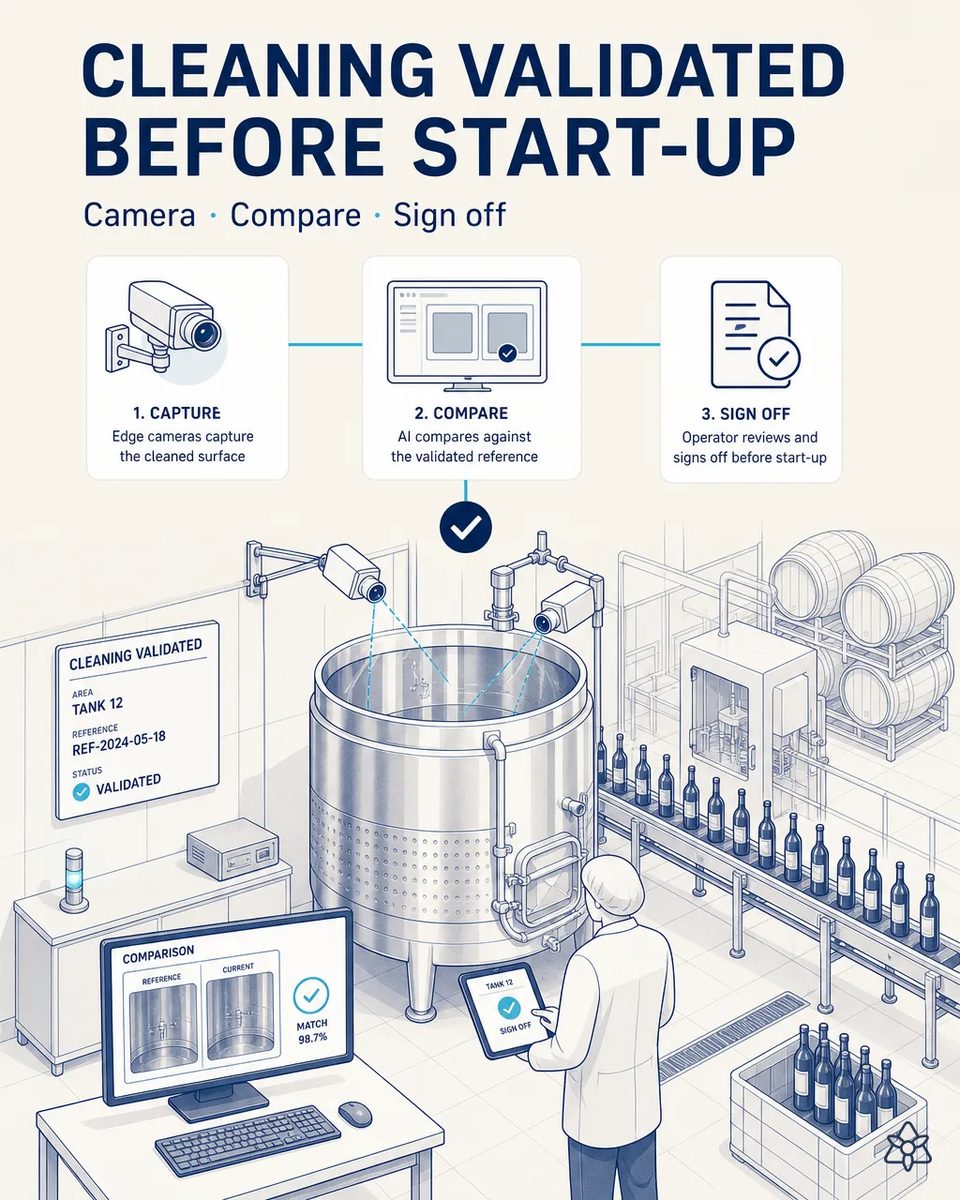
Switching variety or range in a tank or line requires certified cleaning. Today the sign-off is blind. With Edge, fixed cameras compare the current state against the reference before allowing start-up.
Every variety change rests on a signature with nothing behind it.
every variety or range change is a moment of silent risk — responsibility rests on a human sign-off with no structured visual evidence, right in the middle of peak campaign.
- Switching variety or range in a tank or on a line requires certified cleaning. If wine residue or tartrate stays behind, the next batch starts mixed.
- Today the cleaning is signed off on a checklist. The signature says someone looked; it does not show what they saw.
- Those changes pile up right in the middle of peak campaign, when the cellar is shortest of time and hands and every tank is needed again the same day. Under that pressure, cleaning is exactly the step that gets rushed.
- And when a reserva shows a fault months later, the investigation finds a ticked box and no evidence of what the tank looked like. The person who signed may not even remember that change among the dozens of the campaign.
Edge with JIDOKA AI — start-up stays blocked until the image matches and the winemaker signs.
Edge plus JIDOKA AI. Cameras with CNNs trained to recognize "clean vs. wine residue". Start-up blocked until OK plus the winemaker's sign-off.
The camera does not replace the winemaker's judgment; it gives that judgment something to look at. The sign-off stays human, but it is now made on visual evidence at each critical point instead of on trust in whoever cleaned the tank. And every sign-off, with its image, becomes part of the evidence the regulatory council can ask for later, without anyone having to prepare it.
Blind sign-off versus camera-backed sign-off
| Aspect | Today | With iLEAN Edge |
|---|---|---|
| Proof that the tank is clean | A ticked checklist | Image compared with the clean reference |
| Wine residue on walls or valve | Seen if someone looks closely | Detected before filling |
| Risk of variety mixing | Silent | Blocked at start-up |
| Who authorizes the fill | Whoever signs the sheet | The winemaker, on the image |
| Reserva and gran reserva batches | Exposed at every change | Protected at every change |
| Evidence for the council | None | Stored per tank and per change |
blind sign-off with risk of variety mixing → sign-off based on visual evidence at each critical point.
Why the payback depends on how often you change variety.
The block below is an estimate to be validated against your plant's actual data. We put it forward so the committee has an order of magnitude; we refine it during the assessment.
- No fixed payback range: we do not set one, because the return depends on how often your tanks and lines change variety or range.
- It protects the quality of the highest-value ranges, reserva and gran reserva, where one mixed batch costs the most. A reserva batch compromised by residue from a young wine loses the value of years of aging.
- It protects origin certification, because each change leaves visual evidence instead of a signature alone.
- The estimate is built with your own number of changes per campaign before anything is committed. Wineries with many varieties sharing few tanks usually see the case pay faster.
protects the quality of the highest-value ranges (reserva/ gran reserva) and origin certification. Payback depends on change frequency. Estimate to validate.
And the fair question from the production manager
"What if the camera blocks a clean tank during harvest, when we cannot afford to wait?" — comparing a known tank against its own clean reference is an anchored task, where the best models drop below 1.5% error [1]. When the image is doubtful, the system does not block in silence: it shows the winemaker the side-by-side comparison, and their sign-off decides.
[1] OpenAI paper "Why Language Models Hallucinate", 2025 — on the reliability of AI in anchored tasks.
What people ask about validating tank cleaning with cameras
Where are the cameras placed?
At the critical points defined with your team: tank interior through the manway, valves, transfer lines. Each point has its own clean reference image. The references are taken with your team after a cleaning everyone agrees is correct.
Does it work with stainless steel reflections?
Yes. The model is trained on your tanks with their real lighting, precisely so that reflections on the steel are not taken for wine residue or tartrate. Commissioning includes a period where the comparison runs without blocking, to tune it to your cellar.
Does the check slow down a variety change?
The comparison takes seconds. What slows changes today is the extra margin added when nobody is completely sure the tank is clean. With evidence on screen, the winemaker can sign in the moment instead of going to look.
Is this only for tanks?
No. Bottling lines and transfer hoses can be covered too, wherever a variety or range change creates a real risk of mixing. The same comparison logic applies; only the reference images change.
Can the block be overridden in an emergency at the winery?
Yes, with the winemaker's explicit sign-off, and it is recorded as an exception. What cannot happen is a fill with no trace of who allowed it. Those exceptions are listed in the evidence pack, so they are visible in the next audit.
More cases from this series
- The capital pain of any winery, solved in 4 rings4 coordinated rings (ERP, labeler, Edge, evidence pack) stop the line the moment a batch or vintage…
- The audit dossier, ready before the auditor shows upEvery critical change automatically generates a photo, log and sign-off. Agents organizes the evidence…
- Nothing enters the ERP without your confirmationNothing iLEAN captures reaches the ERP without a human confirming it with 2 taps on an industrial tablet.
- The fermentation curve, digitized without touching the equipmentAn external camera digitizes the fermentation temperature curve from a legacy control panel, without…
- From the grower's text message to action, in secondsiLEAN reads associated growers' alerts in silent copy and reschedules harvest before the trailer even…
- The grower's delivery note, from paper to ERP in secondsPhotograph the grower's weighbridge note and it goes straight to the ERP after one confirmation tap.…
Tell us how many variety changes your tanks go through in a campaign.
We work on your plant's real data, not ours. Assessment with no commitment.
Request estimated ROI within 48h ‹ See all cases of wineries See food industry