No defective bottle reaches the case
At real bottling-line speed, the human eye tires and lets defective bottles through. iLEAN Edge inspects every bottle in milliseconds and ejects it before boxing.
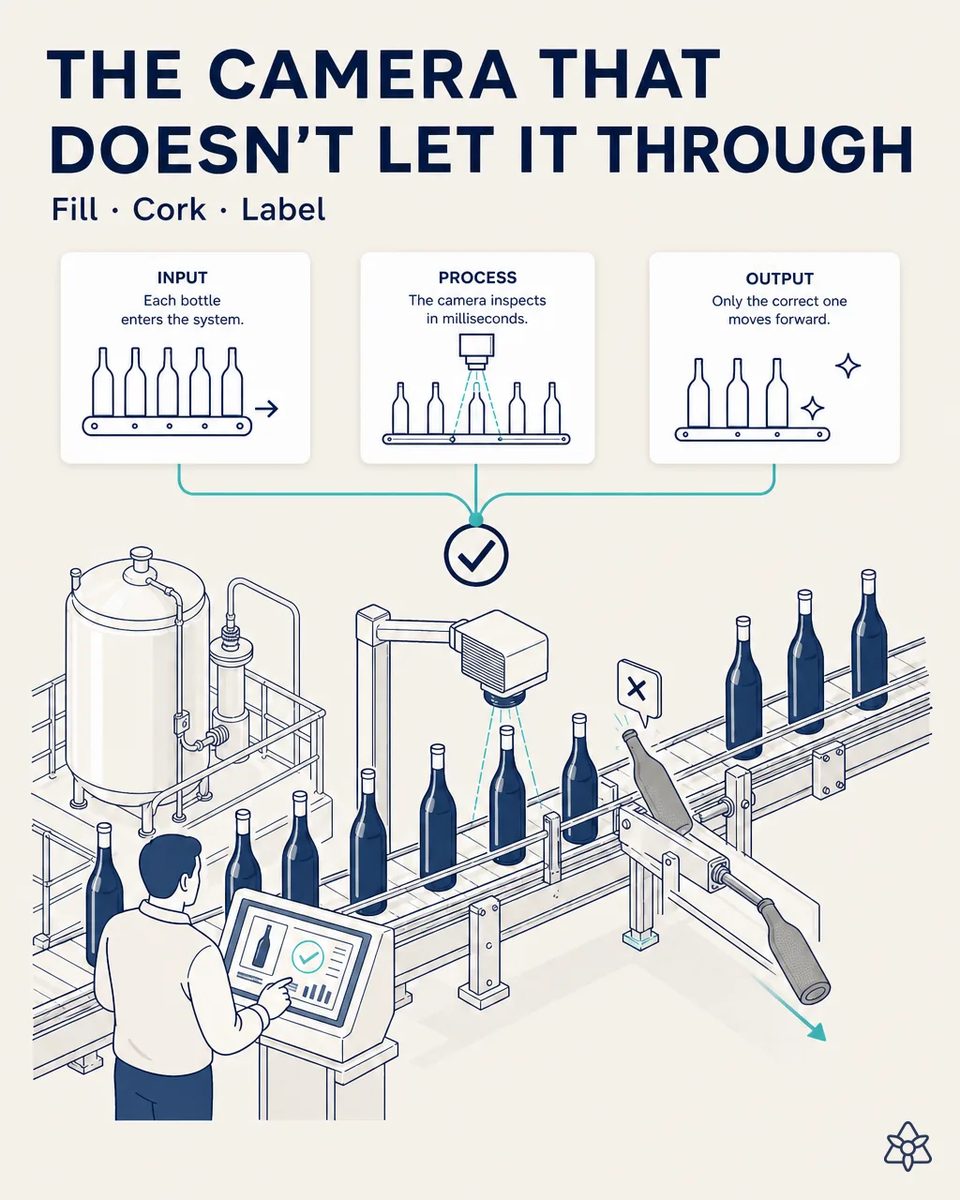
At full line speed, the eye gives up before the shift ends.
100% human visual control is impossible at real line speed; sample-based inspection leaves gaps, and a batch with a defect can reach distribution undetected.
- Low fill level, a cork sitting proud or crooked, a capsule badly crimped, a back-label skewed or missing: each one is a bottle the end customer will notice on the shelf.
- Checking every bottle by eye at real bottling speed is impossible. Inspection becomes sampling, and sampling leaves gaps by definition.
- A batch with a recurring defect can reach the distributor before anyone at the winery sees it, because the samples happened to be good ones.
- Then the complaint comes back from the importer, with the cost of a return and a damaged relationship attached. And nobody can show which bottles, of which hour, carried the defect, so the whole batch falls under suspicion.
Edge — local vision on the bottling line, no image leaves the winery.
Edge — local CNN vision, no image sent to the cloud. Model trained on examples of the specific bottle format.
The model is trained on your bottle, your cork and your label, not on a generic catalog. That is what keeps false rejects low enough for the line team to trust the ejector instead of switching it off in the second week. It is also what makes the ejected bottles useful: each one comes with the image that explains why it left the line, so the filler, the corker or the labeler can be adjusted at the source.
Sampled bottles versus every bottle inspected
| Aspect | Visual sampling | With iLEAN Edge |
|---|---|---|
| Share of bottles checked | 1-2% | 100% |
| Fill level, cork and label | Checked when someone looks | Checked on every bottle in milliseconds |
| A defective bottle | Boxed with the rest | Ejected before casing |
| Images of the line | — | Processed locally, never sent to the cloud |
| Distributor and importer complaints | Recurring | Drastic reduction |
| Format change | New eyes to train | Model switched to the active format |
1-2% sampling → 100% bottle control; distributor/importer complaints → drastic reduction.
Impact estimate on the line — to be validated with your current defect ratio.
The block below is an estimate to be validated against your plant's actual data. We put it forward so the committee has an order of magnitude; we refine it during the assessment.
- Estimated payback 5-12 months, depending on the current defect ratio of your line.
- From 1-2% sampling to 100% bottle control, at real bottling speed. Every bottle, not a sample, has a recorded verdict. The line keeps its speed; the camera adapts to it, not the other way around.
- Distributor and importer complaints drop drastically, and with them the cost of returns and replacements. Fewer complaints also means fewer hours spent by quality answering them.
- And every ejected bottle keeps its image, which explains the defect instead of just counting it.
estimated payback of 5-12 months depending on the current defect ratio. Estimate to validate.
And the fair question from the production manager
"What if it starts rejecting good bottles and slows the line?" — the false reject is the real risk of any vision system, which is why the model learns from good and bad examples of your specific format and under that station's lighting. Classifying a known defect on a known bottle is an anchored task, where the best models drop below 1.5% error [1], and borderline cases go to a person instead of being thrown away.
[1] OpenAI paper "Why Language Models Hallucinate", 2025 — on the reliability of AI in anchored tasks.
What people ask about inspecting bottles on the bottling line
Which defects does it detect at the winery?
Fill level, cork or capsule position, missing or skewed label and back-label, and any other defect you can show it with real examples from your own line. Each new defect type is added with a handful of real examples, not a new project.
Why does the processing stay inside the winery?
Because the decision has to be taken in milliseconds at line speed, and because the images of your line do not need to leave the building to be useful. It also keeps working if the winery's internet connection drops during a bottling run.
Do we need many bottles to train it?
Fewer than people expect. What matters is that they are real bottles from your format, both good and defective, filled and closed on your line. The trial run with your bottles shows the detection rate before any commitment.
Does it work with dark glass?
Yes. Lighting and camera position are set for the glass color and shape you bottle, which is exactly why the trial run uses your own bottles. Sparkling, still, clear and dark glass are each trained with their own references.
What happens with the ejected bottles?
They leave the line with their image and the reason recorded, so the team decides whether to rework them and quality sees the pattern behind them. A cluster of low fills, for instance, points to a filler valve rather than to bad luck.
More cases from this series
- The capital pain of any winery, solved in 4 rings4 coordinated rings (ERP, labeler, Edge, evidence pack) stop the line the moment a batch or vintage…
- The audit dossier, ready before the auditor shows upEvery critical change automatically generates a photo, log and sign-off. Agents organizes the evidence…
- Nothing enters the ERP without your confirmationNothing iLEAN captures reaches the ERP without a human confirming it with 2 taps on an industrial tablet.
- The fermentation curve, digitized without touching the equipmentAn external camera digitizes the fermentation temperature curve from a legacy control panel, without…
- From the grower's text message to action, in secondsiLEAN reads associated growers' alerts in silent copy and reschedules harvest before the trailer even…
- The grower's delivery note, from paper to ERP in secondsPhotograph the grower's weighbridge note and it goes straight to the ERP after one confirmation tap.…
Tell us how many bottles per hour your line runs and how you check them today.
We work on your plant's real data, not ours. Assessment with no commitment.
Request estimated ROI within 48h ‹ See all cases of wineries See food industry