Audit-ready, without weeks of prep
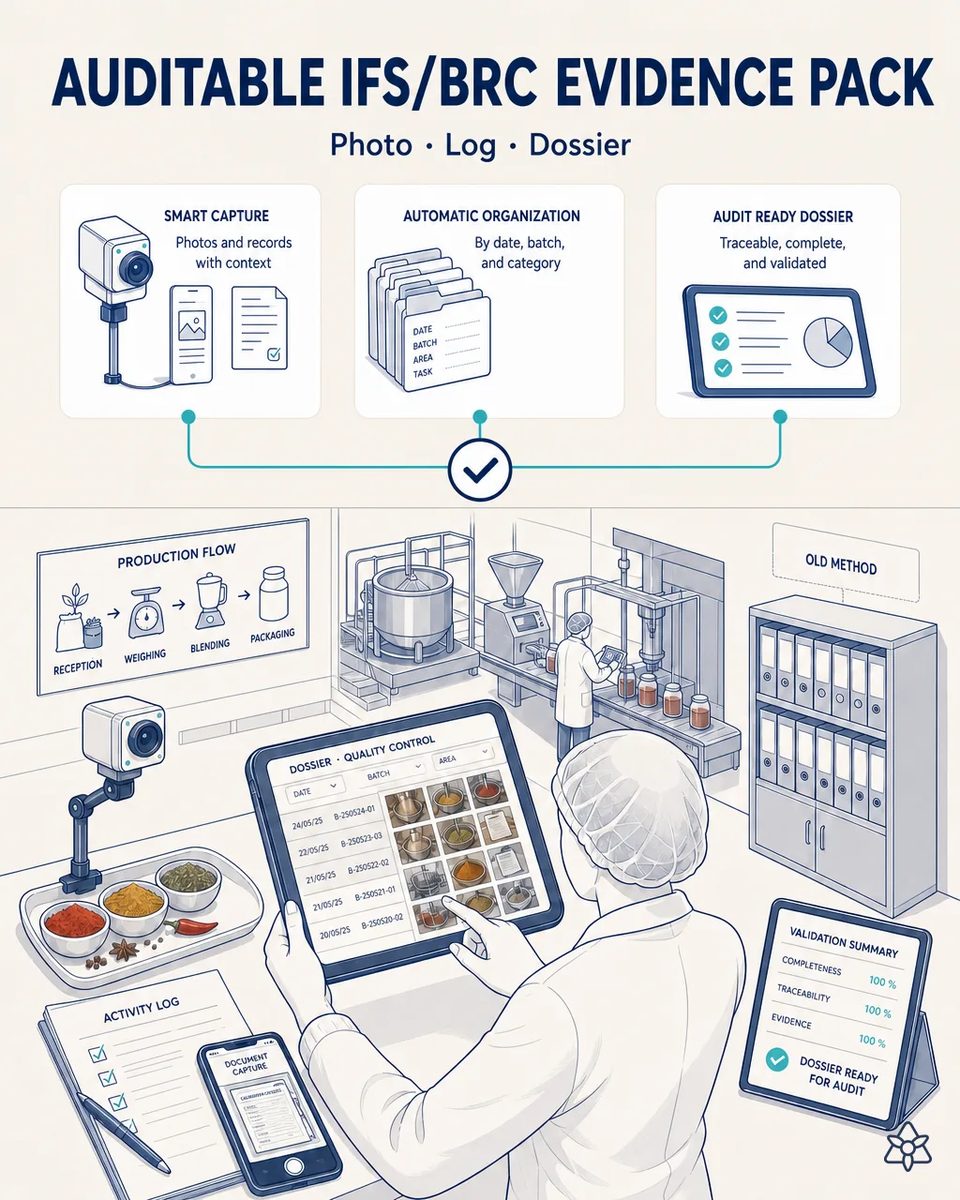
On audit day, someone on the quality team spends weeks rebuilding traceability. With Edge + Agents, every critical change already logged itself, and Agents organizes it automatically by certifying standard.
The cost of the audit is not the audit.
scattered paperwork and documentation gaps can trigger a non-conformity even when the real process was correct.
- The evidence exists, but it is scattered across binders, the lab spreadsheet, the ERP and people's memory. That is the honest diagnosis of almost any certified plant of this size, and nobody in it would pretend otherwise.
- The cost is the weeks beforehand, repeated for every standard and every customer that audits, absorbed by a quality team that is already the smallest one in the building.
- And what the auditor finds is rarely a bad process: it is a missing record for a cleaning that was done correctly, or a moisture reading nobody wrote down on a batch that was perfectly fine.
- A documentation gap is a non-conformity even when the process was right, and it is discovered on the worst possible day, in front of the person deciding whether your certificate is renewed.
Edge and Connect capture; Agents organizes by standard.
Agents organizes photos, logs and sign-offs from every critical event (cleaning, formula change, receiving, moisture) by standard and audited period.
Every batch and every changeover leave their dossier closed at the moment they happen. Anything rebuilt afterwards inherits the gaps of whatever nobody wrote down — and it is precisely in the assembly, not in the process, that non-conformities appear. The plant was compliant; the paperwork was late.
Today's preparation versus the permanent dossier
| Aspect | Today | With iLEAN Agents |
|---|---|---|
| Audit preparation | Weeks of the quality team | Hours of review |
| IFS and BRC | Assembled separately | Same evidence, another index |
| A customer audit on top | Repeated in full | Another view of the same pack |
| Where the evidence lives | Binders, spreadsheet and memory | One downloadable package |
| A missing record | Found by the auditor | Flagged when it should have existed |
| Cleaning and moisture history | Printed and hunted down | Already in the package |
weeks of manual rebuilding → dossier available on demand.
Estimated impact — to validate with your own numbers.
The block below is an estimate to be validated against your plant's actual data. We put it forward so the committee has an order of magnitude; we refine it during the assessment.
- No standalone payback figure is claimed here: the brief measures this case by the drastic reduction in preparation time, and the month count depends on how many audits you take.
- The saving multiplies by the number of standards and customers with audit rights, which in this sub-sector is rarely just one and is often four or five a year.
- The documentation gap is flagged the day the record should have been generated, when it can still be corrected, instead of on the auditor's morning when it cannot.
- And the quality team stops spending its scarcest weeks rebuilding what already happened, which is the capacity you need to certify the next standard a customer asks for.
drastic reduction in audit preparation time. *Estimate to validate*.
And the fair question from the production manager
"Isn't this just another document manager?" — the difference is direction. A document manager stores what somebody decides to upload afterwards, and inherits the same gaps. Here the dossier closes the instant the batch or the changeover happens, and what Agents does is reindex it for whichever standard asks. Classifying each record against a standard is an anchored task where the best models drop below 1.5% error [1], and the quality manager reviews the index before it is issued.
[1] OpenAI paper "Why Language Models Hallucinate", 2025 — on the reliability of AI in anchored tasks.
What people ask about the evidence pack
Does it serve IFS and BRC at the same time?
Yes, and that is the point: the evidence is the same, what changes is the scheme it is indexed against. That reindexing is exactly the work that gets repeated in full for each auditor today, by hand and against the clock.
Does it cover customer audits too?
Yes, scoped to the period and the products that customer buys. They see their own evidence and nothing else, which is also what your commercial team wants when two customers are competitors.
Does it warn about a missing record?
That is the function with the most value: it detects that evidence for a critical event was never generated, at the time it should have been generated, instead of on the auditor's morning when nothing can be done about it.
Does the auditor get into our systems?
No. They access a view bounded to the scope and the period of their audit, where they filter and download. There is no access to the ERP, the lab files or any other period.
What about the history from before we started?
It stays where it is. The dossier builds from day one forward; bringing the old binders in is optional and, in practice, rarely worth the effort compared with what the next twelve months generate.
More cases from this series
- Seamless traceability, from sack to packConnect, Edge, Agents, JIDOKA AI and SMED AI coordinated against untraced traceability risk in spice…
- Paperless batch startupHow a spice factory digitizes the production order and blend formula at batch startup with a simple…
- Validate the formula in seconds, no typingNo formula or allergen data enters the central system without human validation first, in 2 taps.
- The delivery note, to ERP in one tapPhoto the delivery note and raw-material sack labels: Connect validates and pushes to the ERP, no driver…
- The dryer that now talksAn external camera digitizes the moisture curve of a vintage dryer/mill without touching the original…
- A headset so plant knowledge never gets lostA spice factory's section lead talks to the AI while walking the floor; no plant knowledge gets lost.
Tell us how many weeks your last certification audit took to prepare.
We work on your plant's real data, not ours. Assessment with no commitment.
Request estimated ROI within 48h ‹ See all cases of spices and seasonings See food industry