Allergen cleaning, validated by camera
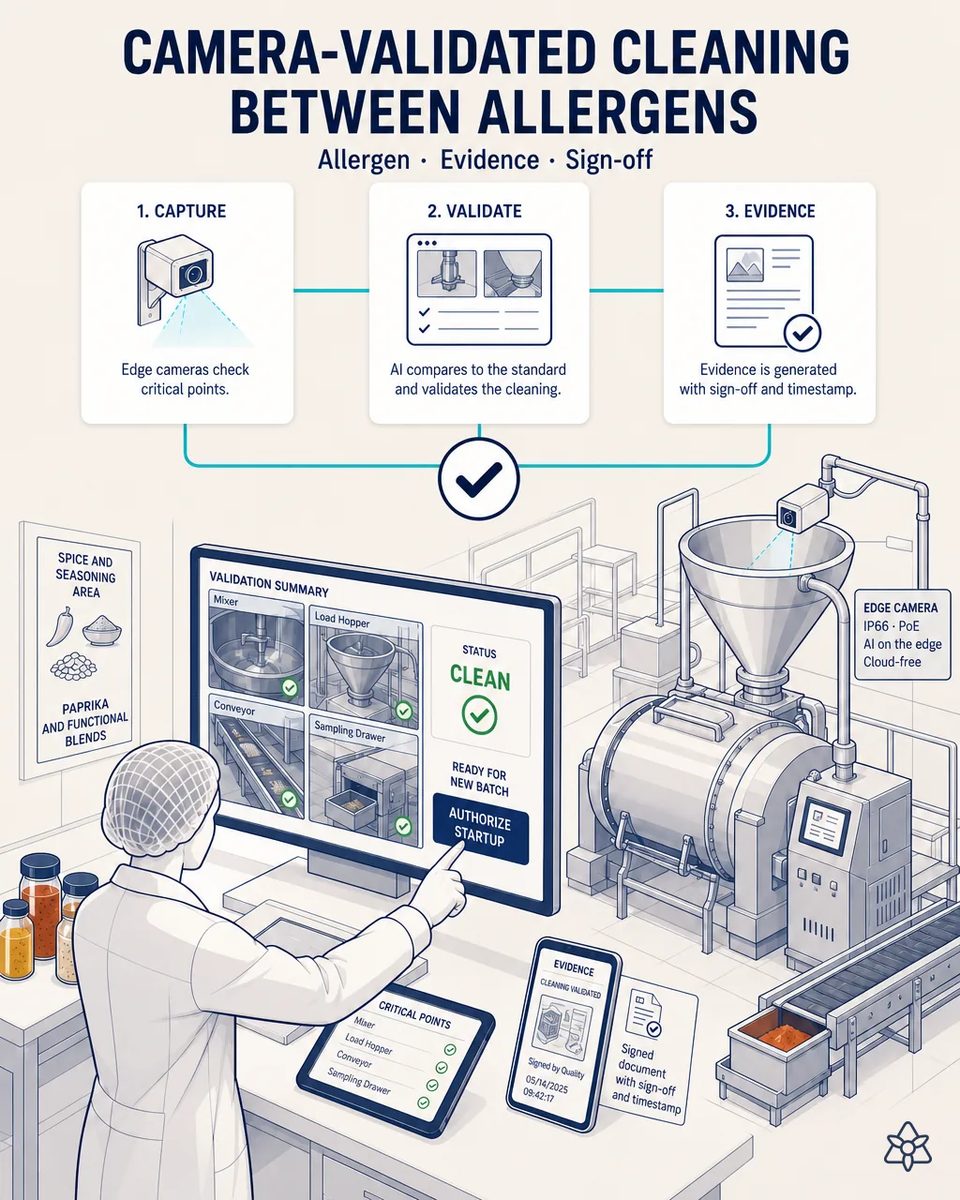
Switching between formulas with and without a given allergen is the plant's most sensitive moment. With Edge, cameras at the critical points compare the current state against the clean reference before allowing startup.
The procedure is good. The problem is what proves it was followed.
today, cleaning is validated with a sign-off and no objective evidence; if it starts poorly, the first batch gets contaminated.
- Going from a formula with mustard, celery or sesame to one that declares none of them is the most sensitive moment in the plant, and it happens several times a week.
- The cleaning procedure exists and is well written. What fails is the evidence: a signature on a sheet, taken under time pressure because the changeover sits on the shift's critical path.
- Powder hides where a glance does not reach: the underside of the ribbon, the corner of the load hopper, the sampling drawer, the transfer between conveyor and bagger. A fine seasoning blend gets everywhere, and nobody is going to dismantle the mixer twice a day to look.
- If the mixer restarts with residue, the first batch is contaminated and declares an allergen it does not list. And when the investigation comes, it runs into a ticked box and no proof.
Edge with JIDOKA AI — the mixer does not restart without conformity and a sign-off.
Edge cameras at N critical points + JIDOKA AI — no startup until every camera confirms the correct state and the quality manager signs off.
The camera does not decide alone: it checks each critical point against its clean reference image and it is the quality manager who authorizes on that evidence. What changes is not who decides, but what they decide on — and what is left behind afterwards, which today is a signature and tomorrow is a dated set of photographs.
Today's changeover versus the validated changeover
| Aspect | Today | With iLEAN Edge |
|---|---|---|
| Validating the cleaning | A signature on a sheet | N reference points checked |
| Residue in the load hopper | Found later, or never | Detected before startup |
| Under the ribbon and in the drawer | Out of reach of a glance | Covered by a fixed camera |
| First batch after the change | Under suspicion | Authorized on evidence |
| Evidence for the auditor | A ticked box | Dated photographs with a sign-off |
| Changeover frequency | More changes, more exposure | More changes, the same check |
sign-off with no evidence → objective photographic evidence with history.
Estimated impact — to validate with your own numbers.
The block below is an estimate to be validated against your plant's actual data. We put it forward so the committee has an order of magnitude; we refine it during the assessment.
- No standalone payback figure is claimed here: the brief measures this case by cross-contamination risk, and that is not honestly expressed in months.
- What changes is that the cleaning stops being validated by signature and starts being validated by objective evidence, with a dated history behind every single changeover.
- That evidence is also what closes a customer audit question in minutes instead of opening a corrective action you then have to answer in writing.
- And it pairs with SMED AI: the time the changeover gains is the margin people add today precisely because there is no evidence.
reduced cross-allergen contamination risk. *Estimate to validate*.
And the fair question from the production manager
"What if the camera blocks the mixer for no reason?" — that is the right objection, because the changeover is on the critical path. Conformity is checked against the clean reference for that specific point, an anchored comparison where the best models drop below 1.5% error [1], and in case of doubt the system does not block silently: it escalates to the quality manager, who signs on the evidence.
[1] OpenAI paper "Why Language Models Hallucinate", 2025 — on the reliability of AI in anchored tasks.
What people ask about camera-validated cleaning
Does it replace the allergen swab?
No. The swab stays as the analytical check and the procedure does not change; what the camera adds is that the state of every critical point is verified before restart, on every changeover, instead of by sampling.
Which points get a camera?
They are defined at commissioning with your quality team: typically mixer, load hopper, transfer conveyor and sampling drawer. It is a map of where powder actually hides in your plant, not a standard package.
Can it be skipped when the plant is behind?
An exception can be defined with a quality sign-off, and it is recorded as an exception with a name and a reason. What cannot happen is restarting with no trace of who decided to skip the check.
Does it make the changeover longer?
The check takes seconds. What lengthens the changeover today is the safety margin people add precisely because nobody can prove the state of the equipment, which is the time SMED AI gives back.
Does it work on a stainless surface with dark powder?
That contrast is the favorable case, and paprika on steel is about as visible as it gets. The harder one is a light powder such as garlic or onion on light steel, and that is trained explicitly with your own products.
More cases from this series
- Seamless traceability, from sack to packConnect, Edge, Agents, JIDOKA AI and SMED AI coordinated against untraced traceability risk in spice…
- Paperless batch startupHow a spice factory digitizes the production order and blend formula at batch startup with a simple…
- Validate the formula in seconds, no typingNo formula or allergen data enters the central system without human validation first, in 2 taps.
- The delivery note, to ERP in one tapPhoto the delivery note and raw-material sack labels: Connect validates and pushes to the ERP, no driver…
- The dryer that now talksAn external camera digitizes the moisture curve of a vintage dryer/mill without touching the original…
- A headset so plant knowledge never gets lostA spice factory's section lead talks to the AI while walking the floor; no plant knowledge gets lost.
Tell us how many allergen changeovers you run in a week.
We work on your plant's real data, not ours. Assessment with no commitment.
Request estimated ROI within 48h ‹ See all cases of spices and seasonings See food industry