Supplier alerts without a stalled plant
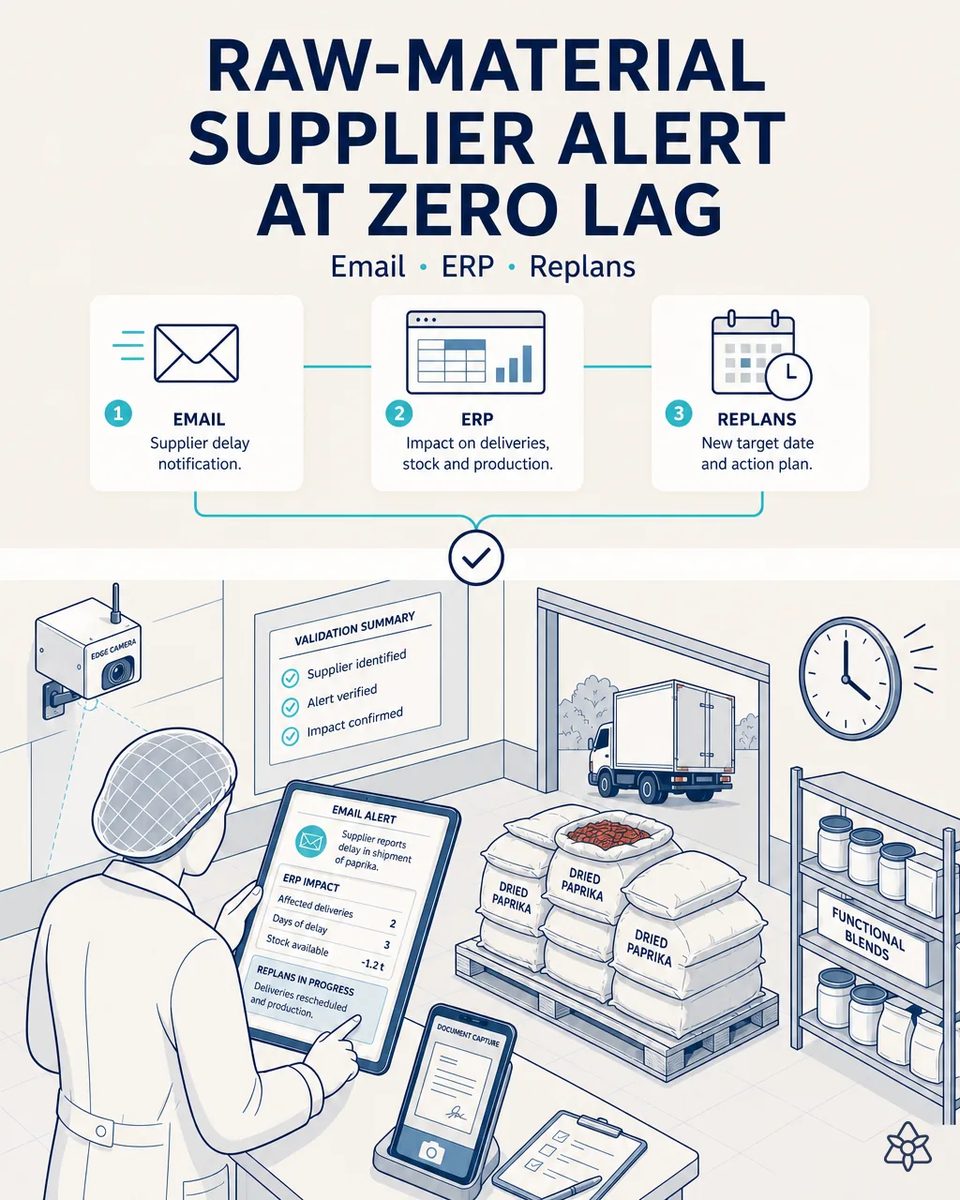
A raw-material supplier's delay email lands in one inbox and gets read hours later, when a milling order is already scheduled. With Connect in silent copy, the alert is processed instantly and cross-checked against active orders.
Nobody designed the channel that carries the bad news.
critical alerts reach people who can't watch the inbox in real time; by the time they're read, plant decisions have already broken.
- The purchase order travels through the ERP, but what changes the week arrives by email: a container of dried peppers held at customs, a cumin lot that came in under specification, a harvest that shifted two weeks.
- It arrives in natural language, unformatted, at a personal address, competing with fifty other messages, and often from a broker's phone rather than from any system.
- A delay read at noon is a milling order already launched, a mill set up and cleaned for a raw material that will not arrive, and a line waiting for stock with people standing on it.
- Caught the day before, the same alert is a reordering of the milling schedule and nothing else. Caught the same morning, it is a stopped plant, an expedited freight invoice and a customer delivery you have to renegotiate.
Connect in chaotic-sources mode — silent copy, twenty-four seven.
Connect chaotic-sources mode — 24/7 mailbox copy, intent and entity extraction, ERP cross-check, alert to the right role with a concrete action.
The difference between reading the alert and acting on it is the cross-check: it is not enough to find out sooner, you need to know which milling orders and which blends are affected and who has to move. A single missing origin lot can touch half a dozen formulas, and that list is what nobody assembles by hand. That is what comes back, and to the right role depending on what it is about.
Today's alert versus the cross-checked alert
| Aspect | Today, in the inbox | With iLEAN Connect |
|---|---|---|
| When it is read | When its recipient opens their email | Seconds after it lands |
| Milling orders affected | Discovered at the mill | Identified in the alert itself |
| A shifted harvest | A stopped line | A replanned schedule |
| Off-spec lot announced | Found at intake | Flagged before the truck leaves |
| Who it reaches | Whoever it was addressed to | Purchasing, planning or quality |
| Who decides | The recipient, hours later | The manager — iLEAN proposes |
hours of human latency → seconds.
Estimated impact — to validate with your own numbers.
The block below is an estimate to be validated against your plant's actual data. We put it forward so the committee has an order of magnitude; we refine it during the assessment.
- Estimated payback 3-7 months, depending on how often these alerts reach you.
- Expedited freight and reactive overtime you stop paying for a shortage that was announced in time to avoid it.
- Mill setups and allergen cleaning cycles not wasted on a raw material that was never going to arrive that week, which is time on the plant's most contended equipment.
- And a replanned milling schedule instead of a line waiting with a full shift standing on it, plus customer deliveries renegotiated a day early rather than simply missed.
estimated payback of 3 to 7 months depending on alert frequency. *Estimate to validate*.
And the fair question from the production manager
"Are you going to read my team's email?" — no. iLEAN sits in copy on a dedicated purchasing mailbox and a company messaging number: it only sees what is sent to those operational channels with growers and suppliers. On extraction, classifying the intent of an alert is an anchored task and the best models drop below 1.5% error [1] — and the replanning is decided by a person.
[1] OpenAI paper "Why Language Models Hallucinate", 2025 — on the reliability of AI in anchored tasks.
What people ask about reading supplier alerts
Does it tell a real delay from routine correspondence?
Yes, and that is what matters most: a held container is flagged top priority because its cost grows by the day, while a delivery moved by one afternoon interrupts nobody and should not wake anyone up.
Does it know which blends are affected?
When it is crossed with the ERP, yes. A single missing origin lot can touch six formulas, and that is the list nobody assembles by hand with the mill already set up and the shift already started.
Does it work with alerts in another language?
That is the normal case when the origin is outside the country, and it is designed for: intent extraction does not depend on the language the grower or the broker writes in, or on how formally they write it.
What if the supplier sends it by messaging instead of email?
Both channels are covered. In this sub-sector a good part of the real news arrives from a broker's phone rather than from a formal notice, and an alert that only lives in one person's phone is the same blind spot as an unread inbox.
Does it replace the purchasing module?
No. The ERP carries the formal order, which is its job. This case covers the message that changes the plan, which is what breaks the week and what no system reads today.
More cases from this series
- Seamless traceability, from sack to packConnect, Edge, Agents, JIDOKA AI and SMED AI coordinated against untraced traceability risk in spice…
- Paperless batch startupHow a spice factory digitizes the production order and blend formula at batch startup with a simple…
- Validate the formula in seconds, no typingNo formula or allergen data enters the central system without human validation first, in 2 taps.
- The delivery note, to ERP in one tapPhoto the delivery note and raw-material sack labels: Connect validates and pushes to the ERP, no driver…
- The dryer that now talksAn external camera digitizes the moisture curve of a vintage dryer/mill without touching the original…
- A headset so plant knowledge never gets lostA spice factory's section lead talks to the AI while walking the floor; no plant knowledge gets lost.
Tell us what the last late raw-material delivery cost you in stopped hours.
We work on your plant's real data, not ours. Assessment with no commitment.
Request estimated ROI within 48h ‹ See all cases of spices and seasonings See food industry