The encoder, stitched to the ERP, no typing
The encoder printing batch, expiry and allergens is already a modern system, but isolated. Any change gets typed twice, with the costliest risk in food: incorrect labeling. Connect stitches both systems via API.
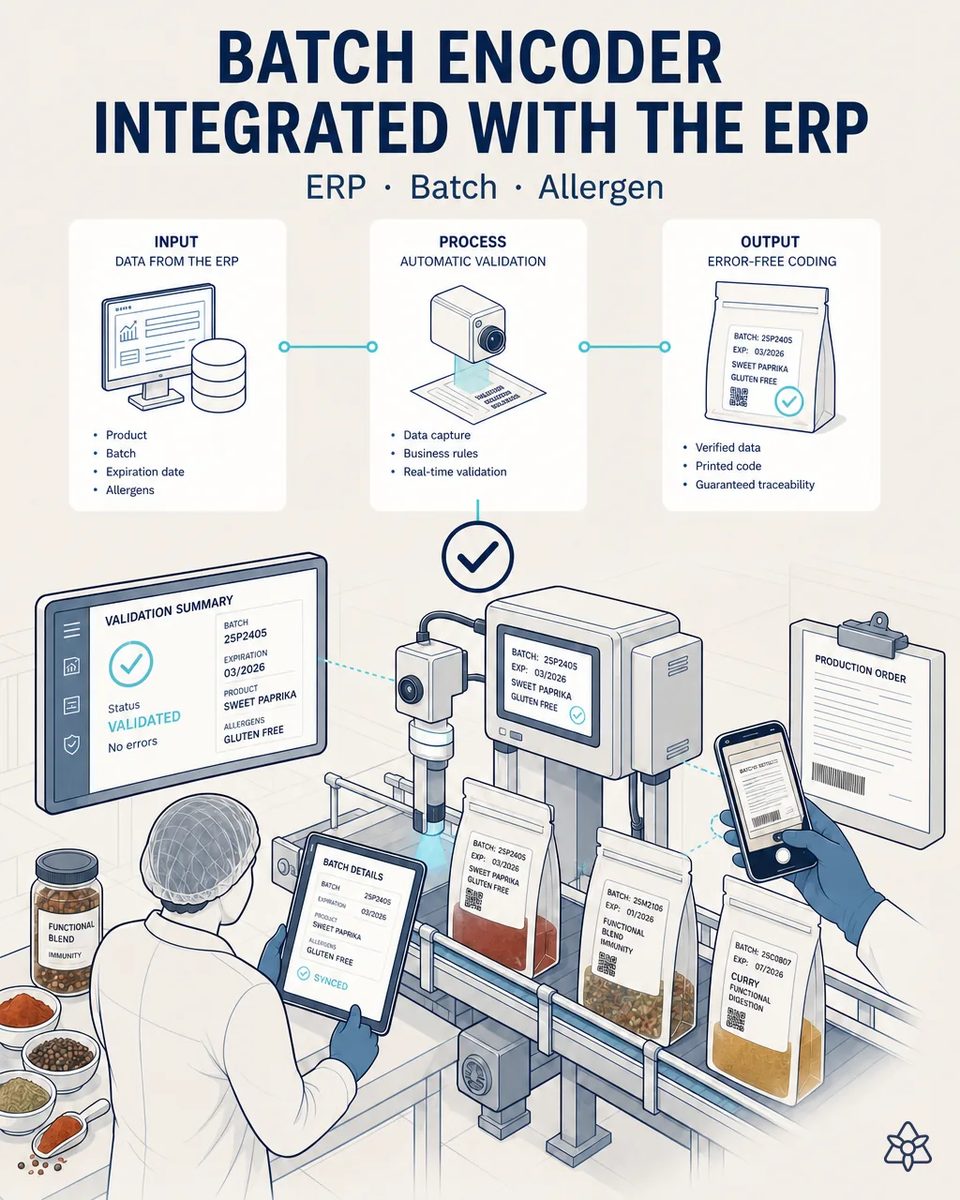
The same data typed twice, in the place where a mistake costs most.
double entry, sync risk between ERP and encoder on a last-minute change.
- The encoder prints batch, best-before date, product and the allergen declaration. It is modern, capable and has a documented interface — and it sits outside the real flow.
- Every format or formula change means somebody picks the right template by hand on its panel, retyping data that is already in the ERP two meters away, under time pressure and usually near the end of a shift.
- The changes are constant because the mix is high: sweet paprika in a jar in the morning, a functional blend in stick packs in the afternoon, bulk for an industrial customer at night.
- One wrong finger on that panel is a whole run printed with the previous product's allergen line. That is not scrap, it is a withdrawal, and if it has already shipped it is a customer non-conformity served on a plate along with the recall cost.
Connect stitches the two systems through APIs, replacing neither.
Connect integrates ERP and encoder without replacing either; the ERP becomes the single source of truth.
What was actually printed comes back confirmed to the system: not what was asked to be printed, but what the encoder says it printed. That distinction is what turns the code on the pouch into evidence instead of an assumption, and it is the difference that matters when a customer sends you a photo of a bag and asks what happened.
The isolated encoder versus the stitched encoder
| Aspect | Today | With iLEAN Connect |
|---|---|---|
| Typing the same data | Twice per changeover | Once, in the ERP |
| Wrong allergen line printed | A permanent risk | Eliminated by construction |
| Changeover time on the encoder | Minutes on the critical path | A tap in the ERP |
| What was actually printed | Assumed | Confirmed back to the system |
| Best-before date | Recalculated by hand | Derived from the order |
| Either system | — | Neither is replaced |
risky double entry → one source of truth reflected automatically.
Estimated impact — to validate with your own numbers.
The block below is an estimate to be validated against your plant's actual data. We put it forward so the committee has an order of magnitude; we refine it during the assessment.
- No standalone payback figure is claimed here: the brief measures this case by the risk it removes, not by a month count, and inventing one would be dishonest.
- What disappears is incorrect labeling, the single most expensive failure mode in food and the one that ends in a withdrawal rather than in a rework order.
- On top of that, the double entry on every format changeover, which is minutes on the critical path of the shift and not idle time somebody had spare.
- With a high mix, the number of changeovers stops increasing your exposure: more changes, the same risk, which is none.
elimination of out-of-sync labeling risk, time saved on double entry. *Estimate to validate*.
And the fair question from the production manager
"Wouldn't a classic integration be cleaner?" — it would, on the day that project reaches the top of the list, and that is the problem: this is the textbook case of a modern machine still isolated because there was never time. On the extraction side it is an anchored task where the best models drop below 1.5% error [1], and the stitching replaces neither system and needs no shutdown window, so it does not compete in that queue.
[1] OpenAI paper "Why Language Models Hallucinate", 2025 — on the reliability of AI in anchored tasks.
What people ask about connecting the encoder
Do we have to replace the encoder or the ERP?
Neither. Connect leans on the documented interface the encoder already has and on what the ERP publishes when the packing order opens. Nothing is migrated and no shutdown window is needed.
Does it cover the allergen line?
That is the field that most justifies the case. The declaration travels from the ERP with the formula version, so a pouch carrying the previous product's allergens stops being possible by construction rather than by attention.
What if the encoder misfires and prints nothing?
It is detected, because what comes back is confirmation of what was actually printed. Today that failure raises no signal at all: the system simply assumes the requested code went on the pack.
Does it calculate the best-before date?
It is derived from the order and the product's shelf life rather than recalculated by hand at the panel, which is where date errors come from today, especially on a formula with a shelf life different from the one that ran before it.
Does the same pattern work on other machines?
Yes: any modern island with an interface that is fed by hand today fits the same way, including the checkweigher and the labeler. You start with the encoder because that is where a mistake is most expensive.
More cases from this series
- Seamless traceability, from sack to packConnect, Edge, Agents, JIDOKA AI and SMED AI coordinated against untraced traceability risk in spice…
- Paperless batch startupHow a spice factory digitizes the production order and blend formula at batch startup with a simple…
- Validate the formula in seconds, no typingNo formula or allergen data enters the central system without human validation first, in 2 taps.
- The delivery note, to ERP in one tapPhoto the delivery note and raw-material sack labels: Connect validates and pushes to the ERP, no driver…
- The dryer that now talksAn external camera digitizes the moisture curve of a vintage dryer/mill without touching the original…
- A headset so plant knowledge never gets lostA spice factory's section lead talks to the AI while walking the floor; no plant knowledge gets lost.
Tell us how many format changeovers your encoder runs in a day.
We work on your plant's real data, not ours. Assessment with no commitment.
Request estimated ROI within 48h ‹ See all cases of spices and seasonings See food industry