The old slicer also talks — Connect on the control panel, without touching the machine.
In a dairy processing plant, the old slicer or packing machine produces the most profitable formats, but its proprietary HMI publishes nothing to the network. Replacing it costs hundreds of thousands of euros and a month of stoppage. iLEAN Connect places an external camera aimed at the panel and the plant digitizes its readings without touching the machine.
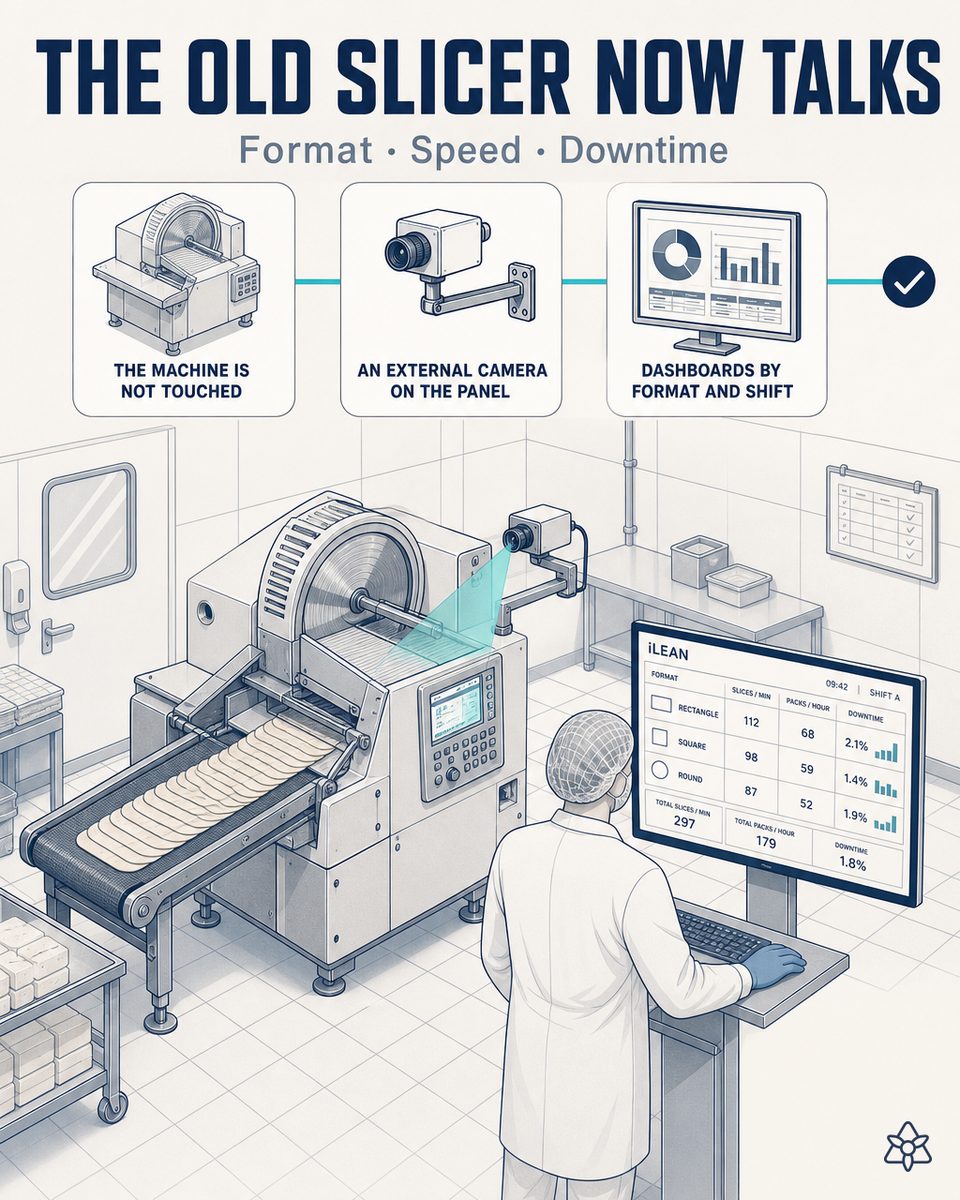
The plant's most profitable machine is also its blindest.
In a dairy processing plant, the slicer or packing machine producing the highest-margin formats is usually also the line's oldest: 10-20 years of life, the original manufacturer's proprietary HMI and a screen showing valuable data in real time — data that never leaves it.
- A proprietary HMI with no network output — the screen shows average weight, stroke count, bar temperature and vacuum quality, but that data lives and dies on the panel's glass. Nobody records it shift after shift.
- Replacing the machine is not realistic in the short term — a new line with native connectivity costs more than €300,000 and demands a month of stoppage. While the slicer keeps producing within tolerance, that CAPEX does not get signed.
- A direct consequence on the floor — zero correlation between the machine's fine parameter and the real per-SKU waste, and zero ability to run a per-batch root cause analysis when something deviates.
The result is a critical machine that produces well most of the time, but about which nobody can explain why one specific batch gave more waste than another — because the only witness of what happened is a screen nobody photographs or records.
Connect in photo mode — the camera watches the panel, the machine stays itself.
The slicer's panel needs no new PLC and no communications card nobody manufactures anymore. What already shows on the screen — average weight, strokes, bar temperature, vacuum — needs to be recorded without depending on an operator noting it by hand. That is what Connect in photo-on-panel mode is for.
A fixed industrial camera watches the slicer's HMI. Connect reads the screen by OCR anchored to the known layout, structures each reading by SKU and batch, and crosses it with the ERP's active work order. When waste spikes, the root cause analysis is ready in minutes, not days.
How Connect operates on the slicer's panel:
- A fixed industrial camera over the panel — installed watching the HMI from outside, with no cable or connection to the machine. It captures the screen at regular intervals throughout the shift.
- OCR with an anchored language model — each capture is read by OCR specialized in industrial panels and anchored to that specific screen's layout to extract average weight, stroke count, bar temperature and vacuum quality without interpretation errors.
- Structured by SKU and batch, crossed with the ERP — each reading is ordered into a time series by SKU and batch, and automatically crossed with the active work order already existing in the plant's ERP.
- Per-batch root cause analysis in minutes — when a batch gives more waste than expected, the quality manager filters the panel's history for that SKU and batch and sees in minutes which parameter moved, instead of reconstructing it from memory weeks later.
A blind slicer vs. a slicer with Connect on the panel
| Aspect | Blind slicer | With Connect on the panel |
|---|---|---|
| The HMI's readings (average weight, strokes, bar temperature, vacuum) | Only visible on screen, nobody records them | Camera-captured and structured by SKU and batch |
| Fine parameter vs. waste correlation | Zero — no exportable data exists from the machine | An automatic correlation, available per batch |
| Root cause analysis facing high waste | Days, with no reliable cause data | Minutes, with the panel's history at hand |
| Per-SKU and per-batch traceability of this machine | Manual reconstruction or nonexistent | An automatic time series, crossed with the ERP's order |
| Intervention on the machine | None possible without opening the electrical cabinet | None — an external camera, no wiring and no PLC touched |
| The line's replacement CAPEX | Pending, undated, on the committee's table | Deferred indefinitely while the machine performs |
Impact estimate for your plant — to be validated with your own numbers.
The block below is an estimate to be validated against your plant's actual data. We put it forward so the committee has an order of magnitude; we refine it during the assessment.
- Dairy processing plant with one or several 10-20-year-old slicing or packing lines, a proprietary HMI with no network output.
- Connect pilot in photo mode on the critical machine's panel — only an external camera, with no construction work or dedicated line stoppage.
- Indicative payback between 5 and 10 months, depending on the frequency of waste with no known cause and each lost batch's cost at your plant.
- Avoidance of a replacement CAPEX above €300,000 per line, by deferring the machine's change while it keeps performing. Estimate to be validated with your data.
And the fair question from the production manager
"What if the camera misreads a digit on a 15-year-old screen and gives me false data?" — hallucination is a problem of free generation, not of anchored tasks. In tasks where the AI limits itself to recontextualizing a specific data point from one medium to another — reading a fixed field of the panel and moving it into a structured series —, the best models brought the error below 1.5% [1]. And even then, nothing critical is decided alone: Connect discards the reading when it does not reach the confidence threshold and the person reviews and signs the history. The three safety rings are there precisely for this.
[1] OpenAI paper "Why Language Models Hallucinate", 2025 — on the reliability of AI in anchored tasks.
What people ask about digitizing an old slicer's panel without touching it
Why can't the machine simply be wired to get the data out?
Because a 10-20-year-old slicer's proprietary HMI normally has no open industrial protocol or accessible data port — the original manufacturer no longer supports it, or the control cabinet is a closed box that not even the local integrator dares open without losing the residual warranty or risking an unplanned stoppage. Wiring the machine would mean opening the electrical cabinet, identifying signals with no reliable documentation and taking on the risk of stopping the line that remains the plant's most profitable. iLEAN Connect avoids that risk entirely: the camera watches the screen from outside, just as an operator would, and touches not a single panel cable.
Does the line have to stop to install the camera?
No. The installation is a fixed industrial camera on an external mount, aimed at the HMI from a distance and angle that interfere neither with the operator nor with maintenance access. The mounting happens in a brief scheduled stop — a shift change or a cleaning —, not a dedicated production stoppage. There is no electrical or data connection with the machine: the camera is powered and transmits independently, so the installation's stoppage risk is practically nil.
How does the OCR read an old screen reliably?
The system combines OCR specialized in industrial panels with a language model anchored to that specific screen's known layout — it does not try to "understand" the machine generically, it reads the same fields (average weight, stroke count, bar temperature, vacuum quality) at the same position, capture after capture. It is an anchored recontextualization task, not free generation: in that type of task the best models bring the error below 1.5%. When a reading does not reach the confidence threshold — a reflection, a screen off, a partially covered digit — Connect discards that capture instead of forcing a value.
What if the HMI changes layout with a manufacturer update?
It is infrequent on 10-20-year-old machines with no active support contract, but if it happens — or if the screen's language simply changes or the operator navigates to another view — Connect detects it as a layout deviation and stops automatically structuring that reading until the model is re-anchored to the new field arrangement, a configuration adjustment, not a reinstall. In the meantime no data is invented: the capture is flagged for review and the previous history remains intact.
How is the root cause data used in practice?
The quality or line manager enters the history by SKU and batch and sees, in the same time series, the panel's reading (average weight, strokes, bar temperature, vacuum) crossed with that batch's real waste and the ERP's active order. Instead of reconstructing by hand what happened three shifts ago, they filter by the SKU with the most waste and check in minutes whether the pattern repeats with a specific parameter combination — for example, a low bar temperature in the first strokes of every startup. That analysis, which today does not exist because the data never leaves the screen, is the basis for adjusting the parameter before the waste repeats in the next batch.
More cases from this series
- The audit always ready — zero manual reconstruction in the processed cheese plant.Every critical changeover and every cold chain event generates an auditable dossier ready by standard.…
- Three machines stitched to the ERP — one tap changes the SKU on all threeiLEAN stitches the coder, the dynamic checkweigher and the slicer to the ERP via API. An SKU change in…
- From the laboratory’s Excel to the ERP, without transcribing — and with license savingsiLEAN Connect reads the laboratory’s Excel, validates on screen and feeds the ERP. Typical saving of -50…
- Nothing enters the system without a human having seen it — the tablet at the line asks for a two-tap signature before the data crosses into the ERP.An industrial tablet at the line. iLEAN shows a visual summary, the operator signs with two taps and…
- Receiving stops blocking the manager for an hour — the truck waits while the delivery note and the GS1-128 labels are typed by hand into the ERP.iLEAN Connect digitizes the delivery note and GS1-128 labels at cheese base receiving. Fewer carrier…
- Line startup in a dairy processing plant — the order and the shift checklist live on paper until someone keys them in.iLEAN Connect captures by photo the work order and the line startup checklist in a dairy processing…
Tell us your case and we will send within 48h the estimated ROI of this AI project to digitize your dairy processing plant's critical machine.
We work on your plant's real data, not ours. Assessment with no commitment.
Request estimated ROI within 48h ‹ See all 12 processed cheese cases See food industry