Three machines stitched to the ERP — one tap changes the SKU on all three
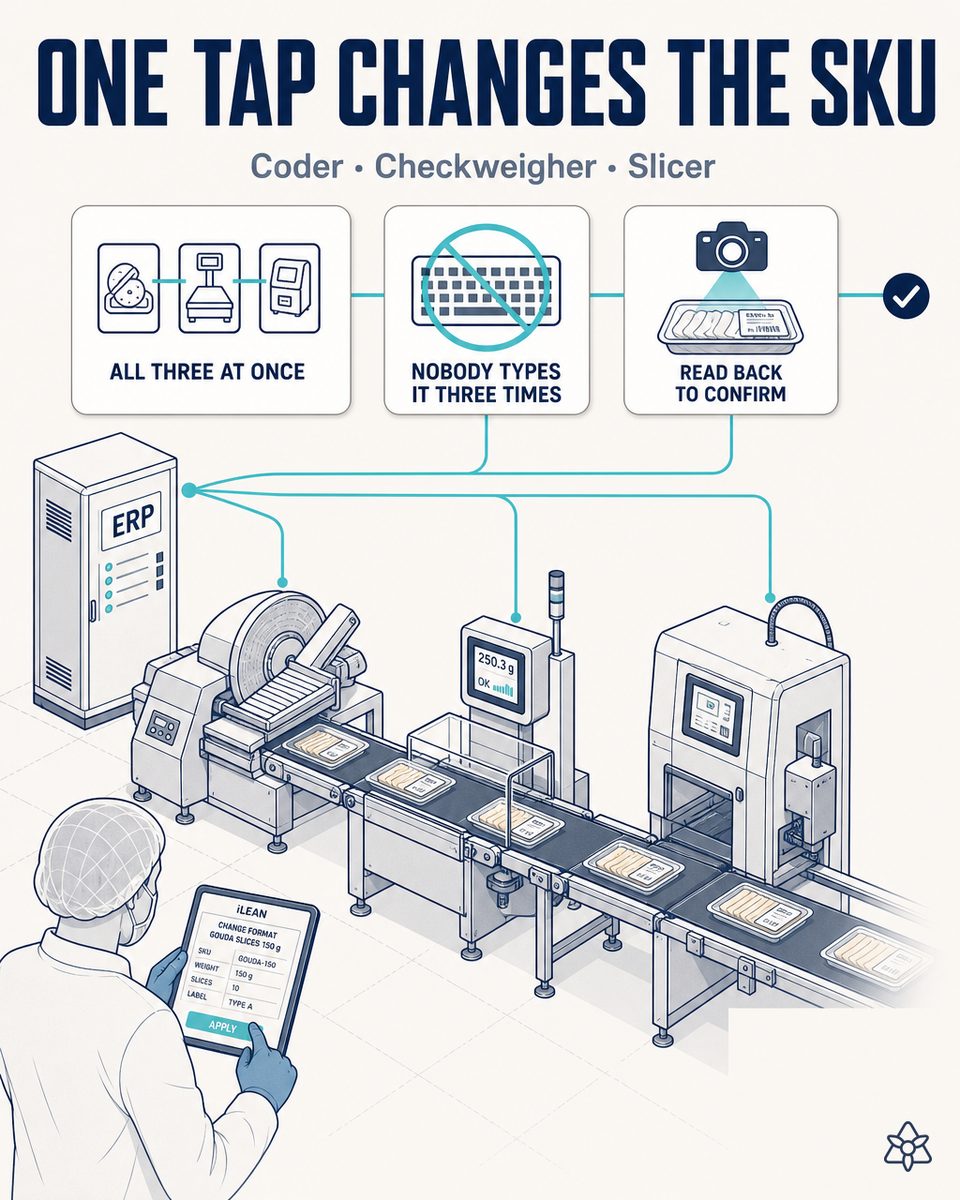
The coder, the dynamic checkweigher and the slicer in a dairy processing plant are modern and have APIs, but every SKU change demands typing by hand into all three panels. One error becomes a recall. iLEAN stitches the three systems to the ERP: a SKU change is one tap in the ERP, 30 s in sync.
The SKU change is where traceability is at stake, not steady-state production.
In a dairy processing plant making cheese in different formats and designations, the slicing and packing line in steady state is stable: the coder, the dynamic checkweigher and the slicer run alone, package after package. The problem is the SKU change, happening several times per shift when a new batch, a new reference weight or a new customer comes in. The three machines are modern — all have APIs — but nobody has stitched them to each other or to the ERP:
- The three machines concentrate the recall risk — a batch, designation, weight or allergen data point mistyped on any of the three panels can end in a recall of product already on the shelf.
- Typing spread across three panels at every change — someone enters by hand the batch and expiry into the coder, the designation and target weight into the checkweigher, and the cutting parameters into the slicer. Three screens, three chances to err, no cross-check between them.
The work order arrives from the ERP, but stays there: the ERP knows which SKU is due, but does not tell the three machines. Someone has to translate it by hand, three times, with the line stopped waiting.
Connect stitches the three machines to the ERP via API — one tap, three panels in sync.
The SKU change needs no more screens or typing: the data that already lives in the ERP needs to reach the three machines at the same time, with nobody rewriting it three times. That is what Connect is for.
When the work order starts, the ERP publishes batch, designation, expiry date and allergens to the coder and the checkweigher; it publishes the cutting parameters to the slicer. One tap in the ERP, 30 seconds and the three machines are synchronized.
How Connect operates on the SKU change in a dairy processing plant:
- Connect stitches the three systems via API — the coder, the dynamic checkweigher and the slicer already have modern interfaces; Connect connects to all three and to the ERP without touching the line's PLC or replacing any equipment.
- The ERP publishes when the work order starts — batch, sales designation, expiry date and declared allergens reach the coder and the checkweigher the very instant the work order is started.
- The cutting parameters reach the slicer — thickness, number of slices and target weight per tray are published to the slicer without the operator re-entering them.
- A cross-confirmation before releasing the line — Connect checks that the three machines have received and applied the same SKU before the operator releases the first package; if one lags behind, it holds and alerts.
- A record of the change for traceability — which SKU was published, at what time, to which three machines and with which confirmation is archived, with nobody having to reconstruct it for the traceability file.
A SKU change typed by hand vs. a SKU change synchronized with Connect
| Aspect | SKU change typed by hand | SKU change synchronized with Connect |
|---|---|---|
| SKU change time | 15-20 min of typing spread across three panels | 30 s synchronized from the ERP |
| Typing errors | 2-3 typing errors/month | Zero of human origin |
| Batch and expiry coding | Typed by hand into the coder | Published by the ERP when the work order starts |
| Designation and weight on the checkweigher | Typed by hand, no cross-check with the ERP | Published by the ERP along with the batch |
| Cutting parameters on the slicer | Adjusted by hand by the operator | Published automatically from the ERP |
| Confirmation across the three machines | None — each panel is an island | Connect confirms all three before releasing the line |
Impact estimate for your plant — to be validated with your own numbers.
The block below is an estimate to be validated against your plant's actual data. We put it forward so the committee has an order of magnitude; we refine it during the assessment.
- Dairy processing plant with a coder, a dynamic checkweigher and a slicer already equipped with APIs, and several SKU changes per shift.
- Connect pilot on the SKU change — it stitches the three machines to the ERP via API, without replacing equipment or touching the line PLC. First value expected within a few weeks.
- Estimated payback between 3 and 6 months, depending on the frequency of SKU changes per shift and the average cost of a recall or rework. Estimate to be validated.
- Beyond the payback, SMED between batches becomes more effective: fewer stopped minutes per change, more clean startup windows.
- The hard lever is a single recall avoided from a data point mistyped on any of the three panels — one recall pays for the pilot several times over.
And the fair question from the production manager
"What if Connect goes down and we still have to start?" — Connect is not a single point of failure for starting production: if the integration is unavailable, the operator goes back to the usual manual typing, exactly as today. Connect adds no new dependency to produce; it removes redundant work when available and steps aside without blocking the line when it is not.
[1] OpenAI paper "Why Language Models Hallucinate", 2025 — on the reliability of AI in anchored tasks.
What people ask about linking the coder, checkweigher and slicer to the ERP
Which interfaces or protocols does the integration with the three machines use?
Connect connects via REST API or OPC-UA, depending on what each manufacturer exposes on the coder, the dynamic checkweigher and the slicer — most line equipment under 8-10 years old already ships with one of the two. On the ERP side, Connect integrates via REST API or webhook on the work order module, without touching the database directly. There are no intermediate files or manual exports: it is event-by-event publishing, the moment the work order starts.
What if one of the three machines lacks a modern API?
If any of the three exposes no API — typical in older slicers with a closed proprietary panel — Connect covers the gap with manual mode: the data is published just the same from the ERP to the two machines that do have an API, and the third receives the same data on screen or printed so the operator enters it a single time, already validated and with no free-transcription margin. There is no need to wait for equipment replacement to start the project; it is completed when the renewal comes.
How is it guaranteed that the three machines receive the same data without desynchronizing?
Connect publishes the same data package — batch, designation, expiry, allergens and cutting parameters — to the three machines in the same transaction, not in three independent calls. Before signing off the startup, Connect reads back what each machine confirms having applied and compares it against what was published. If all three match, it releases the green light; if one differs, it is not considered synchronized even if the other two are correct.
What happens if the SKU change fails mid-synchronization?
If one of the three machines does not confirm in time or returns a data point different from what was published, Connect holds the startup and alerts the operator or the shift lead with a short phrase, indicating which of the three lagged behind. The line does not release the first package with a half-done synchronization — it is the same safety-rings logic applied in every iLEAN deployment: the person validates before production continues.
Does this replace the operator or free them for another task?
It does not replace the line operator: it removes the repeated typing on three different panels at every SKU change, the mechanical, error-prone part of the job. What used to be 15-20 minutes typing batch, designation, weight and cutting parameters becomes one confirmation tap in the ERP. That time comes back for supervising the real startup, the first package's quality check or the rest of the format-change tasks that do require human judgment.
More cases from this series
- The audit always ready — zero manual reconstruction in the processed cheese plant.Every critical changeover and every cold chain event generates an auditable dossier ready by standard.…
- From the laboratory’s Excel to the ERP, without transcribing — and with license savingsiLEAN Connect reads the laboratory’s Excel, validates on screen and feeds the ERP. Typical saving of -50…
- Nothing enters the system without a human having seen it — the tablet at the line asks for a two-tap signature before the data crosses into the ERP.An industrial tablet at the line. iLEAN shows a visual summary, the operator signs with two taps and…
- Receiving stops blocking the manager for an hour — the truck waits while the delivery note and the GS1-128 labels are typed by hand into the ERP.iLEAN Connect digitizes the delivery note and GS1-128 labels at cheese base receiving. Fewer carrier…
- Line startup in a dairy processing plant — the order and the shift checklist live on paper until someone keys them in.iLEAN Connect captures by photo the work order and the line startup checklist in a dairy processing…
- A retailer order change in a dairy processing plant — the planner’s inbox is where the waste is lost.iLEAN Connect reads the retailer’s email and WhatsApp 24/7, crosses them with active orders and suggests…
Tell us your case and we will send within 48h the estimated ROI of this AI project to link the coder, checkweigher and slicer to the ERP in your plant.
We work on your plant's real data, not ours. Assessment with no commitment.
Request estimated ROI within 48h ‹ See all 12 processed cheese cases See food industry