A retailer order change in a dairy processing plant — the planner’s inbox is where the waste is lost.
A notice from a large chain's buyer at 09:15 can break three orders planned for that afternoon. If the planner does not read it until 11:30, the product is packed with no destination. iLEAN Connect in chaotic-sources mode reads the message at second zero and returns a concrete action on the orders.
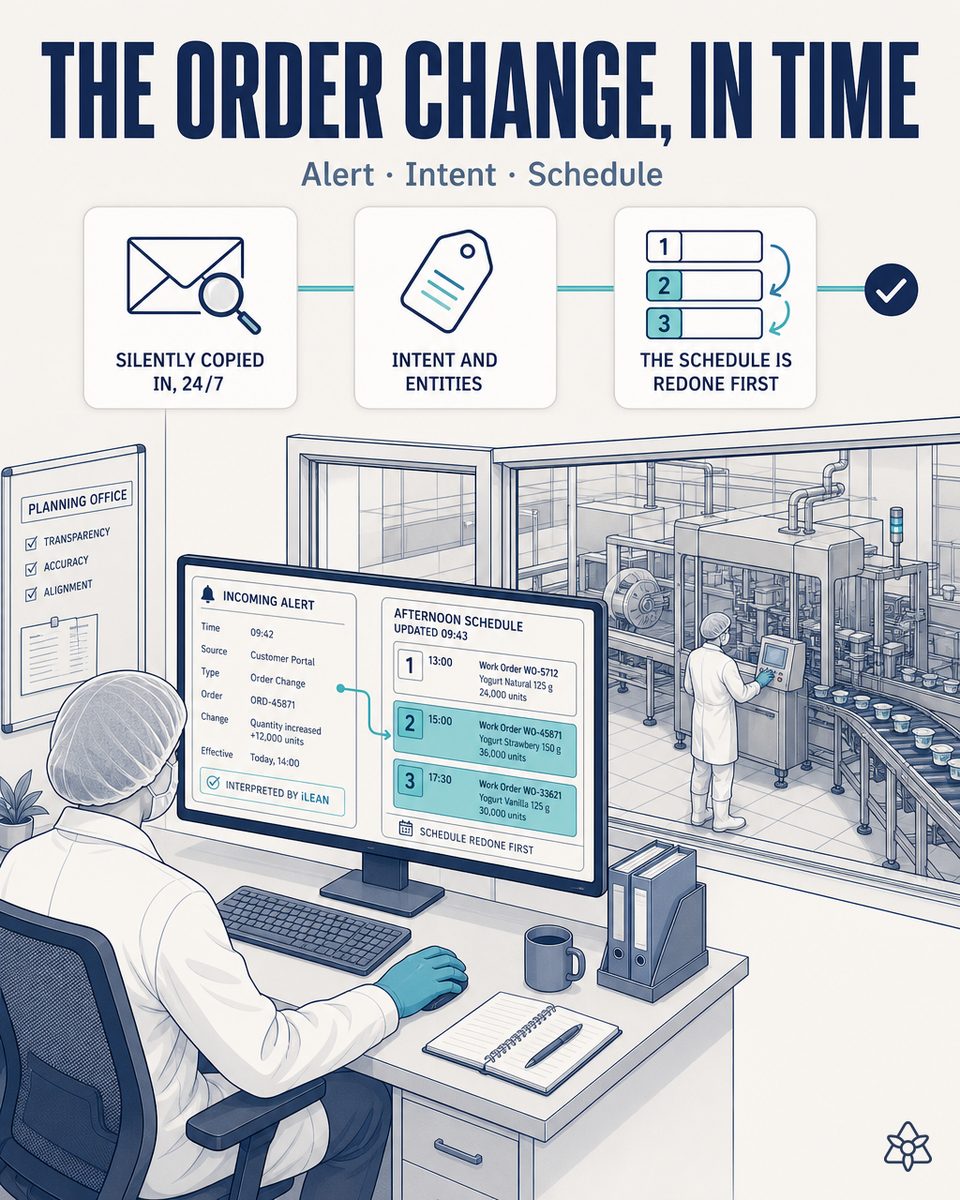
The retailer's order change is where the waste is lost, not on the line in steady state.
In a dairy processing plant — grated, slices or portions for private label — steady-state production is predictable: once the order is launched, the line cuts, weighs and packs without surprises. The problem appears before packing, when the chain's buyer changes the order and that change does not reach whoever plans in time:
- Critical changes by email or WhatsApp — the notice of a bring-forward, a cancellation or a volume change lands in one specific person's inbox or phone, and they cannot keep it open in real time between the line, other orders and the rest of the shift.
- Product packed without its optimal destination loses value every day it goes unplaced — and in grated and slices, with an especially short commercial window, that margin runs out in a matter of days.
A notice at 09:15 can break three orders planned for that same afternoon. If the planner does not read it until 11:30 — because they were on the line or in another meeting — the product has already been packed with no destination, and what was a simple order change becomes waste or an urgent sale at a low price. It is the inbox's natural bottleneck, not the factory's.
Connect in chaotic-sources mode — it reads the retailer's email and WhatsApp before the window is lost.
The order change needs no integration project with the retailer or an ERP change. The message that already arrives by email or WhatsApp needs to be read, understood and crossed with the active orders the instant it enters — without waiting for the right person to have a moment. That is what Connect in chaotic-sources mode is for.
A message enters the inbox or WhatsApp Business. Connect reads it at second zero, extracts what the retailer asks and on which order, and returns a concrete action to the planner. Nothing is touched in the ERP without a person confirming it.
How Connect operates in chaotic-sources mode on the retailer's order change:
- The mailbox and WhatsApp Business silently copied 24/7 — Connect receives a copy of the mail and the WhatsApp Business where the orders and their changes arrive, replacing nobody and without changing the channel the retailer already uses.
- The LLM extracts intent and entities — a bring-forward, a cancellation or a volume change as the intent; SKU, customer, date and volume as entities. In seconds, the message stops being loose text and becomes structured data.
- Immediate cross-reference with the active orders — Connect compares the extracted intent against the open production plan and detects which specific orders are affected by the change.
- A concrete action returned to the planner — not a summary of the email, but an actionable proposal: "reschedule order X with the alternative SKU, cancel order Y, you gain Z units without a destination". The planner sees the option already built, they do not reconstruct it by reading the thread.
- Human confirmation before touching the ERP — Connect neither reschedules nor cancels anything on its own. The person confirms the action and only then does it move to the ERP or the planning system.
An inbox with no cross-reference vs. an order change managed with Connect
| Aspect | Inbox with no cross-reference | Order change with Connect |
|---|---|---|
| Detecting the order change | Email/WhatsApp read when the planner has a moment — 2-3 h of latency | Read and extracted at second zero, 24/7 |
| Cross-reference with active orders | Manual, reviewing the production plan by hand | Automatic, an immediate cross-check with the open orders |
| Action on the plan | The planner decides without full impact visibility | A concrete action suggested — reschedule, cancel, an alternative |
| Product with no destination | Packed anyway, waste or an urgent sale per the commercial window | Reassigned before packing — the waste avoided |
| Confirmation before touching the ERP | Not applicable, the whole circuit is manual | Human confirmation required, nothing executes alone |
| The change's traceability | Reconstructing the email/WhatsApp thread after the fact | Message, extraction and action archived by order |
Impact estimate for your plant — to be validated with your own numbers.
The block below is an estimate to be validated against your plant's actual data. We put it forward so the committee has an order of magnitude; we refine it during the assessment.
- Dairy processing plant (grated, slices, portions) with private label orders from one or several retail chains.
- Connect pilot in chaotic-sources mode on the planning team's mailbox and WhatsApp Business — without touching the ERP except on human confirmation. First value expected within a few weeks.
- Indicative payback between 3 and 7 months, depending on the frequency of private label order changes your plant handles. Estimate to be validated.
- Expected reduction of product packed with no destination, with the biggest impact on grated and slices for their short commercial window. Estimate to be validated with your data.
- The hard lever is a batch reassigned in time: the same product that was going to waste or sell urgently finds a destination because the change was read at second zero.
And the fair question from the production manager
"What if Connect misinterprets a message and reschedules something it should not have?" — hallucination is a problem of free generation, not of anchored tasks. In tasks where the AI limits itself to recontextualizing a specific data point from one medium to another (reading a retailer's message and comparing it with the open orders), the best models brought the error below 1.5% [1]. And even then, nothing critical is decided alone: Connect proposes the action and the person confirms before touching the ERP. The three safety rings are there precisely for this.
[1] OpenAI paper "Why Language Models Hallucinate", 2025 — on the reliability of AI in anchored tasks.
What people ask about the retailer's order change in processed cheese
How does Connect tell a trivial message from a critical one?
Connect does not react to everything entering the inbox: the LLM first extracts the message's intent (a bring-forward, a cancellation, a volume change, or simply a receipt confirmation with no effect on the order) and the entity it refers to (SKU, customer, date, volume). Only when that intent affects an active order does the message become an actionable alert for the planner. A generic question, an acknowledgment or a message unrelated to any open order generates no action — it stays as a read message, adding no noise to the planner's inbox.
Is there a risk of Connect acting alone on the ERP unsupervised?
No. Connect proposes, it does not execute. When it detects an order change affecting an active order, it returns a concrete action to the planner — for example, rescheduling an order with an alternative SKU or canceling another — but that action stays in proposal state. Nothing moves to the ERP or the planning system until a person confirms the change. It is the same three-safety-rings principle governing the rest of the IRIS system: the critical is not decided alone.
What happens if the retailer's message is ambiguous or incomplete?
If the message does not allow clearly extracting the affected SKU, date or volume, Connect does not guess: it flags the message as incomplete, shows the planner which data is missing and which orders are candidates based on what was understood, and waits for the person to complete or confirm before suggesting an action. We prefer an alert with a visible gap over an action proposed on an assumption — the planner decides with the real information, not a forced reading of the message.
How does Connect connect to WhatsApp Business securely?
Connect integrates with the commercial or planning team's official WhatsApp Business API, as a silent copy on the conversation with the retailer — it does not connect to personal numbers or scrape chats. Access is limited to the conversations relevant to the order, messages are processed encrypted and the history is archived by order for traceability, without exposing the complete conversation to anyone outside the team that already managed it.
What about messages arriving after hours?
Connect reads and extracts the message's intent at second zero, 24 hours a day, also outside the planner's hours. What changes after hours is not the reading, but the execution: the action proposal is prepared and prioritized by impact, ready for the person to confirm as soon as they return to the inbox — usually first thing next shift — instead of discovering the change while reviewing the mail hours late.
More cases from this series
- The audit always ready — zero manual reconstruction in the processed cheese plant.Every critical changeover and every cold chain event generates an auditable dossier ready by standard.…
- Three machines stitched to the ERP — one tap changes the SKU on all threeiLEAN stitches the coder, the dynamic checkweigher and the slicer to the ERP via API. An SKU change in…
- From the laboratory’s Excel to the ERP, without transcribing — and with license savingsiLEAN Connect reads the laboratory’s Excel, validates on screen and feeds the ERP. Typical saving of -50…
- Nothing enters the system without a human having seen it — the tablet at the line asks for a two-tap signature before the data crosses into the ERP.An industrial tablet at the line. iLEAN shows a visual summary, the operator signs with two taps and…
- Receiving stops blocking the manager for an hour — the truck waits while the delivery note and the GS1-128 labels are typed by hand into the ERP.iLEAN Connect digitizes the delivery note and GS1-128 labels at cheese base receiving. Fewer carrier…
- Line startup in a dairy processing plant — the order and the shift checklist live on paper until someone keys them in.iLEAN Connect captures by photo the work order and the line startup checklist in a dairy processing…
Let the planner's inbox stop being the bottleneck. Tell us your case and we will send the estimated ROI within 48h.
We work on your plant's real data, not ours. Assessment with no commitment.
Request estimated ROI within 48h ‹ See all 12 processed cheese cases See food industry