Nothing enters the system without a human having seen it — the tablet at the line asks for a two-tap signature before the data crosses into the ERP.
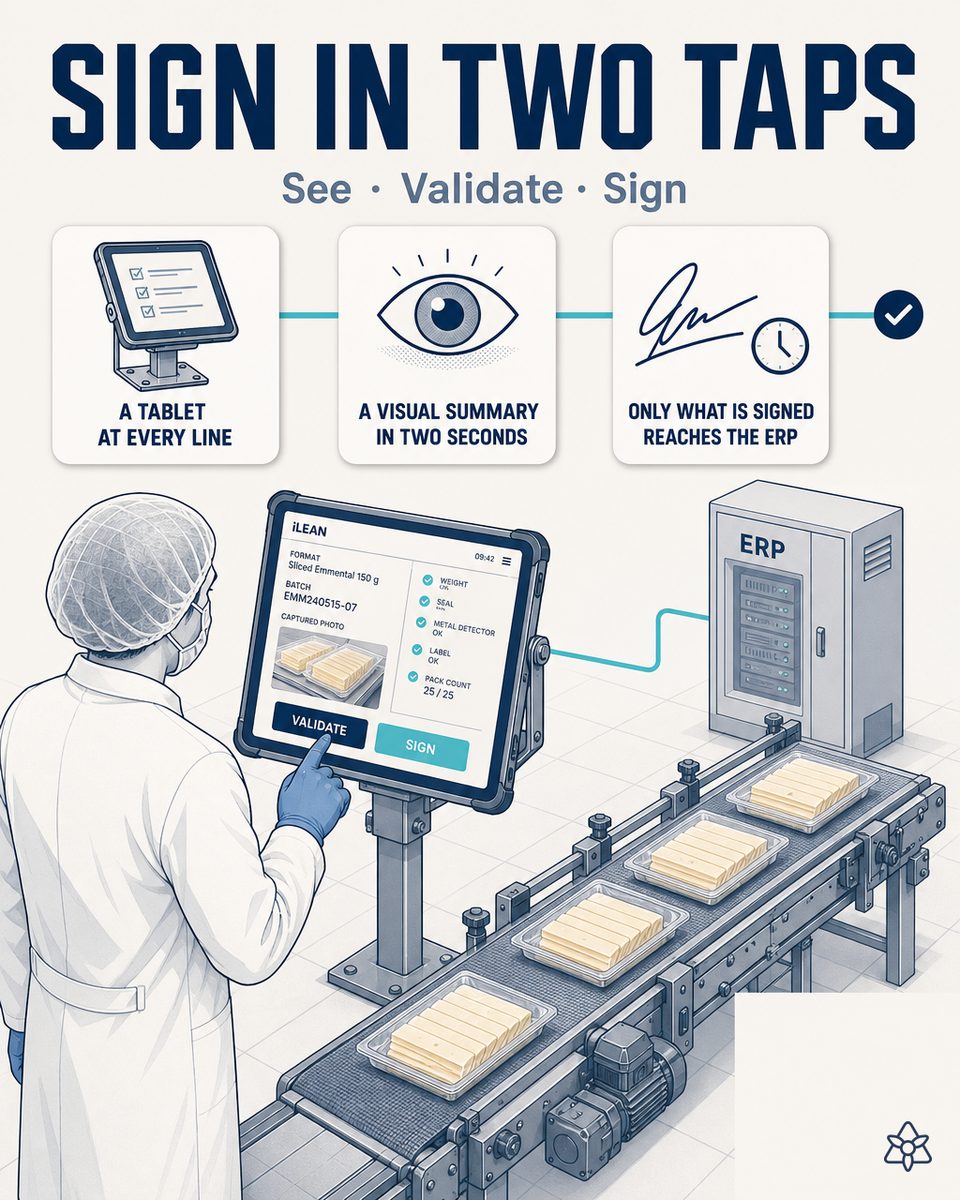
What sets iLEAN apart from an autonomous agent pushing unsigned data is early human verification. An industrial tablet at each line shows in two seconds a visual summary of what iLEAN just captured (photo, voice, parsed email, panel reading). Two taps and the data enters the ERP.
The fear is not the AI — it is nobody seeing it before it decides.
In a dairy processing plant, the ERP is the master feeding everything from the production order to traceability before the customer and the auditor. Any data entering wrong — a misidentified batch, a misread temperature, a crossed recipe — propagates to everything depending on that master: planning, quality, invoicing, a product recall if it comes to that. That is why the management committee rightly distrusts an AI that captures and decides alone:
- A legitimate cultural fear — if the AI contaminates the master, the impact is transversal. It does not stay on one line: it propagates to everything resting on that data, from planning to the file shown to the auditor.
- But the operator does not want to type either. If the alternative to AI is a form of fields to fill by hand, the operator skips it, fills it wrong or fills it late — and the data is still unreliable, only now nobody knows it is.
Automating everything is scary. Automating nothing does not work. The answer is not choosing an extreme — it is putting a third ring between the two.
Connect in early-verification mode — the tablet that puts the person before the master, not after.
Everything iLEAN does rests on three safety rings: Connect transports the data as it arrives (photo, voice, parsed email, panel reading), Agents interprets it and decides which action to propose, and the person signs before it crosses into the master. This piece is where the third ring becomes visible and tactile — on a tablet, with two big buttons, at the very station where the event happens.
An industrial tablet at each line. A visual summary in two seconds. Two big buttons: accept or correct. The latency between capture and a clean master is measured in seconds, not shifts.
How early human verification operates in a dairy processing plant:
- An industrial tablet at each line — a UI designed to validate in two seconds, not for data entry. No keyboard, no nested menus: a photo or a summary and a decision.
- A visual summary (SKU, batch, event) — whether the data comes from a photo, voice, a parsed email or a panel reading, Connect normalizes it to the same simple format before showing it to the operator.
- Two big buttons: accept or correct — the operator rewrites nothing; they confirm what they see or correct it with the minimum gesture needed.
- Latency between capture and a clean master: seconds — the validated data reaches the ERP almost as it was generated, not at the end of the shift.
- No signature, no master — if the operator does not validate, the data is held and contaminates nothing downstream. The line goes on; the data waits.
Unvalidated data (or uncaptured out of distrust) vs. data signed in seconds
| Aspect | Without early verification | With the tablet at the line |
|---|---|---|
| Capture by photo/voice/email/panel | Discarded out of distrust, or enters straight in unreviewed | Always passes through a visual summary before touching the master |
| The operator's validation | A form of fields to fill by hand — skipped or delayed | Two big buttons, two taps, no keyboard |
| Wrong or doubtful data | Contaminates the ERP, discovered weeks later in an audit | Held back — it does not cross into the master until someone signs |
| Time between capture and a clean master | Hours or shifts, if it gets recorded at all | Seconds |
| The management committee's trust in AI | Low — "we do not know what is entering on its own" | High — every data point entering carries a human signature |
| The rest of the Connect/Edge/Agents ecosystem | Does not dare activate because nobody signs downstream | Activates safely because this piece closes the circuit |
Impact estimate for your plant — to be validated with your own numbers.
The block below is an estimate to be validated against your plant's actual data. We put it forward so the committee has an order of magnitude; we refine it during the assessment.
- It is the enabling piece: every Connect, Edge or Agents landing in your dairy processing plant depends on this ring existing so the data they capture can enter the master without fear.
- It does not replace work — it replaces doubt. The cost it avoids is not an operator hour, it is the paralysis of "we do not dare automate this".
- The indicators that can be measured from the first pilot: the percentage of captures validated in under 5 seconds, and the percentage of held data that turned out to be real corrections — the latter measures whether the tablet is well calibrated, not whether "the AI fails".
- We do not state a payback in months here — that would be inventing a number only your plant's assessment can give. What we can state is that, without this piece, the rest of the IRIS roadmap in your plant stays a pilot and does not scale.
And the fair question from the management committee
"Why not automate everything, if we already have AI that reads well?" — because reading well is not the same as deciding well, and deciding well is not the same as being authorized to touch the master with nobody watching. iLEAN separates the three functions on purpose: Connect transports the data as it arrives, Agents interprets it and proposes the action, and the person signs before it crosses into the ERP. Those are the three safety rings, and this piece is where the third becomes physical: a tablet, two buttons, a human gesture. Hallucination is a problem of free generation, not of anchored tasks — in tasks where the AI limits itself to recontextualizing a data point (reading a panel, transcribing a label, parsing an email), the best models brought the error below 1.5% [1]. And even then, nothing critical is decided alone: that is why the tablet exists.
[1] OpenAI paper "Why Language Models Hallucinate", 2025 — on the reliability of AI in anchored tasks.
What people ask about early human verification with a tablet on the line
Why not automate everything if AI can already read the data well?
Because "reading well" is not the same as "being allowed to write into the master with nobody watching". iLEAN separates Connect (transports the data), Agents (interprets and decides which action to propose) and the person (signs before the data crosses into the ERP) — they are the system's three safety rings, and none replaces another. Automating everything sounds faster, but it converts the risk of a one-off error into a systemic one: if the AI errs alone, it errs on every batch until someone notices. With the tablet, every data point entering the master carries a human signature — the risk is bounded to the second it happens, not the whole shift.
How fast is "two taps" really?
In practice, 2-3 seconds per validation: the operator sees the visual summary (SKU, batch, event) on the tablet, compares at a glance with what is in front of them, and presses the big "accept" button or the "correct" one. There are no fields to fill or menus to navigate — the interface is designed to validate, not to type. On a line with several events per hour (a format change, a panel reading, a parsed supplier email), the accumulated validation time is still a minimal fraction of the shift, far below what a classic form would cost.
What if the operator corrects something — is the AI's original capture lost?
No. When the operator presses "correct", the original data Connect captured is archived together with the correction, not overwritten. This matters for two reasons: first, so the quality team can audit whether the AI errs recurrently at one specific point (a badly focused camera, a panel with glare) and adjust it; second, because in a dairy processing plant the traceability file requires showing what happened, not only what was corrected. The ERP master receives the validated data; the history keeps both.
Does this work for all data origins (photo, voice, email, panel) with the same tablet?
Yes — that is precisely this piece's point. The tablet is not channel-specific: it is the convergence point where the visual summary arrives, whether the data comes from a photo (label, panel, package), from voice (the shift lead speaking through the earpiece), from a parsed email (a supplier sending a delivery note) or from the direct reading of a panel. Connect normalizes every origin to an equally simple summary — SKU, batch, event — so the operator does not have to learn a different interface depending on where the data comes from. One validation gesture, whatever the capture channel.
How many tablets does a plant need?
It depends on the number of points where an event needing early validation is generated, not on the number of lines. In a dairy processing plant with 2-3 lines, the usual start is one tablet per line at the station where the critical changes concentrate (batch startup, format change, raw material receiving), expanding if the assessment shows another point with enough capture volume. It is not about covering every meter of the plant — it is about covering the points where, if the data enters wrong, the impact propagates to the rest of the system.
More cases from this series
- The audit always ready — zero manual reconstruction in the processed cheese plant.Every critical changeover and every cold chain event generates an auditable dossier ready by standard.…
- Three machines stitched to the ERP — one tap changes the SKU on all threeiLEAN stitches the coder, the dynamic checkweigher and the slicer to the ERP via API. An SKU change in…
- From the laboratory’s Excel to the ERP, without transcribing — and with license savingsiLEAN Connect reads the laboratory’s Excel, validates on screen and feeds the ERP. Typical saving of -50…
- Receiving stops blocking the manager for an hour — the truck waits while the delivery note and the GS1-128 labels are typed by hand into the ERP.iLEAN Connect digitizes the delivery note and GS1-128 labels at cheese base receiving. Fewer carrier…
- Line startup in a dairy processing plant — the order and the shift checklist live on paper until someone keys them in.iLEAN Connect captures by photo the work order and the line startup checklist in a dairy processing…
- A retailer order change in a dairy processing plant — the planner’s inbox is where the waste is lost.iLEAN Connect reads the retailer’s email and WhatsApp 24/7, crosses them with active orders and suggests…
An early human signature, an always-clean master — tell us your case and we will send within 48h the estimated ROI for your dairy processing plant.
We work on your plant's real data, not ours. Assessment with no commitment.
Request estimated ROI within 48h ‹ See all 12 processed cheese cases See food industry