The Norwegian salmon IQF tunnel — right core, a fillet that sells; wrong core, expensive scrap.
The IQF tunnel in a Norwegian salmon SBP plant decides the quality of the fillet: low core temperature and the right speed, or the product crystallizes badly and the customer notices. iLEAN Edge measures both parameters inline with probe pieces plus inference, an agent proposes the adjustment, and the freezing lead signs.
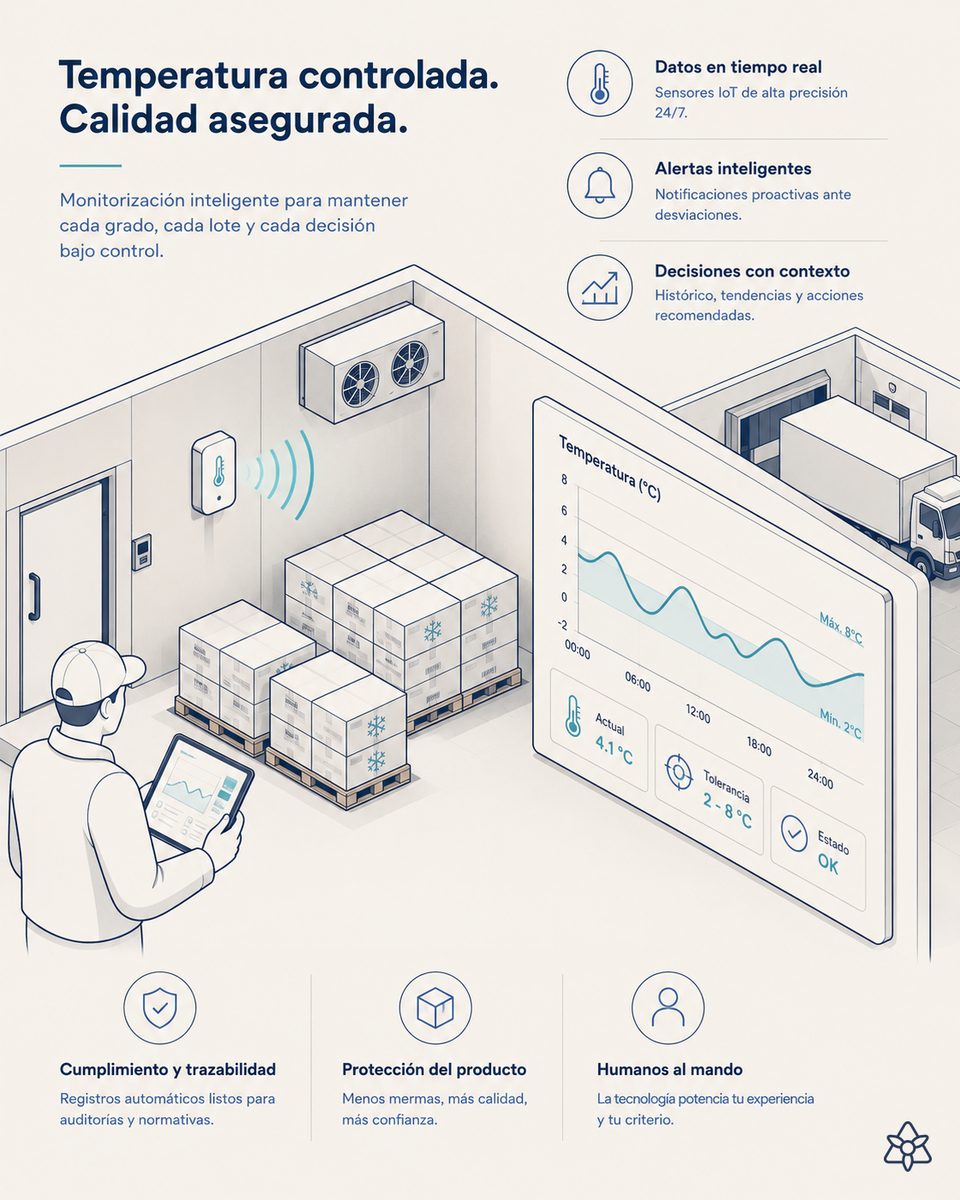
The core of the fillet cannot be seen — it shows up in the customer's cold store.
The freezing lead in a salmon SBP plant knows the IQF tunnel has three levers pulling at once:
- Air temperature (inlet and outlet) — the SCADA reads it, but the quality system does not always read the SCADA.
- Belt speed — adjustable, and under pressure whenever orders peak.
- Fillet mix — different thicknesses entering at the same time, especially on a multi-SKU line.
The freezing lead knows that if the three do not line up, the core does not reach temperature in time, the ice crystals are large, and the fillet loses water and color on thawing. The problem is that the core is invisible at the outlet: the fillet comes out frozen on the outside and the defect only appears later — in the cold store, at the customer's thawing step, or in the retailer's claim. By the time that claim arrives, a whole pallet has already shipped. The classic system (periodic probe pieces plus a trained eye) works 99% of the time — that 1% is the pallet that comes back.
iLEAN does not reprogram your tunnel — it reads the three data points and hands them to the freezing lead together.
The problem is not a lack of information: it is information that lives in islands (the tunnel SCADA knows the speed, the probe pieces know the core of the sample, the order system knows the thickness mix) and nobody cross-references them in real time. iLEAN acts as the putty that fills that gap and gives the freezing lead back the full picture, without asking them to change the tunnel or the SCADA.
Edge measures the probe pieces and models the core of the rest. Connect reads the tunnel SCADA and the production plan. The agent proposes the adjustment. The freezing lead signs — never the other way round.
The three iLEAN pieces applied to the salmon IQF tunnel:
- Edge — a terminal with sensors in periodic probe pieces plus a camera over the tunnel inlet to estimate the thickness and layout of the fillet. A CNN trained to correlate all of it with the core. Calibrated by the freezing lead themselves on your line. It works with no network — if the plant loses WiFi, Edge keeps measuring and storing the data locally.
- Connect — reads the available parameters from the tunnel SCADA (air, speed, alarms), through a modern interface where there is one, OPC-UA if there is one, or a read of the old PLC if that is what you have. And it captures from the production plan the thickness mix expected in each shift. Without asking you to change machines.
- Agent — cross-references estimated core + speed + air + mix, and if the combination falls outside the range that guarantees a good fillet, it proposes the adjustment to the freezing lead through their own channel (traffic light, dashboard, voice). The lead signs the adjustment; the tunnel does not reprogram itself.
Probe pieces plus a trained eye vs. cross-referenced core with iLEAN
| Aspect | Periodic probe pieces + the freezing lead's eye | With iLEAN Edge + Connect + Agent |
|---|---|---|
| Visibility of the core | Only the probe pieces, at isolated moments | Continuous estimate across the whole batch |
| Change in thickness mix | Noticed late, if at all | The agent cross-references it with speed and proposes an adjustment |
| Defect discovered | In the cold store, on thawing or in a claim | At the tunnel outlet, before the pallet is packed |
| SCADA integration | There is none with quality | Connect reads the parameters automatically |
| Operation with no network | n/a | Edge keeps measuring and modeling locally |
| File per pallet | The freezing lead's sheet, rebuilt afterwards | Automatic dossier with curves and signatures |
Impact estimate for your plant — to be validated with your numbers.
The block below is an estimate to be validated with the specific data of your plant. We put it forward so the committee has an order of magnitude; we refine it during the diagnostic.
- SBP plant with 1-2 IQF tunnels, a mix of SKUs (portions, whole fillet, skinless) and seasonal peaks.
- Edge pilot with sensors in probe pieces + a camera at the tunnel inlet + Connect to the tunnel SCADA + an adjustment agent. First value expected within a few weeks (continuous visibility of the core curve).
- Expected reduction in badly frozen pallets reaching the customer ≥ 30% — a conservative floor.
- Indicative payback between 4 and 9 months, depending on tunnel volume and the average cost of rework/returns. A single pallet recovered before it leaves the tunnel pays for a significant fraction of the pilot.
And the freezing lead's reasonable doubt
“What if the agent proposes slowing the belt down and output drops?” — hallucination is a problem of free generation, not of anchored tasks. In tasks where the AI merely cross-references structured records (temperatures, speed, thickness) and proposes a value inside the range, the best models brought error below 1.5% [1]. And even so, the adjustment is signed by the freezing lead — the proposal arrives as a suggestion, not as an order to the PLC. The three safety rings exist precisely for this.
[1] OpenAI paper “Why Language Models Hallucinate”, 2025 — on the reliability of AI in anchored tasks.
What people ask about salmon IQF tunnel control
What core temperature does a salmon fillet need in IQF?
An IQF (Individual Quick Freezing) salmon fillet that reaches packing correctly has a core temperature clearly below −18 °C, reached fast enough for the water to crystallize finely and not tear the fiber. If the core temperature does not come down in time, or the tunnel runs too fast, the crystals are large and on thawing the fillet loses water, color and texture — the retailer's customer notices and sends it back.
How do you measure core temperature without probing the fillet?
Two sources are combined: sensors in periodic probe pieces (fillets deliberately pierced for that purpose), and a core inference model in iLEAN Edge that correlates inlet/outlet air temperature, tunnel speed, and the thickness and layout of the fillet on the belt. The probe piece calibrates and the model extrapolates to the rest in real time, without piercing every fillet. The freezing lead validates — the system does not decide for them.
What happens if tunnel speed changes mid-production?
The agent cross-references belt speed + air temperature + estimated fillet thickness. If the combination falls outside the range that secures the core in time (because thicker fillets are coming in, because refrigeration capacity drops, because speed was pushed up under production pressure), it proposes an adjustment to the freezing lead through their own channel (traffic light, dashboard, voice). The freezing lead signs the adjustment — the tunnel does not reprogram itself.
Does it connect to the tunnel's existing SCADA?
Yes. iLEAN Connect reads the tunnel SCADA parameters (air temperature, belt speed, pressure, alarms) through whatever channel is available — a modern interface where there is one, OPC-UA if it is there, or a local read of the PLC computer if the machine is old and isolated. We do not force you to change the tunnel: we connect to the machine version you have, and if necessary Connect captures the panel with vision until a deeper integration is possible.
How much do you gain by avoiding rework on a badly frozen pallet?
A badly frozen pallet (core not at temperature, coarse crystallization) is typically discovered later — in the cold store, at the customer's thawing step or in the retailer's claim. Reworking means shipping it back, thawing, regrading, possibly downgrading it to a lower-value product. Every pallet recovered before it leaves the tunnel pays for a fraction of the pilot. ROI is usually dominated by the lever of not downgrading good product because of a core defect.
More cases in food
- Grading Huelva white shrimp — reliable pieces/kg without weighing piece by piece.iLEAN Vision grades Huelva white shrimp in pieces/kg on the belt by vision, without weighing each piece.…
- IQF prawn — the ice crystal decides the quality, not the packaging.How iLEAN Edge adapts the speed and temperature of the prawn IQF tunnel to prevent large ice crystals…
- Biofouling is closing the net, oxygen is dropping, mortality is climbing — and nobody sees it until tomorrow's count.How iLEAN Vision detects biofouling on submerged nets and abnormal mortality spikes in Mediterranean sea…
- Denia and Palamós red shrimp — from the boat to the restaurant, without losing whose it is.iLEAN Tracer traces Denia and Palamós red shrimp with RFID per box and a QR per single piece, from boat…
- The filleting operator has both hands busy — traceability cannot wait until the end of the shift.iLEAN Connect assists the anchovy filleting and packing operator in Santoña by voice: batch parameters,…
- Seabass and seabream with a defect that reaches the pack — the retailer sends it back, and your brand pays for it.How iLEAN Vision detects visceral remains, melanosis and flesh defects in seabass and seabream after…
Tell us your case and in 48h we'll send you the estimated ROI of this AI project for your SBP plant.
We work on the real data from your tunnel, not ours. Diagnostic with no commitment.
Request estimated ROI in 48h See premium seafood