IQF prawn — the ice crystal decides the quality, not the packaging.
The quality of premium prawn is decided in the last few meters of the IQF tunnel: if speed and temperature do not adapt to the real load, the crystals grow and the peeled meat breaks up on thawing. iLEAN Edge reads the line in real time and proposes the tunnel setpoint — the person signs.
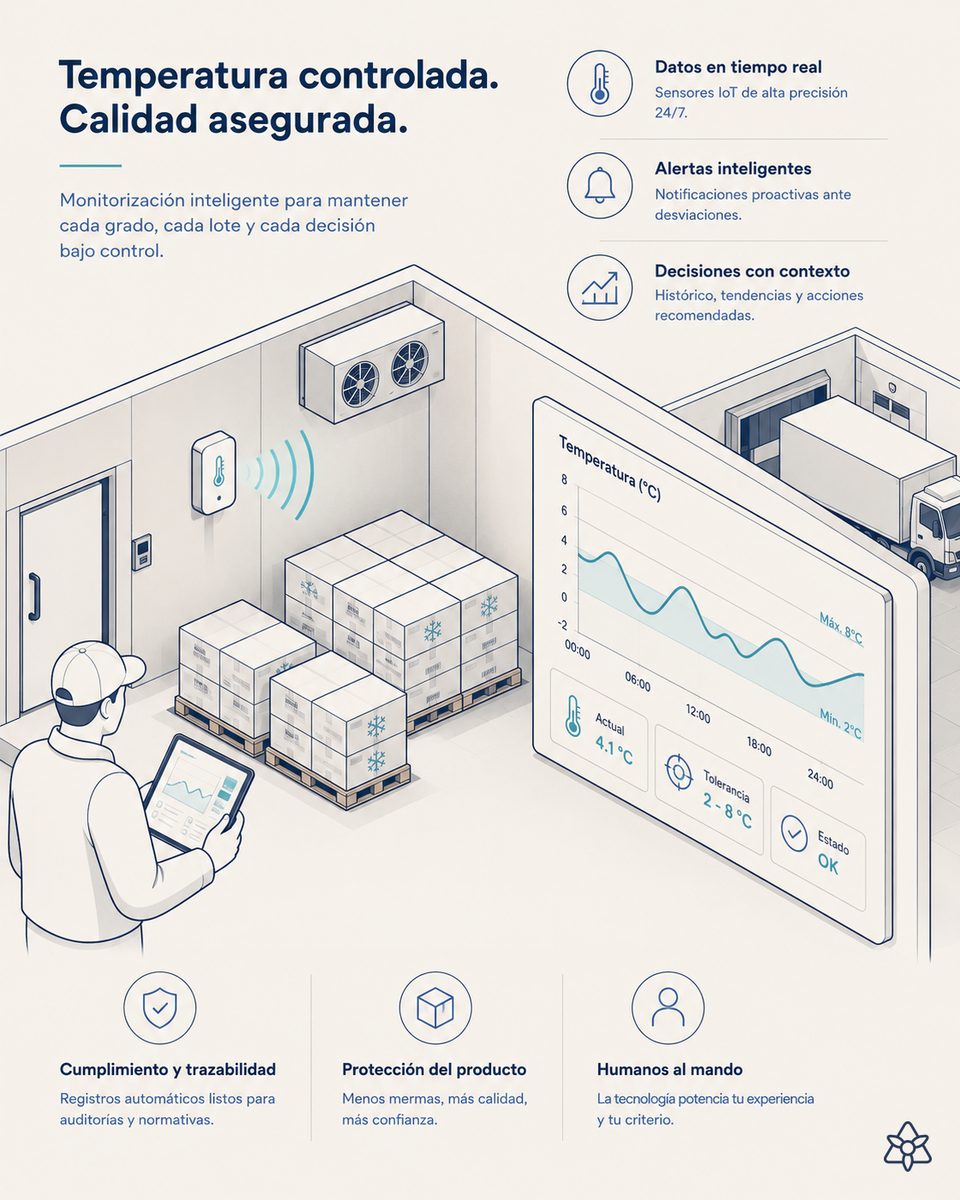
The damage is not visible in the tunnel — it shows up when the importer's kitchen thaws it.
Premium prawn sells on its texture and on the integrity of the peeled meat after thawing. And that is decided entirely in the IQF tunnel, where three things almost never line up at once:
- The size grade changes with every batch — and the tunnel setpoint is usually fixed to the typical grade. Anything thicker crosses the large-crystal zone too slowly; anything thinner gets over-frozen and loses moisture.
- Tunnel load varies with the pace of the plant — higher product density on the belt changes heat transfer; the tunnel performs worse exactly when it needs to perform best.
- Humidity and inlet temperature move with the day — and the operator cannot recalculate the freezing curve every hour of the shift.
Large ice crystals cannot be seen. They show up as broken peeled meat, drip loss in the tray and a complaint from the importer. The classic system (a PLC with a fixed setpoint + the operator's eye) gets it right 95 % of the time. That 5 % is the batch that arrives as second grade — and in margin terms, that 5 % eats the year's premium.
iLEAN does not replace the tunnel — it seals the cracks between the PLC, the probes, the ERP and the shift lead's eye.
The IQF problem is not a lack of information: it is information that lives in islands and that at the critical moment (a size-grade changeover, a load peak) does not reach the decision-maker in time. iLEAN acts as the putty that fills those gaps without asking you to change the tunnel or the PLC.
Edge reads the IQF line in real time. Connect captures size grade, humidity and inlet temperature wherever they live. The agent cross-references them with the small-crystal pattern and proposes a setpoint. The person signs — the tunnel never changes its own recipe.
The iLEAN pieces applied to prawn IQF control:
- iLEAN Edge — a terminal with a CNN and probes in the tunnel's control cabinet. It reads the temperature of every zone, the belt load, relative humidity and the product's outlet temperature. In milliseconds it works out whether the curve is drifting out of the small-crystal range and proposes a speed or thermal setpoint adjustment to the PLC. It works with no network: if the plant loses WiFi, Edge keeps calculating and delivering setpoints; what is critical cannot depend on connectivity.
- iLEAN Connect — captures the batch size grade whether it comes from the ERP, the MES, a quality manager's spreadsheet or an old counting scale, and it also captures what arrives from outside (the importer's specification with the allowable drip-loss range, a supplier alert about a size grade out of tolerance). It reaches the system at second zero, without anyone having to forward anything.
- Agent — cross-references the size grade, the tunnel's real curve, the line's history and the importer's allowable range. If the curve drifts, it does not send an email at 10 p.m.: it proposes a setpoint and alerts the shift lead on whichever channel they use. The person validates and the setpoint goes into the PLC.
An IQF tunnel with a fixed setpoint vs. an IQF tunnel with an adaptive setpoint from iLEAN
| Aspect | Fixed setpoint + the operator's eye | With iLEAN Edge + Connect + Agent |
|---|---|---|
| Adapting to the batch size grade | The operator readjusts by eye if something looks off | Setpoint recalculated for the actual incoming grade |
| Reaction to a load peak | Noticed in the importer's next complaint | Adjusted on the line, before the crystal grows |
| Curve in the critical 0 ºC / −5 ºC zone | Assumed by recipe | Measured in every zone and compared with the optimal pattern |
| Detecting drip loss at the outlet | Visual, at packing | Before packing, on the line |
| Operation with no network | n/a | Edge keeps running on the cabinet's own power |
| Per-batch file for the importer | Rebuilt by hand if there is a claim | Per-batch dossier with the tunnel's real curve, automatic |
Impact estimate for your plant — to be validated with your numbers.
The block below is an estimate to be validated with the specific data of your plant. We put it forward so the committee has an order of magnitude; we refine it during the diagnostic.
- Plant with one or two prawn IQF tunnels, mixed size grades, exporting to a European or American importer with a strict drip-loss tolerance.
- Edge pilot on one tunnel (probes in the zones + a camera over the outlet belt + integration with the PLC and with the batch recipe from the ERP). First value expected within a few weeks.
- Indicative payback between 4 and 9 months, depending on how often batches get downgraded to second grade and on the average cost of an importer penalty.
- Reduction in second-grade batches ≥ 30 % as a defensible floor; the hard lever is the premium/second-grade price gap per kilo and the export share recovered.
And the operations director's reasonable doubt
"What if the AI proposes a setpoint that wrecks the tunnel?" — the Agents have no hands in critical OT: they propose, the person signs, the PLC executes. And hallucination is a problem of free generation, not of anchored tasks: in tasks where the AI merely recontextualizes measured signals (real curve → allowable range), the best models brought error below 1.5 % [1]. The three safety rings exist precisely for this.
[1] OpenAI paper "Why Language Models Hallucinate", 2025 — on the reliability of AI in anchored tasks.
What people ask about IQF prawn control
Why does premium prawn meat break up after thawing?
When the temperature curve in the IQF tunnel is too slow — or the tunnel load has risen without the setpoint being readjusted — the ice crystals grow until they rupture the prawn's muscle membranes. The damage is invisible when the product leaves the tunnel: it shows up on thawing, as stringy flesh, drip loss and broken peeled meat that the importer penalizes. What is critical happens in the last few meters of the tunnel, not at the entrance.
What freezing speed does a premium prawn IQF need?
The operating rule is to cross the zone of maximum crystal formation (between 0 ºC and −5 ºC at the core of the piece) as fast as possible so the crystals stay small. That is not a single setpoint: it depends on the size grade of the prawn, on air humidity, on inlet temperature and on tunnel load. An IQF that always runs at the same speed gets the typical size grade right and damages all the others. iLEAN Edge adjusts the setpoint in real time using those variables.
How does iLEAN detect large ice crystals on the line?
iLEAN Edge does not measure the crystal directly — it measures the indicators that anticipate it: product outlet temperature, the tunnel's thermal profile in each zone, load (product density on the belt), humidity and the reflectance of the prawn's surface. With those indicators cross-referenced, the neural network anticipates when the curve is drifting out of the optimal small-crystal range and proposes a speed or setpoint adjustment. The person validates the setpoint changes on the line.
Does iLEAN Edge work inside an IQF tunnel at −40 ºC?
The Edge terminal does not go inside the tunnel: it goes in the control cabinet, in the adjacent plant room. What goes into the tunnel are the cameras and probes (already designed for extreme cold, fully encapsulated) and the temperature and flow sensors the plant already has. Edge consumes those signals and delivers setpoints to the tunnel's PLC. If the plant loses its network, Edge keeps calculating: what is critical cannot depend on WiFi.
How much does an IQF control pilot cost for a prawn plant?
The order of magnitude of an Edge pilot on a prawn IQF line is close to that of any Edge pilot in food: an initial investment covering the terminal + cameras/probes + integration with the tunnel PLC and with the ERP, plus an annual license. The hard lever is the cost of batches downgraded to second grade and the importer's penalties for drip loss and broken peeled meat. We ask for your plant's data and send you the estimated ROI in 48h.
More cases in food
- The batch file for the inspector should not cost the quality team a full working day every time.iLEAN Agents build the per-batch health dossier (EU Reg. 853/2004 + IFS Food) in fishing and aquaculture…
- PDO Galician mussel depuration — the batch dossier is not rebuilt; it assembles itself as you go.iLEAN Edge tracks salinity, UV, vibrio and E. coli in every depuration tank of PDO Galician mussels and…
- Grading Huelva white shrimp — reliable pieces/kg without weighing piece by piece.iLEAN Vision grades Huelva white shrimp in pieces/kg on the belt by vision, without weighing each piece.…
- Biofouling is closing the net, oxygen is dropping, mortality is climbing — and nobody sees it until tomorrow's count.How iLEAN Vision detects biofouling on submerged nets and abnormal mortality spikes in Mediterranean sea…
- The Norwegian salmon IQF tunnel — right core, a fillet that sells; wrong core, expensive scrap.How iLEAN controls core temperature and IQF tunnel speed inline at a Norwegian salmon (SBP) processing…
- Denia and Palamós red shrimp — from the boat to the restaurant, without losing whose it is.iLEAN Tracer traces Denia and Palamós red shrimp with RFID per box and a QR per single piece, from boat…
Tell us your case and in 48h we'll send you the estimated ROI of this AI project for your prawn plant.
We work on your tunnel's real data, not ours. Diagnostic with no commitment.
Request estimated ROI in 48h See premium seafood and aquaculture