PDO Galician mussel depuration — the batch dossier is not rebuilt; it assembles itself as you go.
Depurating PDO Galician mussels means cross-referencing salinity, the UV cycle and microbiological results (E. coli, vibrio) tank by tank, batch by batch — and today every piece of data lives on its own island. iLEAN Edge captures every tank continuously and assembles the health dossier of the PDO batch automatically. The quality manager signs before dispatch.
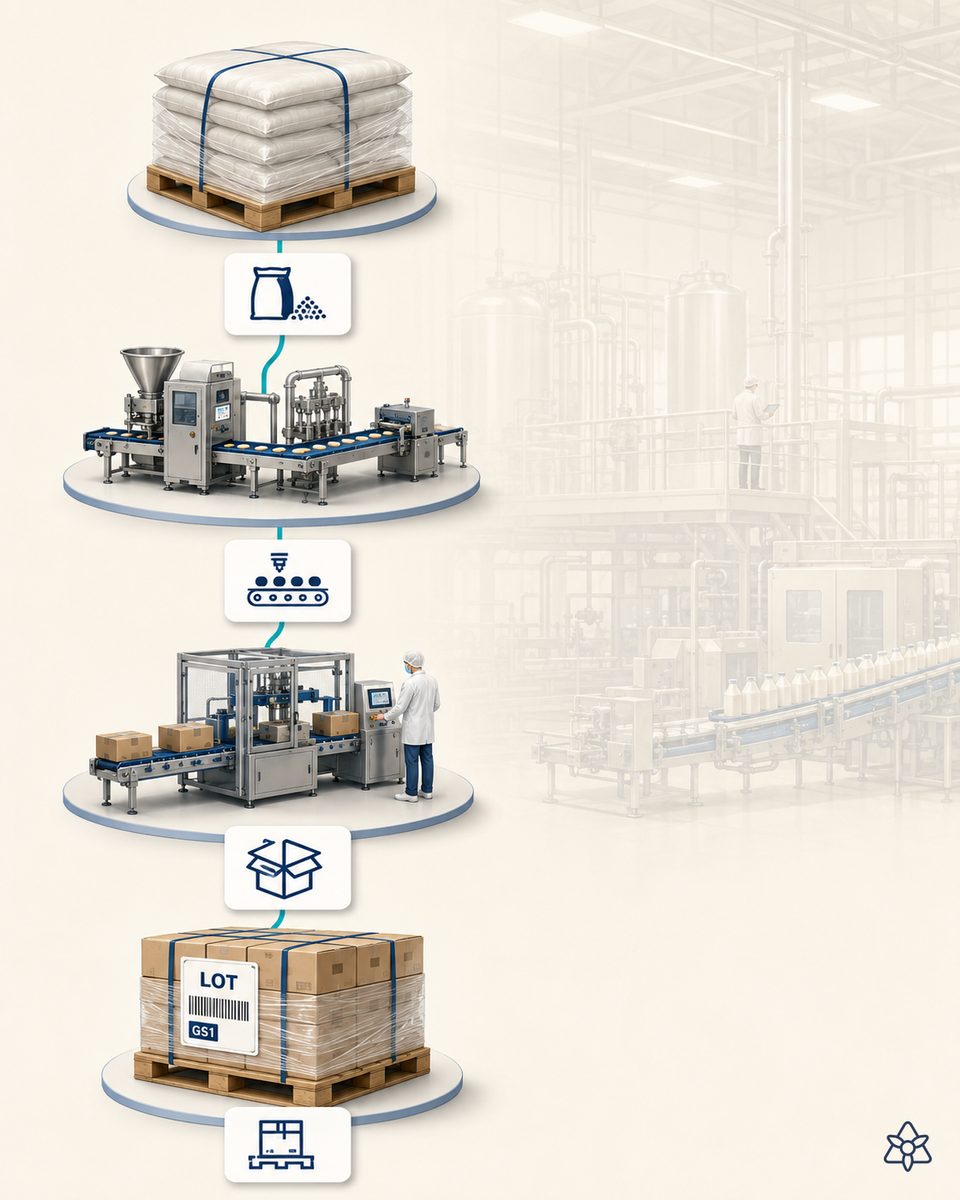
The health dossier is assembled from data living in four different places.
Over the course of a cycle, a PDO mussel depuration tank generates a continuous story: water salinity, temperature, UV intensity, flow rate, pressure, turbidity. At the end of that cycle the accredited laboratory result comes in (E. coli and, during an alert, vibrio). And on top of it all sits the PDO batch that occupied the tank and to which the certificate will be attached.
Today that data lives on four islands:
- The data logger / the SCADA in the room — if there is one — with the raw curve.
- The operator's notebook — the panel readings, the incidents of the shift ("the UV lamp in tank 3 reset at 02:40").
- The external laboratory report — it arrives by email as a PDF and has to be keyed in by hand.
- The quality manager's spreadsheet — where the final dossier is assembled, cross-referencing all of the above manually.
When the inspector, the Regulatory Council or the importer asks for a batch dossier, it gets rebuilt backwards from paperwork. It works 99% of the time. That 1% — the UV lamp that dropped for three hours and was never logged, the salinity that drifted before dawn — is what puts the whole PDO batch at risk.
iLEAN Edge replaces neither the lab nor the SCADA — it seals the cracks between them all.
The problem is not a lack of data: it is information living in islands that reaches the dossier too late. iLEAN acts as the putty between the SCADA, the notebook, the lab and the manager's spreadsheet, without asking you to change anything you already have.
Edge reads every tank continuously. Connect reads the lab result however it arrives. The agent cross-references it with the PDO batch and assembles the dossier. The person signs — never the other way round.
The iLEAN pieces applied to PDO Galician mussel depuration:
- Edge — an industrial AI terminal in the depuration room. It captures salinity, temperature, oxygen, UV intensity, flow rate and pressure per tank. It detects deviations (a degraded UV lamp, a flow rate out of range) and raises the alert there and then, not the following day. It works with no network: if the depuration plant loses its Internet connection, local capture and alerting are not interrupted.
- Connect — collects the accredited laboratory report whether it arrives by email, through the lab's portal or as a PDF attached to a WhatsApp message, and leaves it as structured data per tank and per batch. It also captures the PDO batch when the manager uploads the delivery note of origin or dictates it by voice.
- Agent — cross-references the continuous curve of each tank with the lab result and with the PDO batch that occupied that tank. It composes the health dossier (signed PDF + JSON) ready for the Regulatory Council, IFS/BRC, or a UK or US importer. If the dossier comes out with an incident (an uncompensated UV drop, insufficient depuration time), it holds the batch and alerts the quality manager. The person signs; the batch does not ship on its own.
Dossier rebuilt by hand vs. dossier assembled continuously
| Aspect | Depuration plant with notebook + spreadsheet | With iLEAN Edge + Connect + Agent |
|---|---|---|
| Salinity and UV curve per tank | Manual reading every couple of hours | Continuous, tank by tank, with no gaps |
| A UV drop before dawn | If nobody logged it, it does not exist in the dossier | Recorded, with duration and compensation |
| Cross-reference with the lab result | The manager keys the PDF into a spreadsheet | Connect leaves it structured per tank and batch |
| Dossier for the Regulatory Council / IFS / BRC | Rebuilt against the clock | Ready as soon as the cycle closes, with photo and signature |
| Operation with no network | n/a | Edge keeps capturing and alerting locally |
| Holding a doubtful batch | Depends on the manager's eye | Automatic hold + human signature to release |
Impact estimate for your plant — to be validated with your numbers.
The block below is an estimate to be validated with the specific data of your depuration plant. We put it forward so the committee has an order of magnitude; we refine it during the diagnostic.
- Depuration plant with 6-12 tanks, exporting PDO batches to UK / Italian / French importers and to demanding retailers.
- Edge pilot in one depuration room (instrumentation per tank + integration with the lab + dossier template). First value expected within a few weeks: the first tank already produces its dossier assembled continuously.
- Indicative payback between 4 and 9 months, depending on how often a dossier is rebuilt by hand today and on the average cost of a batch held for incomplete traceability.
- Expected reduction in the time spent on the health dossier of ≥ 30%, and the elimination of the grey area of "nobody wrote it down that night".
- The hard lever is a single PDO batch not shipped because of an incomplete dossier: one avoided consignment pays for the pilot.
And the quality manager's reasonable doubt
“What if the AI infers a deviation wrongly and holds a good batch?” — hallucination is a problem of free generation, not of anchored tasks. In tasks where the AI simply reads a piece of data from one system and cross-references it with another (UV curve vs. minimum cycle, lab result vs. tank), the best models brought error below 1.5% [1]. And even so, what is critical is never decided alone: iLEAN holds the batch and the person signs. The three safety rings exist precisely for this.
[1] OpenAI paper “Why Language Models Hallucinate”, 2025 — on the reliability of AI in anchored tasks.
What people ask about PDO Galician mussel depuration with AI
Which parameters must be controlled in PDO mussel depuration?
Salinity, temperature and dissolved oxygen of the treated seawater; integrity of the UV cycle (actual lamp hours, flow rate); turbidity; and the microbiological results per tank (E. coli as the main indicator, vibrio during a health alert). Every tank is cross-referenced with the PDO batch occupying it and with the minimum depuration time required. The usual trap is that each piece of data lives somewhere different: the data logger, the operator's notebook, the external laboratory report, a spreadsheet.
Why is a single E. coli reading not enough to release a PDO batch?
Because a microbiological result at one point does not tell the story: a tank that lost UV pressure for an hour at 03:00 can still return an acceptable E. coli at sampling time and yet carry a mussel at risk. Releasing the PDO batch requires continuity of salinity and UV throughout the whole depuration cycle, cross-referenced with the lab result — and that is what a serious dossier demonstrates to the inspector and to the importer.
What does iLEAN Edge do in a mussel depuration room?
iLEAN Edge is an industrial AI terminal installed in the room itself — it captures salinity, temperature, flow rate, UV intensity and pressure per tank, continuously. It cross-references them with the PDO batch occupying the tank and, if a parameter drifts (UV lamp fading, salinity out of range), it alerts the manager there and then — not the next day when the lab report arrives. It works with no network: if the depuration plant loses its Internet connection, local capture and alerting do not stop.
How is the health dossier for a PDO mussel batch built?
Every tank leaves a continuous trace: salinity and UV curves across the whole cycle, a photo of the seal, the lab result loaded by Connect at second zero, the quality manager's signature. The agent assembles the dossier (PDF + JSON) per PDO batch, with everything cross-referenced and traceable. When the importer or the Regulatory Council asks for it, nothing has to be rebuilt — it is already done. The manager signs and the batch ships.
Does iLEAN replace the accredited laboratory's analyses?
No, and we never present it that way. The accredited laboratory keeps doing the sampling and the microbiological analysis the standard requires. iLEAN integrates that result with the real operation of the tank (salinity, UV, time) so the batch dossier makes complete sense. The iLEAN piece assists and simplifies the dossier; the person and the lab sign the critical decisions.
More cases in food
- The salting master knows which barrel is ready — but she cannot taste them all today.iLEAN Brain cross-references salinity, temperature and time in Cantabrian PDO anchovy curing to…
- A nitrite creeping up at 4am on a Saturday should not depend on who happens to be on shift.iLEAN Edge cross-references ammonia, nitrite, pH and biofilter data in an eel RAS and assists the shift…
- The batch file for the inspector should not cost the quality team a full working day every time.iLEAN Agents build the per-batch health dossier (EU Reg. 853/2004 + IFS Food) in fishing and aquaculture…
- Grading Huelva white shrimp — reliable pieces/kg without weighing piece by piece.iLEAN Vision grades Huelva white shrimp in pieces/kg on the belt by vision, without weighing each piece.…
- IQF prawn — the ice crystal decides the quality, not the packaging.How iLEAN Edge adapts the speed and temperature of the prawn IQF tunnel to prevent large ice crystals…
- Biofouling is closing the net, oxygen is dropping, mortality is climbing — and nobody sees it until tomorrow's count.How iLEAN Vision detects biofouling on submerged nets and abnormal mortality spikes in Mediterranean sea…
Tell us your case and in 48h we'll send you the estimated ROI of this AI project for your PDO depuration plant.
We work on your room's real data, not ours. Diagnostic with no commitment.
Request estimated ROI in 48h See food industry