A nitrite creeping up at 4am on a Saturday should not depend on who happens to be on shift.
An eel RAS means cross-referencing ammonia, nitrite, pH, oxygen, temperature and biofilter pressure — not as isolated values, but as a trend that gives the problem away 6 hours before it becomes a loss. iLEAN Edge integrates your sensors, learns how your RAS behaves and alerts the shift technician by voice. The person signs — the RAS does not adjust itself.
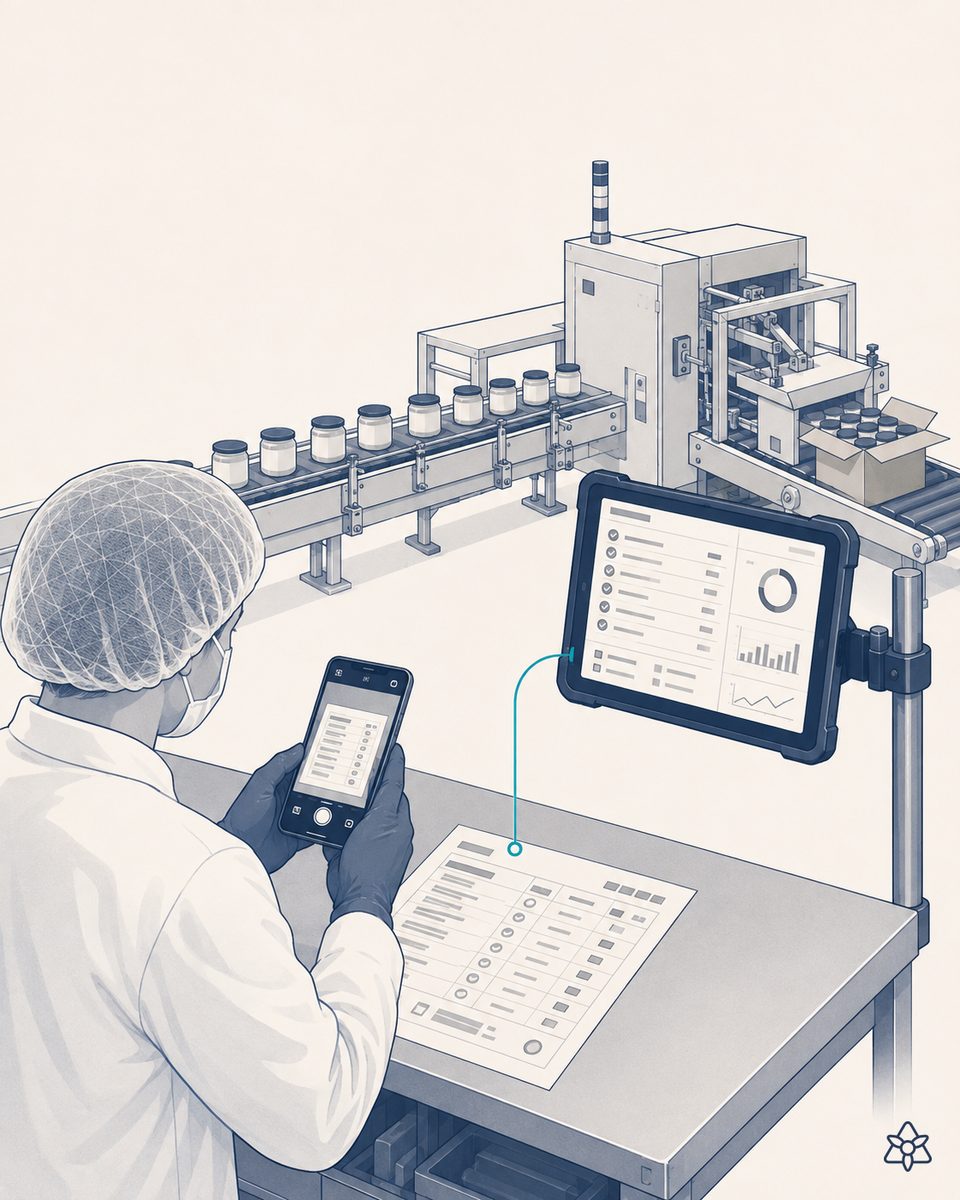
Six sensors, one person, a three-day weekend.
An eel RAS does not fail on the sensor the technician is looking at — it fails on the trend no human can hold in their head seven days a week:
- Ammonia (TAN) — rises when there is overfeeding or when the biofilter loses activity after an aggressive cleaning.
- Nitrite (NO₂) — the intermediate stage, the most toxic one for eel, rises if the biofilter is out of balance between the two nitrification steps.
- pH and temperature — they set how much of the TAN sits as toxic free ammonia (NH₃) rather than as ammonium ion.
- Dissolved oxygen and flow — the indicator that the system is still breathing.
- Biofilter pressure and behavior — the early signal of clogging or of a biological imbalance.
A new technician, on a Saturday night, looks at an instantaneous value and concludes it is "within range". A veteran technician cross-references trend, time of day, the last feed and the last cleaning, and knows what is coming. The veteran's knowledge is the biggest island in the RAS — and the day they retire, half the plant walks out with them.
iLEAN Edge — the veteran's eye reading the RAS at 4 in the morning.
The RAS problem is not a lack of sensors: it is trends that only emerge from the sum of all six, at hours and on days when nobody with 20 years of craft is watching. iLEAN acts as the putty between the sensors you already have and the decision the shift technician has to make. It does not ask you to change your SCADA or to give up your RAS safety protocol.
Edge integrates the sensors. Connect calls the technician by voice when a trend appears. An agent cross-references the history of feeding, cleaning and temperature. The person signs the correction — the RAS does not adjust itself.
The three iLEAN pieces applied to an eel RAS:
- iLEAN Edge — a physical terminal in the RAS plant room. It reads TAN, NO₂, NO₃, pH, O₂, temperature, flow and pressure over Modbus/OPC-UA, or with a camera over the old displays. A CNN learns the normal behavior of your own RAS and detects the anomalous trend — not just the value out of range. It works with no network: if connectivity drops, Edge keeps reading and raising alerts through a dry contact to the panel.
- Connect — the shift technician wears an earpiece (or carries a tablet if phones are not allowed in the plant room). The agent tells them: "nitrite in tank 4 has been rising for 30 minutes, oxygen falling, last heavy feed 6 hours ago, sending you the reading". It also captures what comes in from outside: an email from the feed supplier with a formula change, the vet's report.
- Agents — they cross-reference the history of when and how the biofilter was cleaned, the feeding curve, the vet's reports and Edge's alerts. They propose three actions to the technician (cut the feed, adjust oxygen, slow the recirculation). The technician decides.
Conventional RAS watch-keeping vs. continuous assistance with iLEAN Edge
| Aspect | Conventional watch-keeping | With iLEAN Edge + Connect + Agent |
|---|---|---|
| Reading the trend | Depends on who happens to be looking | Continuous, across the sum of all six sensors |
| Alerting the technician | Threshold alarm on an instantaneous value | A voice call with context and options |
| Integrating old sensors | "Not worth touching it" | Read by camera or through whatever serial port exists |
| Operation without network | n/a | Edge keeps reading and alerting through a dry contact |
| The veteran's knowledge | In their head — it leaves with them | Captured as a pattern, reusable every shift |
| Anticipating the event | Only once the episode is under way | Hours ahead — room to correct |
Impact estimate for your plant — to be validated with your numbers.
The block below is an estimate to be validated with the specific data of your facility. We put it forward so the committee has an order of magnitude; we refine it during the diagnostic.
- Mid-sized eel RAS, nitrifying biofilter, shift technicians on 24/7 cover, sensor history available.
- Edge pilot in the plant room + conversational assistant on an earpiece + integration with the existing sensors. First value expected within a few weeks (the first trend caught in advance).
- Indicative payback between 4 and 9 months, depending on how often mortality episodes or downgraded harvests happen at your facility and what they cost.
- Reduction in events not anticipated ≥30% (a conservative estimate). The hard lever is a single episode avoided: it pays for the pilot and leaves the shift technicians with far less dread of the weekend.
And the RAS manager's reasonable doubt
"What if the AI proposes the wrong action and we lose the biofilter?" — hallucination is a problem of free generation, not of anchored tasks. In tasks where the AI merely reads sensors and compares them against a pattern learned from the RAS itself, the best models brought error below 1.5% [1]. And even so, what is critical is never decided alone: iLEAN proposes three actions, the technician decides and signs. The three safety rings exist precisely for this — the RAS OT network stays sacred.
[1] OpenAI paper "Why Language Models Hallucinate", 2025 — on the reliability of AI in anchored tasks.
What people ask about water quality in an eel RAS with AI
Why is water quality the most critical decision in an eel RAS?
In a recirculating aquaculture system (RAS) the water is reused over and over, and the nitrifying biofilter converts the ammonia (TAN) the eels excrete into nitrite, and nitrite into nitrate. Any imbalance — overfeeding, temperature out of range, pH drift, low oxygen, a biofilter thrown out of balance after a cleaning — pushes ammonia or nitrite above toxic thresholds. Eel tolerates more than other species, but a sustained episode shows up as accumulated mortality or as a harvest of lower quality. The critical decision is not reading one sensor: it is reading all six at once and understanding the direction, not the instantaneous value.
How does iLEAN Edge assist the shift technician without replacing them?
iLEAN Edge connects to the RAS sensors (TAN, NO₂, NO₃, pH, O₂, temperature, flow, biofilter pressure) over whichever protocol you have (Modbus, OPC-UA, plain analog) and keeps a continuous reading. A neural network trained on the RAS's own history detects the trend, not just the value — a nitrite creeping up slowly at dawn after a day of heavy feeding is a signal a human only catches if they happen to be looking. When there is an anomaly, Connect calls the shift technician by voice ("nitrite in tank 4 has been rising for 30 minutes, oxygen falling, sending you the reading") and proposes three actions. The technician decides and signs. It is assistance, not autopilot.
What if the RAS network goes down overnight?
Edge is a physical device installed in the RAS plant room itself. Its basic cycle — read sensors, compare against learned thresholds, fire an audible alert or a dry contact to the panel — works even if the plant loses its network, the Internet and the cloud. What is critical cannot depend on there being WiFi. The part that does need connectivity is the conversational assistance (the agent that talks to the technician), but detection and the first intervention live inside the box itself.
How does iLEAN fit with the SCADA and the RAS sensors I already have?
iLEAN does not replace your SCADA — it sits on top and fills in what the SCADA left uncovered. Capture is graduated machine by machine: if the modern sensor speaks OPC-UA or Modbus, it integrates directly; if the TAN meter is old and has nothing but a display, Edge can read that display with a camera and digitize the value; if the biofilter has an original-vendor screen stranded on a Windows 2000 industrial PC, Connect hooks into whatever output is available. The promise is practical: we do not force you to change anything, we capture wherever there is data and we join it up.
What does it cost to put iLEAN on an eel RAS that is already built?
An Edge pilot on an existing RAS comes at a reasonable order of magnitude: a terminal in the plant room, integration with the existing sensors, training on the RAS's own history and an annual licence. The indicative payback (an estimate to be validated) is between 4 and 9 months, depending on what a mortality episode or a downgraded harvest costs at your facility. The hard lever is twofold: a single episode caught in advance pays for the pilot, and the shift technicians work with far less dread of the weekend. We ask for your numbers and send you the estimated ROI in 48h.
More cases in food
- Bluefin tuna fat grading at the auction hall — the veteran's eye retires, the judgment stays.How iLEAN grades bluefin tuna fat quality (otoro/chutoro) before auction with a hyperspectral camera at…
- The bluefin tuna cold chain — histamine gives no warning, sensors do.How iLEAN controls the bluefin tuna cold chain from landing at the auction hall to the packed fillet to…
- The salting master knows which barrel is ready — but she cannot taste them all today.iLEAN Brain cross-references salinity, temperature and time in Cantabrian PDO anchovy curing to…
- The batch file for the inspector should not cost the quality team a full working day every time.iLEAN Agents build the per-batch health dossier (EU Reg. 853/2004 + IFS Food) in fishing and aquaculture…
- PDO Galician mussel depuration — the batch dossier is not rebuilt; it assembles itself as you go.iLEAN Edge tracks salinity, UV, vibrio and E. coli in every depuration tank of PDO Galician mussels and…
- Grading Huelva white shrimp — reliable pieces/kg without weighing piece by piece.iLEAN Vision grades Huelva white shrimp in pieces/kg on the belt by vision, without weighing each piece.…
Tell us your case and in 48h we'll send you the estimated ROI of this AI project for your eel RAS.
We work on the real data from your facility, not ours. Diagnostic with no commitment.
Request estimated ROI in 48h See the food industry