Bluefin tuna fat grading at the auction hall — the veteran's eye retires, the judgment stays.
Deciding whether a tuna is otoro, chutoro or akami before the auction depends today on the veteran's eye — and that eye is about to retire. iLEAN Vision captures fat quality with a hyperspectral camera in the auction hall itself and proposes the grade; the auctioneer signs. Same judgment, made permanent.
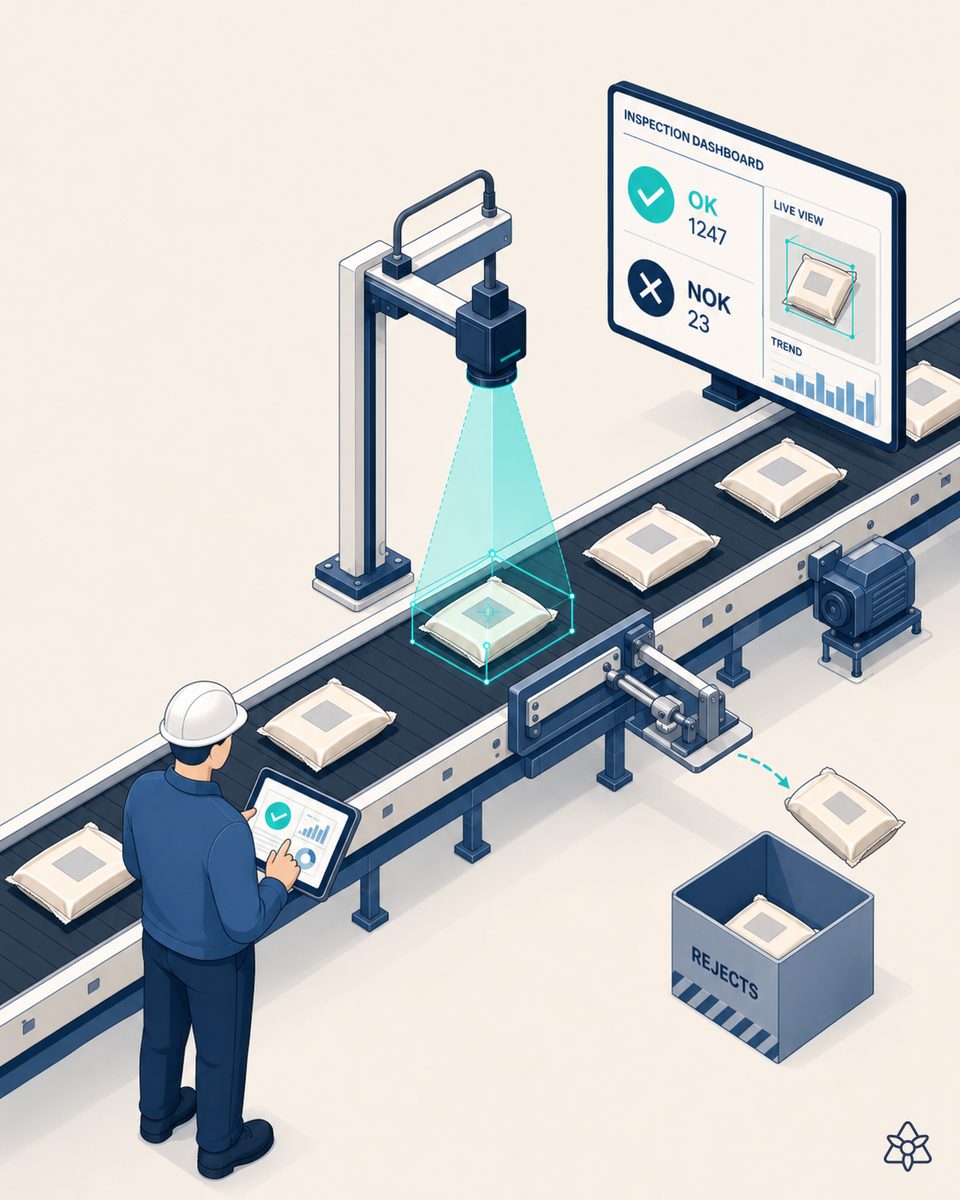
The price of bluefin tuna is set by one eye — and that eye cannot be copied.
In the auction hall, the head grader calls the fish otoro, chutoro or akami in a matter of seconds. The auctioneer accepts the call and the fish goes to market at its price per kilo. The system works — until that grader retires or is out for a day. A replacement takes years to calibrate the eye, and in the meantime:
- Grading too low leaves money on the table — the buyer pays less and takes home a fish that was worth more.
- Grading too high ends in a return from the Japanese wholesaler and damage to the auction hall's reputation.
- The veteran's knowledge is the biggest and worst-protected island of all — it is in no system, it lives in one person.
And the pressure keeps rising: large buyers demand more traceability and more reproducible judgment every year. The veteran's eye is the most valuable thing in the auction hall, and at the same time the most fragile — a classic pattern in industry: what matters most lives in heads, not in systems.
iLEAN Vision does not replace the grader — it captures their eye as a permanent capability.
The problem is not that the AI has to decide in the veteran's place: it is that the day the veteran is no longer there, the judgment leaves with them. iLEAN acts as the putty that captures the expert's eye, keeps it available as a calibrated second opinion on every fish, and lets the auctioneer sign with all the veteran's judgment behind them even when the veteran is not in the room that day.
Vision proposes, the grader validates, the auctioneer signs. The veteran's eye stays in the system — and every new fish sharpens it.
The three iLEAN pieces applied to bluefin tuna fat grading:
- Edge — a terminal with a hyperspectral camera over the grading table or over the belt. Hyperspectral images pick up signatures of fat infiltration that the human eye does not see directly. A CNN trained on fish from your own port, calibrated by the head grader, proposes otoro/chutoro/akami with a confidence level.
- Connect — captures the auctioneer's final grade and the wholesale buyer's feedback (rejections, price adjustments) and feeds them back into training. Buyer feedback stops getting lost in emails and WhatsApp and enters the model's improvement loop.
- Agent — cross-references the Vision proposal with the grader's history, the temperature of the fish and the expected yield, and prepares the fish record for the auctioneer in seconds. If Vision proposes a grade with low confidence, it flags the fish as "check" and the grader confirms it by hand.
The veteran's eye alone vs. the veteran's eye with iLEAN
| Aspect | Classic grading (the veteran's eye) | With iLEAN Vision (hyperspectral + agent) |
|---|---|---|
| Continuity of judgment | Leaves with the head grader | Stays in the system, calibrated by them |
| Second opinion | There is none — a single eye | Hyperspectral proposal with a confidence level |
| Reproducibility | Hard to audit — implicit judgment | Reproducible model, traceable examples |
| Wholesaler feedback | Lost in emails and phone calls | Connect captures it and returns it to the model |
| Operation with no network | n/a | Edge keeps grading locally |
| Fish record for the auction | By hand, on a sheet | Automatic, with photo and proposal |
Impact estimate for your plant — to be validated with your numbers.
The block below is an estimate to be validated with the specific data of your auction hall. We put it forward so the committee has an order of magnitude; we refine it during the diagnostic.
- Auction hall with a daily auction in season, head grader close to retirement, several dozen fish in an average session.
- Vision pilot with a hyperspectral camera + Edge on the grading table + a fish-record agent. First value expected within a few weeks (agreement with the head grader ≥ 90% as a conservative floor).
- Expected reduction in grading error compared with an inexperienced replacement ≥ 30% — conservative floor.
- Indicative payback between 4 and 9 months, depending on auction volume and the price gap between otoro/chutoro/akami. The hard lever is this: no premium fish is sold as a lower grade because the judgment was not in the room.
And the auctioneer's reasonable doubt
"What if the AI gets it wrong and downgrades an otoro to chutoro?" — hallucination is a problem of free generation, not of anchored tasks. In tasks where the AI merely recontextualizes a measured data point (the hyperspectral signature of fat) into a label (otoro/chutoro/akami), the best models brought error below 1.5% [1]. And even so, the auctioneer signs: the AI proposes, it does not decide. The three safety rings exist precisely for this.
[1] OpenAI paper "Why Language Models Hallucinate", 2025 — on the reliability of AI in anchored tasks.
What people ask about bluefin tuna fat grading with vision
What is the difference between otoro and chutoro, and why does the price change?
Otoro is the fattiest belly cut of bluefin tuna, with extremely high marbled fat infiltration — the most expensive part in the Japanese market and in premium sushi. Chutoro is the transition toward the loin, with less intramuscular fat but better balanced. Akami is the lean loin. The price per kilo across the three can vary several times over — and the grade is decided in a few seconds, on the whole fish, right before the auction. Grading too low leaves money on the table; grading too high comes back as a return.
How does iLEAN Vision grade the fat of a whole bluefin tuna?
iLEAN Vision uses a hyperspectral camera over the whole fish or over the control cut. A hyperspectral image sees more than the human eye — it picks up spectral signatures of fat infiltration that correlate with the classic grading. A CNN trained on fish already graded by the veteran proposes otoro/chutoro/akami with a confidence level. It does not replace the auctioneer: it gives an instant second opinion so that the person signs with sound judgment.
Does the hyperspectral camera work in an auction hall with cold and water?
Yes. The camera sits in an industrial IP-rated housing and the Edge terminal goes in a sealed cabinet. The optics adapt to auction-hall lighting (typically cold and lateral) and the algorithms are trained on real fish from your own port. It works with humidity, frost and the pace of unloading. And it works with no network: if the auction hall loses connectivity, Edge keeps grading and storing the data locally.
Does the AI replace the auctioneer or the veteran who used to grade?
No. What iLEAN Vision does is capture the veteran's eye as a permanent capability of the auction hall. The day the head grader retires, the judgment does not leave with him: it stays in the system, calibrated on thousands of fish he already validated. The auctioneer signs — always. We plant our flag on assisting and simplifying, not on automating.
How long does the system take to learn from the fish at our auction hall?
The typical pilot starts with a learning phase on your specific auction hall: the AI trains on fish graded by the head grader during the first few weeks. From that point on it proposes a grade with calibrated confidence, and the auctioneer validates it. Accuracy rises with every fish; the conservative floor is reaching agreement with the head grader above ≥90% in the first weeks — an estimate to be validated with the data from your auction hall.
More cases in food
- Industrial AI in precooked frozen food factoriesTwelve real industrial AI cases in precooked frozen food factories: paperless capture, in-line vision…
- Premium seafood — the value is in the cold chain, and in being able to prove it.Documented iLEAN cases in premium seafood: cold chain, origin traceability, MSC certification and…
- Individual traceability for almadraba bluefin tuna — one lost tag is one fish out of the market.How iLEAN captures the ICCAT tag, GBYP and eBCD piece by piece for almadraba bluefin tuna with vision in…
- The bluefin tuna cold chain — histamine gives no warning, sensors do.How iLEAN controls the bluefin tuna cold chain from landing at the auction hall to the packed fillet to…
- The salting master knows which barrel is ready — but she cannot taste them all today.iLEAN Brain cross-references salinity, temperature and time in Cantabrian PDO anchovy curing to…
- A nitrite creeping up at 4am on a Saturday should not depend on who happens to be on shift.iLEAN Edge cross-references ammonia, nitrite, pH and biofilter data in an eel RAS and assists the shift…
Tell us your case and in 48h we'll send you the estimated ROI of this AI project for your auction hall.
We work on your auction hall's real data, not ours. Diagnostic with no commitment.
Request estimated ROI in 48h See premium seafood