The bluefin tuna cold chain — histamine gives no warning, sensors do.
Histamine in bluefin tuna means a fine, a recall and brand damage. It usually forms in cold-chain gaps that nobody measured in time — it cannot be seen, it cannot be smelled and it survives cooking. iLEAN Edge installs sensors at landing, in transport and in the plant, an agent cross-references the pattern and alerts the technician — the person signs off on the batch entering the line.
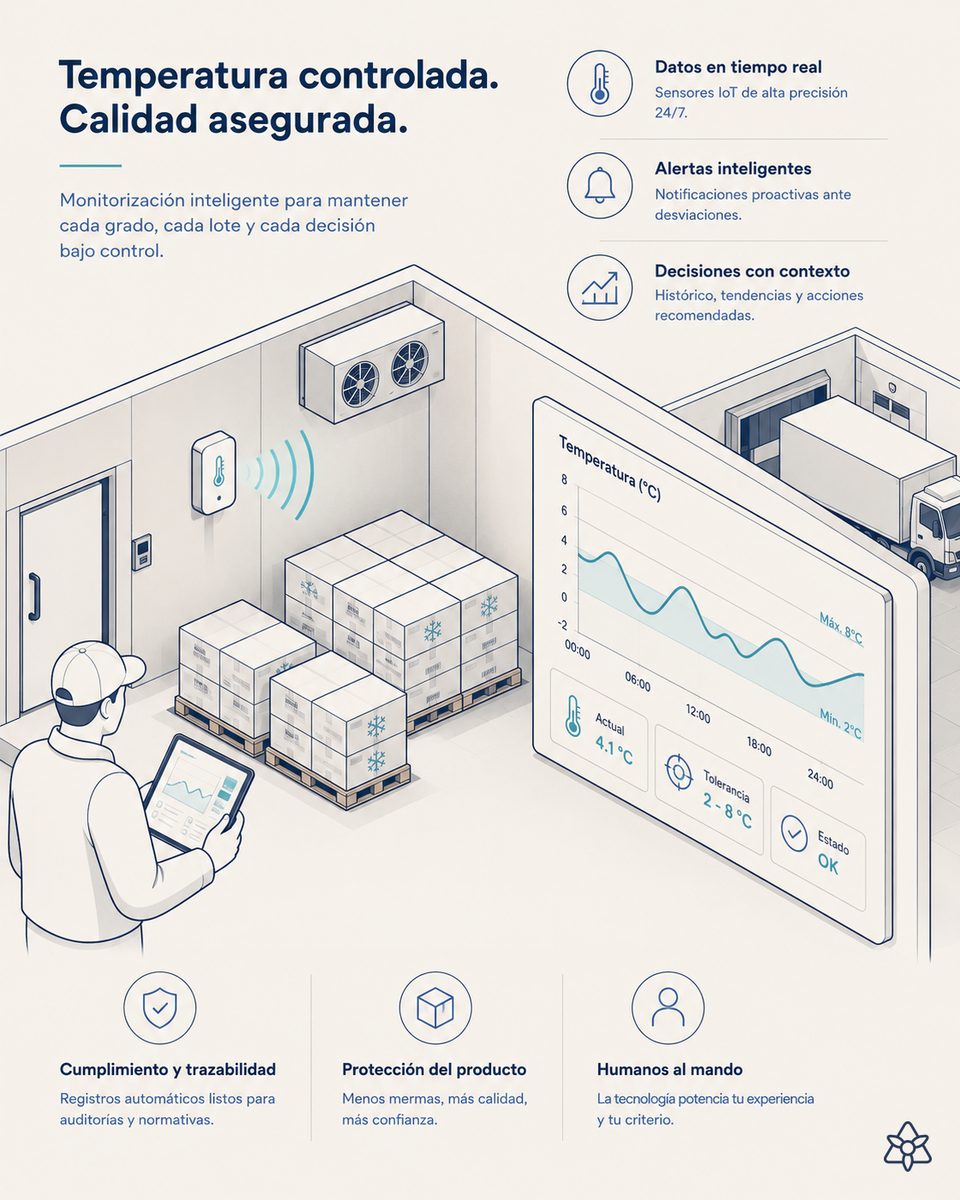
The bluefin tuna cold chain is many systems and no common file.
From catch to packed fillet, a bluefin tuna passes through critical points where temperature has to stay under control, and each point usually has its own record:
- The vessel's hold — the owner's data-logger or the skipper's handwritten log.
- Landing at the auction hall + the auction-hall cold room — a thermometer on the wall, in-house quality control.
- Transport to the plant — the carrier's recorder, which in most cases nobody sees until the truck arrives.
- Cold room and cutting table, tunnel and packing — plant SCADA or separate records.
The quality manager knows that histamine is heat-stable, cannot be seen, cannot be smelled and ends up in RASFF if it slips through. They also know that the classic after-the-fact audit system works 99% of the time — and that 1% is a food safety alert, a recall and brand damage that in premium seafood is extremely hard to repair. Every gap between systems is a dead zone where the temperature curve could have drifted and nobody saw it in time.
iLEAN does not ask you to change your HACCP — it seals the gaps between the systems you already have.
The histamine problem is not a lack of information: it is information living in islands (vessel, transport, auction-hall cold room, plant) so that when someone assembles the file, the temperature curve has gaps. iLEAN acts as the putty that fills those gaps, reads wherever it needs to and builds the per-batch dossier in real time, without asking you to change the HACCP you already have audited.
Edge measures at the critical points. Connect captures the vessel's and the carrier's records however they arrive. The agent cross-references the pattern and, if there is a gap, flags the batch for testing. The person signs — never the other way round.
The three iLEAN pieces applied to bluefin tuna histamine control:
- Edge — redundant temperature sensors at the critical points of the auction hall and the plant (cold rooms, cutting table, tunnel, packing), with a local terminal that keeps measuring and storing data even if the plant loses WiFi. What is critical cannot depend on connectivity.
- Connect — captures the vessel's records (data-logger, a photo of the skipper's log, a WhatsApp message from the owner) and the carrier's records (PDF, truck data-logger) at second zero, without asking them to change systems. And it captures the food safety alerts that arrive by email from the customer or the authority to feed the agent.
- Agent — cross-references temperature by point, ICCAT batch, operations schedule and redundancies. If it detects a gap or a deviation, it flags the batch as suspect for testing before packing and alerts the quality technician on their own channel. The technician signs off on the batch entering the line — not on the line itself.
HACCP in islands vs. a cross-referenced cold chain with iLEAN
| Aspect | HACCP in islands + after-the-fact audit | With iLEAN Edge + Connect + Agent |
|---|---|---|
| Temperature curve per batch | Rebuilt by hand afterwards | Real time, by point, by ICCAT batch |
| Vessel and carrier data | Arrives on paper, or does not arrive | Connect captures it on any channel |
| Time gap in a cold room | Detected at audit or during an alert | The agent flags it on the spot |
| Suspect batch | Goes to packing and is taken on trust | Flagged for testing before packing |
| Operation with no network | n/a | Edge keeps measuring and storing locally |
| File for the authority/customer | Rebuilt by hand, weeks of work | Per-batch dossier, automatic, with every curve |
Impact estimate for your plant — to be validated with your numbers.
The block below is an estimate to be validated with the specific data of your auction hall and your plant. We put it forward so the committee has an order of magnitude; we refine it during the diagnostic.
- Auction hall with its own landings + a fillet plant a short distance away, several own vessels and at least one external carrier.
- Edge pilot with redundant sensors at the critical points + Connect for external records + a HACCP file agent. First value expected within a few weeks (real visibility of the per-batch curve).
- Expected reduction in cold-chain incidents that reach packing ≥ 30% — conservative floor.
- Indicative payback between 4 and 9 months, depending on season volume and the average cost of a histamine test and of a recall. A single alert avoided pays for a good share of the pilot.
And the quality technician's reasonable doubt
"What if the agent signs off a curve that is not sound?" — hallucination is a problem of free generation, not of anchored tasks. In tasks where the AI merely cross-references structured records (sensor curve + schedule + batch), the best models brought error below 1.5% [1]. And even so, what is critical is never decided alone: iLEAN holds the suspect batch and the person signs it into packing. The three safety rings exist precisely for this.
[1] OpenAI paper "Why Language Models Hallucinate", 2025 — on the reliability of AI in anchored tasks.
What people ask about histamine control in bluefin tuna
Above what temperature does histamine form in bluefin tuna?
Histamine forms when histamine-producing bacteria (the Enterobacteriaceae family) act on the histidine in the tuna muscle at temperatures above roughly 4–7 °C. The hard part is that it cannot be seen and, for the most part, cannot be smelled, and it is heat-stable: cooking afterwards does not destroy it. That is why the only way to avoid it is to keep the cold chain gap-free from catch to packed fillet — and to be able to prove it batch by batch to the authority and to the customer.
How does iLEAN Edge monitor the cold chain without replacing the technician?
iLEAN Edge installs temperature sensors at the critical points — the vessel's hold, landing, the auction-hall cold room, transport, the plant cold room, the cutting table, the tunnel and packing. An agent cross-references the records with the operations schedule and the ICCAT traceability of every fish. If it detects a gap (a sensor drifting out of range, a time gap between cold rooms, a door open longer than usual) it alerts the quality technician on their own channel with the specific batch that was affected. The technician decides what to do.
What happens if a chiller sensor fails during transport?
The agent detects the sensor dropping out and, at the same time, cross-references redundancies (another sensor in the same cold room, the carrier's data-logger reading, the time between unloading at origin and loading at destination). If the redundancy backs up that the chain held, it marks it as a reviewed event; if not, it flags the batch as suspect for histamine testing before packing. It works with no network: the Edge sensors store locally and upload when the connection comes back, without losing a single reading.
Does the system work for an auction hall with several vessels and suppliers?
Yes — that is exactly what it is built for. iLEAN Connect captures the vessel's cold-chain records (its own data-logger or a photo of the skipper's log) and the carrier's records through whichever channel they arrive on (email, PDF, WhatsApp), and unifies them with the auction hall's own records. The batch file ends up complete, wherever the data comes from, without asking anyone to change systems.
Does it integrate with our existing HACCP records?
Yes. iLEAN Connect reads the HACCP records from your current system (paper, Excel, vertical software) and enriches them with real-time data from the Edge sensors. The final batch file — the one the auditor asks for — is generated automatically with a photo of the ICCAT seal, the temperature curve at every point, the agent's events and human signatures. You do not have to rewrite the HACCP; it amplifies it.
More cases in food
- Premium seafood — the value is in the cold chain, and in being able to prove it.Documented iLEAN cases in premium seafood: cold chain, origin traceability, MSC certification and…
- Individual traceability for almadraba bluefin tuna — one lost tag is one fish out of the market.How iLEAN captures the ICCAT tag, GBYP and eBCD piece by piece for almadraba bluefin tuna with vision in…
- Bluefin tuna fat grading at the auction hall — the veteran's eye retires, the judgment stays.How iLEAN grades bluefin tuna fat quality (otoro/chutoro) before auction with a hyperspectral camera at…
- The salting master knows which barrel is ready — but she cannot taste them all today.iLEAN Brain cross-references salinity, temperature and time in Cantabrian PDO anchovy curing to…
- A nitrite creeping up at 4am on a Saturday should not depend on who happens to be on shift.iLEAN Edge cross-references ammonia, nitrite, pH and biofilter data in an eel RAS and assists the shift…
- The batch file for the inspector should not cost the quality team a full working day every time.iLEAN Agents build the per-batch health dossier (EU Reg. 853/2004 + IFS Food) in fishing and aquaculture…
Tell us your case and in 48h we'll send you the estimated ROI of this AI project for your auction hall and your plant.
We work on your cold chain's real data, not ours. Diagnostic with no commitment.
Request estimated ROI in 48h See premium seafood