Grading Huelva white shrimp — reliable pieces/kg without weighing piece by piece.
The commercial grade of white shrimp (40/60, 60/80, 80/100) sets the margin — and today it comes from a mechanical grader + sample weighing + an expert eye, with no continuous record per box. iLEAN Vision estimates the weight of every piece by vision on the belt and gives the actual pieces/kg grade continuously. The person signs off on the grade of every batch.
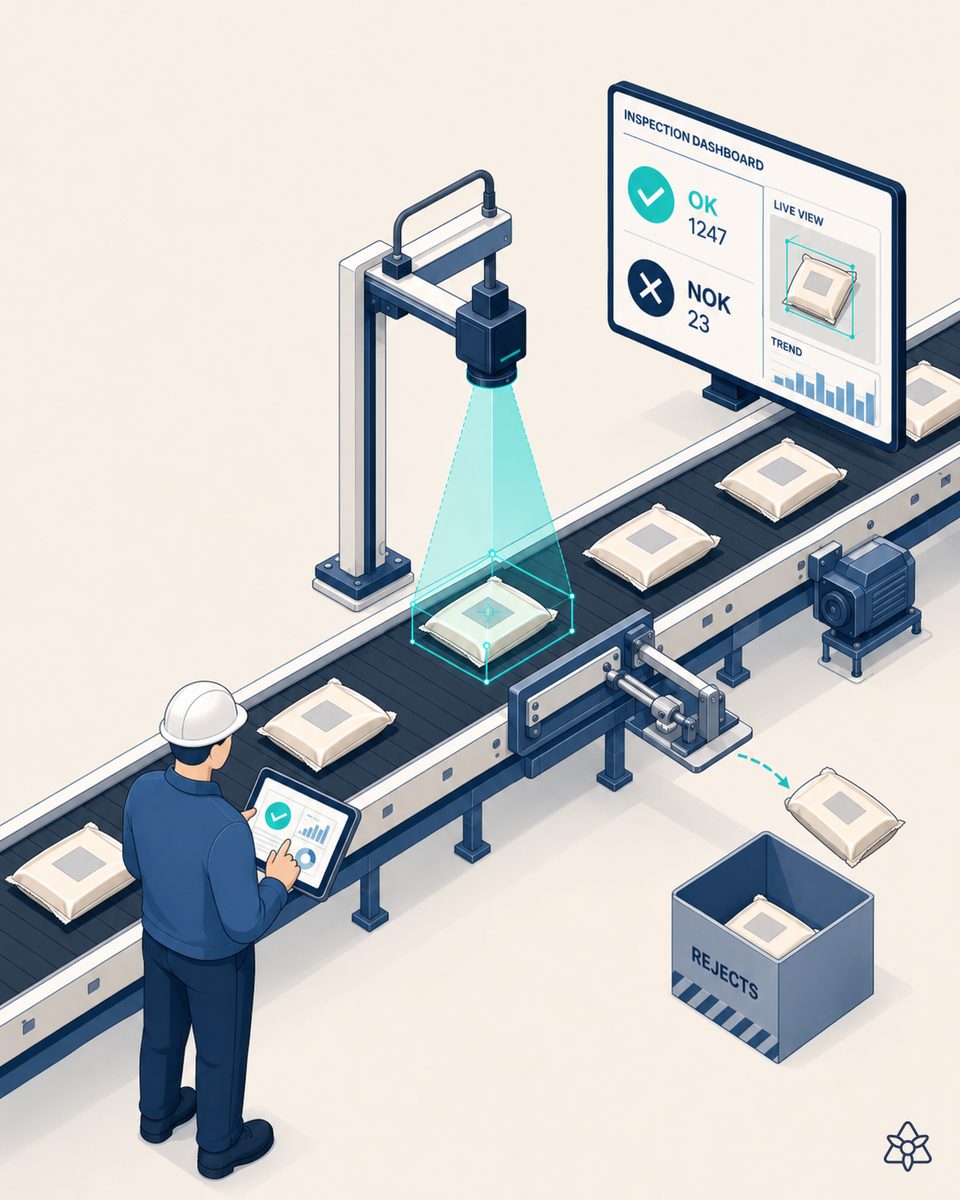
The actual grade of each box does not appear in any system.
In a white shrimp handling plant, grading a box correctly is the difference between the contract and the claim. Today the operation combines three modes that do not talk to each other:
- Mechanical roller grader — sorts by size, fast, but leaves spread within the same grade.
- Weighing on a multihead or control scale — accurate, but sample-based and expensive to maintain at high line speeds.
- The expert grader's eye — irreplaceable for the top grades, but limited by working hours and by the pace of the belt.
The result: there is no continuous record of the actual grade that went into each box. Traceability is done by sampling, claims are one word against another, and the grader is adjusted an hour late rather than in real time. In products where a few grams per piece move the margin of the batch, that adds up.
iLEAN Vision adds a data point that does not exist today — continuous grade per box.
The problem is not a lack of scales: it is information that is not measured continuously and that, at the critical moment (the box about to be sealed), never reaches the system. iLEAN acts as the putty between the grader, the scale and the ERP/MES, without asking you to change the line.
Vision works out the grade piece by piece. The agent cross-references it with the box, the batch and the delivery note. The person signs the traceability — and the customer's claim is answered with the photo and the data.
The iLEAN pieces applied to white shrimp grading:
- iLEAN Vision (Edge) — a camera with a CNN trained on white shrimp from your own plant. It captures the length, projected area and shape of every piece on the belt and estimates the weight per piece with a model calibrated against the scale. It works with no network.
- Connect — captures the control weights from the multihead scale and the model corrections from the operator's tablet. It also captures the shortfall reported by the customer (the distributor's email) to feed the model back when a claim comes in.
- Agent — cross-references the grade estimated by vision with the box being closed, the batch of origin, the delivery note and the contract with the distributor. If a box drifts, it alerts the operator before it is closed. It assembles the traceability dossier box by box (photo + estimate + control weight + batch + delivery note). The person signs the batch release.
Roller grading + sample weighing vs. continuous grading with iLEAN Vision
| Aspect | Today | With iLEAN Vision + Agent |
|---|---|---|
| Data per box | Sample weighing | Continuously estimated grade + scale control |
| Adjusting the grader | An hour late, based on a sample | Real time, based on grade drift |
| Traceability of the box | Batch + delivery note | Batch + delivery note + photo + grade estimate |
| Distributor claim | One word against another | Answered with the photo and the batch data |
| Top grade slipping into mid-grade boxes | Premium product given away | Detected and reassigned before the box is closed |
| The expert grader's work | Eyes on the belt non-stop | Supervise, validate borderline cases, sign the batch |
Impact estimate for your plant — to be validated with your numbers.
The block below is an estimate to be validated with the specific data of your plant. We put it forward so the committee has an order of magnitude; we refine it during the diagnostic.
- White shrimp handling plant in Huelva, 2-4 lines, multi-grade, a mix of premium retail and food service channels.
- Vision pilot on one grading belt (camera + CNN + integration with the scale and the MES). First value expected within a few weeks.
- Indicative payback between 4 and 9 months, depending on the current share of top grade slipping into mid grades and on the frequency of shortfall claims.
- Expected reduction in misallocated top grade ≥ 30%, plus photo + data traceability per box from day one.
- The hard lever: premium product recovered into its own boxes + claims answered with data + fewer manual adjustments of the grader.
And the operations manager's reasonable doubt
"What if the vision estimate is less accurate than the scale?" — it is a fair question, and the answer is an honest one: the vision data does not replace the scale, it complements it. The scale is still there for control and for the top grades; vision adds what the scale cannot give — a reading per piece across the whole belt. Hallucination is a problem of free generation, not of anchored tasks like this one (length and area → weight estimate), where the best models brought error below 1.5% [1]. And even so, the person signs off on the batch grade.
[1] OpenAI paper "Why Language Models Hallucinate", 2025 — on the reliability of AI in anchored tasks.
What people ask about white shrimp grading with AI vision
What does grading white shrimp in pieces/kg mean?
The commercial grade of white shrimp is expressed in pieces per kilo (40/60, 60/80, 80/100…) and it is what sets the shelf price and the contract with the distributor. Grading a box correctly is not optional: a grade that drifts downward gets penalized, and a grade that drifts upward is premium product given away for free. In a Huelva plant running at high line speeds, keeping the grade constant box by box is one of the hard margin levers.
How is white shrimp graded in the plant today?
Three modes coexist: (1) a mechanical roller grader sorting by size, fast but with spread; (2) individual weighing on a multihead weigher, accurate but slow and expensive to maintain; (3) the operator's expert eye, irreplaceable for the top grades but limited by line speed. None of them leaves the operation a continuous, traceable record of the actual grade that went into each box.
How does iLEAN Vision estimate the weight of each shrimp without weighing it?
iLEAN Vision uses a camera and a convolutional neural network (CNN) trained on samples from your own plant — it captures the length, projected area and shape of every shrimp on the belt and estimates the weight per piece with a model calibrated against the scale. The system gives the actual pieces/kg grade of the box being filled, continuously. It does not replace control weighing, it assists it — and it leaves the trace for claims, for the retailer or for an audit.
How accurate is a vision estimate compared with the scale?
A vision estimate, with a model trained on samples from your plant and periodically recalibrated against the scale, reaches a deviation that is more than good enough for commercial use — and, more importantly: it generates continuous data for the whole belt, not for a sample. The scale is still there for control and for the top grades; iLEAN Vision adds the traceability and the real-time adjustment of the mechanical grader when a box drifts.
What does the iLEAN agent do with the grading data?
The agent cross-references the actual grade estimated by vision with the box the belt is filling, the batch of origin and the customer's delivery note. If a box goes out of tolerance, it alerts the operator to readjust before the box is closed and leaves the trace box by box (photo + estimate + control weight). The quality manager signs the per-batch traceability — the customer's claim stops being one word against another.
More cases in food
- A nitrite creeping up at 4am on a Saturday should not depend on who happens to be on shift.iLEAN Edge cross-references ammonia, nitrite, pH and biofilter data in an eel RAS and assists the shift…
- The batch file for the inspector should not cost the quality team a full working day every time.iLEAN Agents build the per-batch health dossier (EU Reg. 853/2004 + IFS Food) in fishing and aquaculture…
- PDO Galician mussel depuration — the batch dossier is not rebuilt; it assembles itself as you go.iLEAN Edge tracks salinity, UV, vibrio and E. coli in every depuration tank of PDO Galician mussels and…
- IQF prawn — the ice crystal decides the quality, not the packaging.How iLEAN Edge adapts the speed and temperature of the prawn IQF tunnel to prevent large ice crystals…
- Biofouling is closing the net, oxygen is dropping, mortality is climbing — and nobody sees it until tomorrow's count.How iLEAN Vision detects biofouling on submerged nets and abnormal mortality spikes in Mediterranean sea…
- The Norwegian salmon IQF tunnel — right core, a fillet that sells; wrong core, expensive scrap.How iLEAN controls core temperature and IQF tunnel speed inline at a Norwegian salmon (SBP) processing…
Tell us your case and in 48h we'll send you the estimated ROI of this AI project for your shrimp plant.
We work on your line's real data, not ours. Diagnostic with no commitment.
Request estimated ROI in 48h See food industry