Denia and Palamós red shrimp — from the boat to the restaurant, without losing whose it is.
With premium red shrimp, origin is the price. Today that origin travels on four different labels (auction hall, distributor, transport, restaurant) that do not talk to each other. iLEAN Tracer ties every link together with RFID per box encoded at the auction hall and a QR per single piece, and lets the chef and the diner know which boat that shrimp came from. The person signs off on every step.
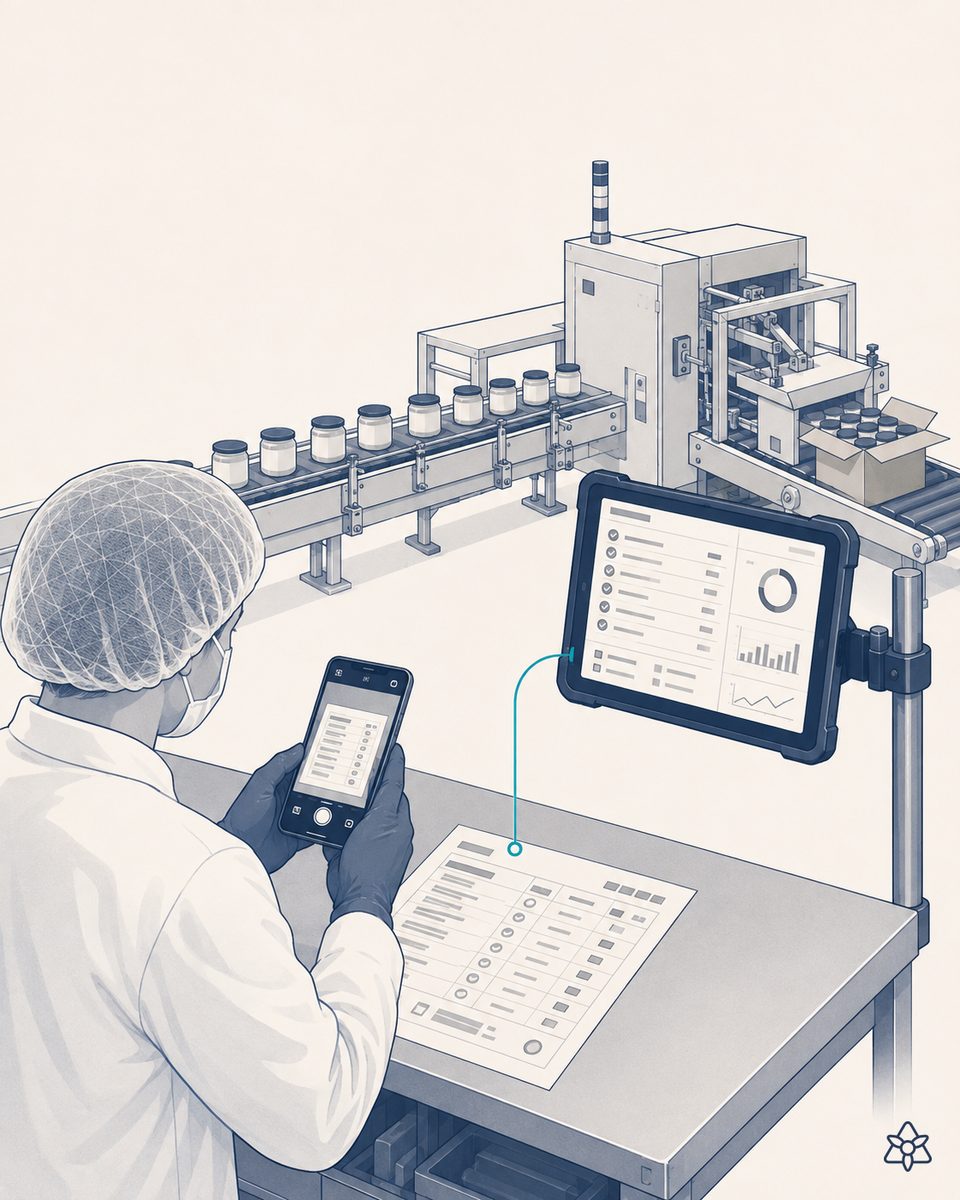
The trace travels on four different labels — and it breaks at the first handover.
Mediterranean red shrimp (Denia, Palamós, Sant Carles, Vilanova) is one of the products where the gap between identified origin and generic origin is charged for on the menu. The premium restaurant charges it, the diner pays and, more and more often, asks — "which boat?". And the chain, today:
- Auction hall — a box label with batch, boat, sale, weight, grade. It lives in the auction hall's system, not necessarily in the buyer's.
- Middleman / distributor — their own delivery note and their own label. The auction hall's box gets relabeled.
- Refrigerated transport — the carrier's label, a temperature docket. If the chain breaks, the gap has to be reconstructed.
- Restaurant — a kitchen docket with the origin "from Denia" or "from Palamós" — the original box label is probably in the trash.
Four pieces of paper, four systems, none of them chained together continuously. The information exists — at every link — but it is not joined up. When a box arrives late, when a customer complains, when the chef wants to compare boat X with boat Y, there is no single place where the whole story can be seen. It is the classic data-island problem, applied to fresh seafood.
iLEAN Tracer does not force the auction hall to change anything — it picks up the trace however it comes.
The problem is not a lack of technology at the auction hall: it is information that lives in islands and that at the critical moment (the restaurant table, the claim to the supplier) does not arrive joined up. iLEAN acts as the putty between the systems at every link, without asking any of them to change what they already do.
RFID per box at the auction hall, a QR per piece at the handling plant, a read at every link. The person signs — and the chef (or the diner) scans from the table.
The iLEAN pieces applied to red shrimp traceability:
- iLEAN Tracer (Connect + Agents) — capture of the auction-hall data whether it comes from the hall's own system, from the buyer's app or from a WhatsApp message from the boat's skipper; printing of the RFID label with boat/batch/sale/weight/grade; printing of a QR per piece during handling for food service.
- Connect — listens on every channel: the distributor's email, the transport temperature sheet, an RFID read at the intermediate warehouse, a QR read in the restaurant kitchen. Every read closes a link at second zero.
- Agent — assembles the story per box and per single piece: boat → auction hall → distributor → transport → restaurant. If a link breaks (a box delivered late, temperature out of range), it alerts the person responsible. When the chef scans the QR they see boat, haul, sale and weight. If the diner scans it, they see the commercial story (without the distributor's sensitive data).
Box-label trace vs. piece-level trace with iLEAN Tracer
| Aspect | Today | With iLEAN Tracer |
|---|---|---|
| Auction-hall label | Lives in the auction hall's system | RFID with boat/batch/sale linked in the cloud |
| Traceability down to the piece | Does not exist, only per box | A QR per single piece linked to the batch and the box |
| Goods-in at the restaurant | Delivery note + eyeball | RFID read on arrival, link closed |
| Backing up "from Denia / Palamós" on the menu | "It says so on the chalkboard" | The diner scans the QR and sees boat and haul |
| Claim to the supplier | Days of emails | Full trace of the broken link in minutes |
| Cold chain | The carrier's paper docket | Connect captures the temperature log per trip |
Impact estimate for your plant — to be validated with your numbers.
The block below is an estimate to be validated with the specific data of your chain. We put it forward so the committee has an order of magnitude; we refine it during the diagnostic.
- Premium red shrimp distributor, 1-3 auction halls of origin (Denia, Palamós, Sant Carles), top restaurants in Madrid, Barcelona, Bilbao and the Costa Brava.
- Tracer pilot on one route: auction hall → plant → 5-10 pilot restaurants (RFID label at the auction hall + a QR per piece at the plant + reads at every link). First value expected within a few weeks: the first boxes already tell their story.
- Indicative payback between 4 and 9 months, depending on the average cost of handling a box claim and on the price premium the chef accepts when they can back up the origin to the diner.
- Reduction in the time spent handling cold-chain and origin incidents ≥ 30%.
- The hard lever: backing up the menu + claims closed in minutes + chefs paying a premium for product traceable down to the piece.
And the distributor's reasonable doubt
"What if the restaurant does not want to deal with yet another reader?" — the restaurant does not "deal with a reader". The box is scanned with a phone (NFC RFID) on arrival, and the chef sees the story on a screen. The QR per piece is optional for the end diner. iLEAN's capture ladder adapts to the least digital link: if the restaurant does not scan, Connect closes the link when the delivery note is signed. The system never forces anyone to digitize against their will — the iLEAN piece assists and simplifies where it should. Hallucination is a problem of free generation, not of anchored tasks like this one; in anchored tasks the best models brought error below 1.5% [1].
[1] OpenAI paper "Why Language Models Hallucinate", 2025 — on the reliability of AI in anchored tasks.
What people ask about red shrimp traceability with iLEAN Tracer
Why does Denia or Palamós red shrimp need traceability down to the individual piece?
Because this is the product where origin is the price: Denia or Palamós red shrimp from an identified boat is worth several times more than red shrimp of generic origin. The premium restaurant prices it on the menu as such, and the diner paying €120/kg wants to know which boat and which fishing ground that specific piece came from. The traditional box-label trace disappears the moment the waiter takes it out of the kitchen. What is needed is a trace at piece level, not at delivery-note level.
How is a box of red shrimp traced today from the auction hall to the restaurant?
In the classic chain: the box label at the auction hall (batch + boat + sale), the middleman's origin delivery note, the distributor's label, the restaurant's docket. Four pieces of paper, four systems, none of them chained together in real time. If a diner at the table asks "which boat is it from?", the answer is usually "from Palamós", which is what the chalkboard says — but not "from boat X, the haul on such a day, box number Y". That information exists across the chain; it is just not joined up.
What does iLEAN Tracer do along this journey?
iLEAN Tracer is the capture and orchestration piece that ties every link of the chain together: RFID per box encoded at the auction hall (boat, batch, sale, weight, grade) + a QR per single piece printed at the handling plant, both linked to the batch. Every read (warehouse, distributor, restaurant) closes a link. The restaurant scans the box on arrival and, optionally, the end diner scans the piece from the table and sees its story.
Does the auction hall have to change its systems for this to work?
No. iLEAN Connect captures the sale data whether it comes from the auction hall's own system, from the buyer's field sheet, from the boat's app or from a WhatsApp message — the capture ladder (manual, intermediate, integrated) adapts to whatever is there. In practice, the buyer at the auction hall prints an RFID label with the iLEAN app and that alone links the batch to the boat. Nobody forces the auction hall to digitize so that the restaurant can have the trace.
What concrete problem does this solve for the premium restaurant?
Three at once: (1) backing up the menu — "Denia or Palamós red shrimp" on the menu can be proven, with the very piece in front of the diner, by scanning a QR; (2) purchasing — the chef compares auction hall, day and boat at a glance and learns which product fits the menu; (3) claims to the supplier — if a box arrives late or short, the trace shows where the chain broke, and those are negotiations that close in minutes instead of days.
More cases in food
- IQF prawn — the ice crystal decides the quality, not the packaging.How iLEAN Edge adapts the speed and temperature of the prawn IQF tunnel to prevent large ice crystals…
- Biofouling is closing the net, oxygen is dropping, mortality is climbing — and nobody sees it until tomorrow's count.How iLEAN Vision detects biofouling on submerged nets and abnormal mortality spikes in Mediterranean sea…
- The Norwegian salmon IQF tunnel — right core, a fillet that sells; wrong core, expensive scrap.How iLEAN controls core temperature and IQF tunnel speed inline at a Norwegian salmon (SBP) processing…
- The filleting operator has both hands busy — traceability cannot wait until the end of the shift.iLEAN Connect assists the anchovy filleting and packing operator in Santoña by voice: batch parameters,…
- Seabass and seabream with a defect that reaches the pack — the retailer sends it back, and your brand pays for it.How iLEAN Vision detects visceral remains, melanosis and flesh defects in seabass and seabream after…
- High FCR in seabass and seabream — every kilo of feed that sinks to the bottom is margin thrown away.How iLEAN Vision reads the behavior of seabass and seabream schools in open-sea cages and adjusts feed…
Tell us your case and in 48h we'll send you the estimated ROI of this AI project for your red shrimp chain.
We work on your routes' real data, not ours. Diagnostic with no commitment.
Request estimated ROI in 48h See food industry