The filleting operator has both hands busy — traceability cannot wait until the end of the shift.
Filleting and packing Santoña anchovy is done by hand, by craft. The problem is not the operator — it is that batch parameters, size grade and yield end up on a sheet at the end of the day that somebody keys into a spreadsheet at 10pm. iLEAN Connect gives her an earpiece, asks her only what is needed and records the data at second zero. No paper, and no change to the way she works.
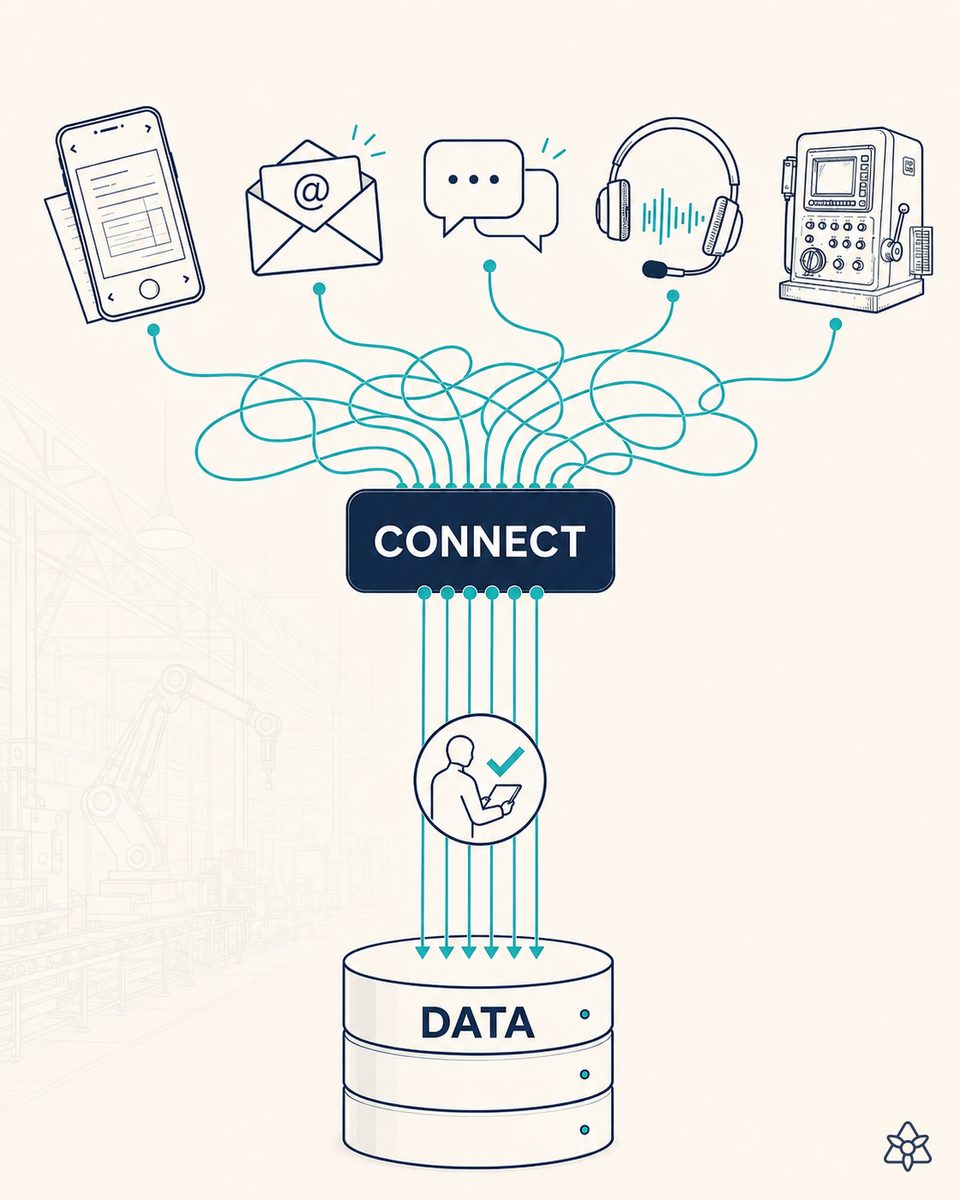
Twenty operators, twenty sheets of paper, one person typing it all up at 10pm.
A Santoña anchovy filleting room works as the sum of small individual lines — each operator opens her barrel, strips off salt and skin, cuts fillets and packs them. The craft is by hand and that does not change. What does weigh, day after day:
- Batch and barrel — which barrel was opened, when, and the size grade of the matured fish.
- Size grade and yield — how many fillets come out per kilo of anchovy in, the weight per tin, the oil-to-anchovy ratio the end customer requires.
- Traceability for the PDO and for the customer — what was done to which barrel, by which operator, with which packing recipe, for which customer.
The classic system: a paper sheet per station, manual transcription at the end of the shift, the occasional error, and a traceability risk if the premium customer asks to see one specific case three months later. The operator does not make mistakes in the filleting — the paper makes mistakes at the end of the day.
iLEAN Connect — earpiece, voice and traceability at second zero.
The problem in the filleting room is not cadence: it is information traveling on paper when the operator already knows it in the moment. iLEAN acts as the putty between what happens at the station and what the ERP/vertical seafood system needs, without asking the operator to change the way she works.
Connect speaks to her when it matters, asks her the bare minimum and records at second zero. The operator keeps working by hand — the paper disappears.
The three iLEAN pieces applied to Santoña anchovy filleting and packing:
- iLEAN Connect — a full-duplex earpiece on the line (or a tablet by proximity if the operator prefers). The agent asks her the size grade when she opens a new barrel, calls out the customer's packing recipe when the tin format changes, and gives her the traceability back if she asks for it. Connect also captures what comes from outside: an email from the importer with a recipe change, a WhatsApp message from the plant manager.
- iLEAN Agents — they live on Central. They cross-reference batch, size grade and yield by operator, by day, by customer. If one size grade yields poorly and keeps doing so (a specific batch, a specific barrel), they alert the room supervisor before the shift's yield drops below target. They also generate the per-batch dossier for the PDO and for the customer without anyone rebuilding anything by hand.
- Edge (optional) — if the room has an electronic packing scale or a belt controller, direct integration means you do not have to depend on a spoken reading of the weight per tin.
Filleting with a paper sheet vs. filleting with iLEAN Connect by voice
| Aspect | Classic filleting room | With iLEAN Connect + Agents |
|---|---|---|
| Size grade record | Paper sheet at the start of the batch | By voice, at second zero, as the barrel is opened |
| Packing recipe per customer | Room whiteboard / the operator's memory | Called out by the agent at each tin changeover |
| Night-time transcription | One person, ~40 min per room shift | Zero — the data is already in the ERP |
| Traceability for a premium customer | Manual reconstruction, days | Automatic dossier with the original voice record |
| Grade/customer change mid-shift | Risk of a packing error | Voice alert to the operator |
| Hygiene | n/a — paper + oil | No screen to touch, no paper on the table |
Impact estimate for your plant — to be validated with your numbers.
The block below is an estimate to be validated with the specific data of your room. We put it forward so the committee has an order of magnitude; we refine it during the diagnostic.
- A filleting room with several operators per shift, multiple size grades, and several end customers with different packing recipes.
- Connect pilot: earpieces, a conversational agent trained on the room's vocabulary, integration with the ERP/vertical system. First value expected within a few weeks (the first day with no night-time transcription).
- Indicative payback between 4 and 9 months, depending on the size of the room and on what paper + transcription + traceability errors cost you today.
- Reduction in post-shift admin time ≥30% (a conservative estimate). The hard lever is threefold: traceability at second zero, the end of night-time transcription, and a per-batch dossier ready for the premium customer in minutes.
And the room supervisor's reasonable doubt
"What if the AI mishears the operator and logs the wrong size grade?" — hallucination is a problem of free generation, not of anchored tasks. In tasks where the AI simply transcribes a short answer to a specific question from the agent, the best models brought error below 1.5% [1]. And even so, the operator hears back what the system understood and corrects it on the spot if needed. Connect carries, the Agents decide, the person signs.
[1] OpenAI paper "Why Language Models Hallucinate", 2025 — on the reliability of AI in anchored tasks.
What people ask about voice assistance in anchovy filleting and packing
What is Santoña anchovy filleting and why is it done by hand?
Filleting is the stage that follows curing: the operator lifts the matured anchovy out of the barrel, strips off the salt, the skin and the backbone by hand, cuts it into fillets and packs them in oil — usually olive oil — to deliver to the consumer the premium product that defines the Santoña name. It is done by hand because the anchovy is a delicate, irregularly sized piece; every fillet calls for judgment (cut, presentation, size grade) that no machine has matched in this premium segment. The consequence is that each operator is a small line of her own, with her batch, her size grade and her yield, and traceability ends up on a sheet of paper at the end of the day that somebody has to key into a spreadsheet.
Why does the filleting operator need voice assistance instead of a screen?
Because both her hands are busy and she works with oil and salt. Stopping to type in a parameter or to check a screen costs cadence and compromises hygiene. iLEAN Connect gives her an earpiece (or a tablet by proximity if she prefers) on a full-duplex line: the agent asks her the size grade of the batch she is opening, she answers out loud ("grade 12-15, batch 247") and the system records it within the second. If she needs the packing recipe for that customer (weight per tin, oil-to-anchovy ratio), she asks for it out loud and gets it without interrupting the work. The assistance is by voice because the craft is by hand.
What happens to batch traceability for the Santoña product?
Connect captures every interaction the operator has with the batch (which barrel she opened, when, the declared size grade, the packed weight per tin, the end customer's code) and links it to the batch in the ERP or vertical seafood system you already run. The end-of-day sheet of paper disappears — the data is already where it needs to be for the food-safety dossier and for PDO control. And if a premium customer asks three months later for the traceability of one specific case, the Agents rebuild the file, complete with the original voice of the operator who worked on it, in minutes.
Doesn't voice assistance end up setting the operator's pace?
No — and that is the difference between assisting and replacing. iLEAN Connect answers the operator when she asks, and asks her only the bare minimum (parameters she would be asked to write down on the end-of-day sheet anyway). It does not set cadence and it does not flag anyone. Speed is set by the craft; what changes is that information travels at second zero and the operator does not finish her shift with 40 minutes of paperwork. It is assisting and simplifying, not automating. The tool works for her, not on her.
What does adding voice assistance to an anchovy filleting room cost?
A Connect pilot in a filleting room comes at a reasonable order of magnitude: earpieces (or tablets for the operators who prefer them), the conversational agent trained on the room's vocabulary, integration with the ERP/vertical seafood system, and the annual licence. The indicative payback (an estimate to be validated) is between 4 and 9 months, depending on the room's volume and on what manual transcription and traceability errors cost you today. The hard lever is threefold: traceability at second zero, the end of night-time transcription, and the operators' craft captured as data without changing the way they work. We ask for your numbers and send you the estimated ROI in 48h.
More cases in food
- Biofouling is closing the net, oxygen is dropping, mortality is climbing — and nobody sees it until tomorrow's count.How iLEAN Vision detects biofouling on submerged nets and abnormal mortality spikes in Mediterranean sea…
- The Norwegian salmon IQF tunnel — right core, a fillet that sells; wrong core, expensive scrap.How iLEAN controls core temperature and IQF tunnel speed inline at a Norwegian salmon (SBP) processing…
- Denia and Palamós red shrimp — from the boat to the restaurant, without losing whose it is.iLEAN Tracer traces Denia and Palamós red shrimp with RFID per box and a QR per single piece, from boat…
- Seabass and seabream with a defect that reaches the pack — the retailer sends it back, and your brand pays for it.How iLEAN Vision detects visceral remains, melanosis and flesh defects in seabass and seabream after…
- High FCR in seabass and seabream — every kilo of feed that sinks to the bottom is margin thrown away.How iLEAN Vision reads the behavior of seabass and seabream schools in open-sea cages and adjusts feed…
- Grading Skrei into A and B cannot depend on how tired the last shift of the season is.iLEAN Vision grades Skrei cod fillets A/B (color, firmness, integrity) on the line for premium European…
Tell us your case and in 48h we'll send you the estimated ROI of this AI project for your filleting room.
We work on your plant's real data, not ours. Diagnostic with no commitment.
Request estimated ROI in 48h See the food industry