Seabass and seabream with a defect that reaches the pack — the retailer sends it back, and your brand pays for it.
Visceral remains after gutting, melanosis nobody caught, a bruise hidden in the shadow of the loin: defects the inspection operator cannot catch at 6,000 pieces/hour — and the retailer certainly can. iLEAN Vision inspects every piece on the line and diverts the doubtful ones before packing — the person signs.
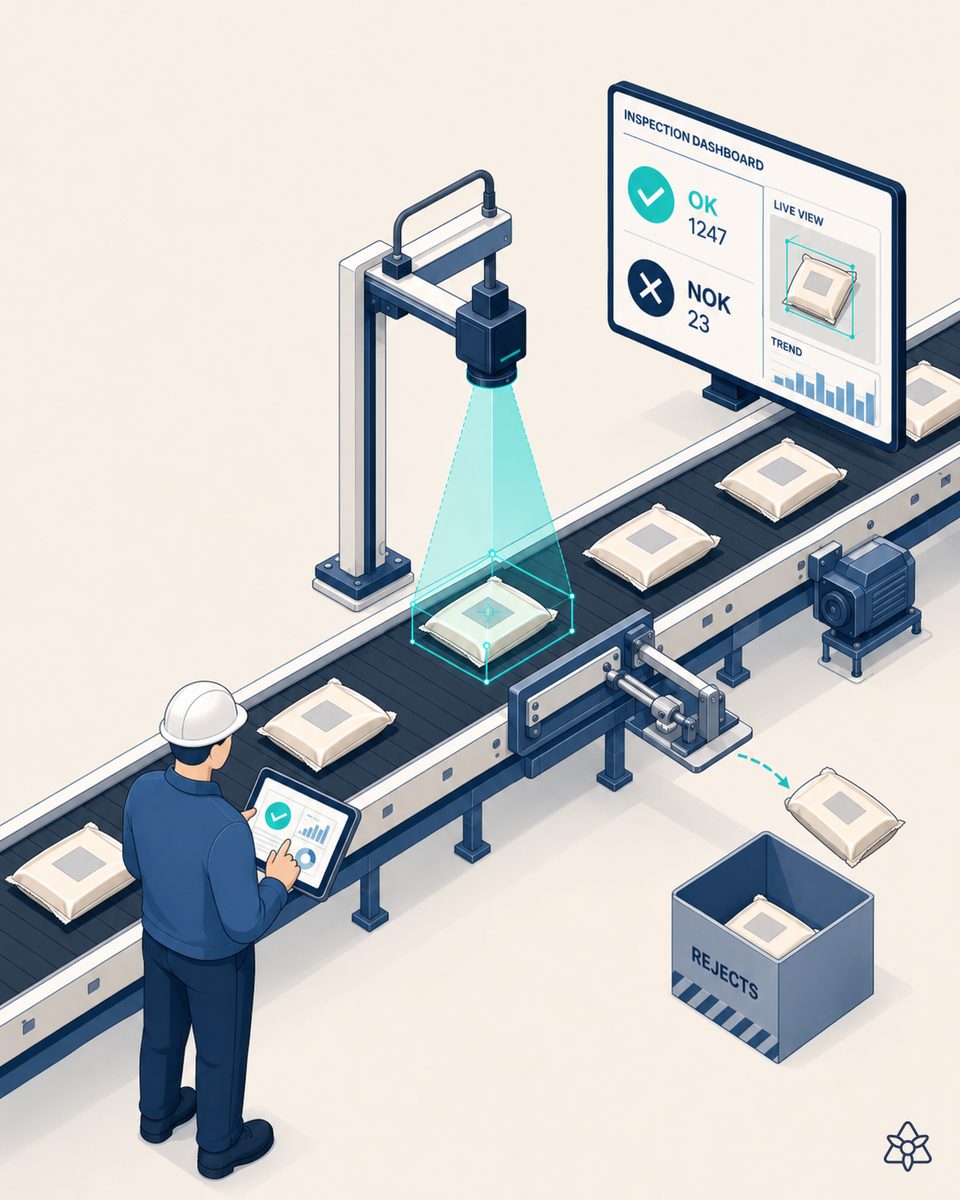
The inspector cannot see 6,000 pieces/hour — and the retailer does see the one that slips through.
The post-gutting line for seabass and seabream is playing against four types of defect that the human eye catches with effort and a neural network catches with consistency:
- Visceral remains — liver, gall bladder or gut the gutting machine did not finish cleaning. Small, hidden, and the root cause washes away with the water.
- Melanosis — dark patches from ante-mortem stress or an impact in transport. Cosmetic, yes, but the retailer sends them back.
- Bruising along the loin — masked by the natural shadow of the fish, easy to miss at line speed.
- Mechanical damage from the gutting machine itself — uneven cuts, poorly scraped scales, a belly opened too far.
The plant inspector performs heroics. And even so: the human eye at 6,000 pieces/hour catches 95%. That 5% is the retailer complaint — and in margin terms, that 5% decides whether you export next year or not.
iLEAN does not replace the inspector — it puts their eyes on every single piece.
The problem with post-gutting control is not a lack of inspection: it is human inspection outrun by line speed. iLEAN acts as the putty that fills that gap without asking you to change the gutting machine, the belt or the quality team.
Vision reads every piece after gutting. Connect captures the retailer's criteria wherever they are. The agent cross-references the SKU and the severity, and the actuator diverts. The person signs — the line does not grade on its own outside the configured criteria.
The iLEAN pieces applied to post-gutting inspection:
- iLEAN Vision (Edge) — an industrial camera over the post-gutting belt, with a CNN trained on the four typical defects (visceral, melanosis, bruising, mechanical damage). It processes every piece in milliseconds, classifies by severity and fires the actuator (air blast, ejector, stack light). It works with no network: if the plant loses WiFi, Edge keeps inspecting and diverting; what is critical cannot depend on connectivity.
- iLEAN Connect — captures the batch SKU from the ERP/MES and also captures what arrives from outside (the US retailer's specification as a PDF, the European importer's alert about melanosis tolerance, a new internal instruction from the quality manager over WhatsApp). Everything enters the system at second zero, without anyone forwarding anything.
- Agent — cross-references the Vision classification with the SKU, the destination retailer and the criteria currently in force. If a piece falls in the grey zone, it is diverted to the review belt; if rejections for one defect rise abnormally within an hour, the agent does not send an email at 22:00: it alerts the inspector to check the gutting machine upstream (usually an adjustment or a blade change). And it assembles the batch file automatically for the IFS/BRC auditor.
Human inspection at the belt vs. assisted Vision inspection
| Aspect | Inspector + belt at speed | With iLEAN Vision + Connect + Agent |
|---|---|---|
| Inspection coverage | Visual sampling, depends on fatigue | 100% of pieces, every shift, with no fatigue |
| Detecting mild melanosis | Poor discrimination at high speed | Color signature recognized on the line |
| Bruising in the shadow of the loin | Slips through on a fast belt | Lighting + CNN isolate it |
| Small visceral remains | Hard to see under the belt water | Detection by color and morphology |
| Reaction to a defect spike | Noticed when the inspector notices it | Alert on the first abnormal jump in the rate |
| IFS/BRC file per batch | Rebuilt by hand | Batch dossier with photos of the doubtful pieces |
Impact estimate for your plant — to be validated with your numbers.
The block below is an estimate to be validated with the specific data of your plant. We put it forward so the committee has an order of magnitude; we refine it during the diagnostic.
- Plant with an automatic seabass and seabream gutting machine, several thousand pieces per hour, exporting to a European retailer with recurring incidents for melanosis or visceral remains.
- Vision pilot on one line (camera + lighting + diverting actuator + integration with the MES and with the SKU recipe). First value expected within a few weeks.
- Indicative payback between 4 and 9 months, depending on the current retailer return rate and the average cost of a recall/rework per batch.
- Reduction in returns for cosmetic defects ≥ 30% as a defensible floor; the hard lever is the returned batch that is not returned and the retailer share you protect.
And the quality manager's reasonable doubt
“What if the AI scraps good pieces?” — the Agents have no hands on the critical work order: they classify and divert, the person signs off changes of criteria and overrides the doubtful ones. And hallucination is a problem of free generation, not of anchored tasks: in classifying visual defects against defined criteria, the best models brought error below 1.5% [1]. Every human override trains the system — the quality manager's judgment stays in the plant; it does not leave with the inspector.
[1] OpenAI paper “Why Language Models Hallucinate”, 2025 — on the reliability of AI in anchored tasks.
What people ask about post-gutting control of seabass and seabream
Which flesh defects are critical in seabass and seabream before packing?
Four are critical: visceral remains (liver, gall bladder, gut) left by incomplete gutting; melanosis (dark patches caused by ante-mortem stress or impact); bruising along the loin; and mechanical damage from the gutting machine itself (uneven cut, poorly scraped scales). Each one has a different visual signature and all of them reach the retailer if they are not caught on the line — because the inspection operator cannot look at 6,000 pieces/hour with the level of detail being asked of them.
Can vision read melanosis at the speed of the gutting line?
Yes. iLEAN Edge with a CNN processes the image in milliseconds per piece, which covers speeds of several thousand pieces/hour. Melanosis has a clear color signature for a trained network, and the system distinguishes between a mild cosmetic patch (which can go to a second-grade channel) and a severe lesion (scrap or rework). The severity level is configured per SKU and per retailer.
How is a rejected piece handled — rework or scrap?
iLEAN does not decide alone: it classifies the piece by severity and diverts it through an actuator (ejector, air blast to the rework belt or to the scrap belt). The plant operator sees the reason for the decision (photo + category) and can override it manually if they see fit; every override trains the system. The person signs — the line does not decide on its own about batches or about changes of criteria.
Does iLEAN Vision replace the plant inspector?
No. It frees them from the dumb work (staring at 6,000 identical pieces) so they can do the work that matters (analyzing the borderline ones, tuning the criteria with quality, training the team, handling the rare incident). Human inspection is what brings judgment; iLEAN Vision puts a constant eye on every piece. Assist and simplify, not replace. The inspector works with a safety net, not without one.
What happens if the retailer changes the defect criteria?
Connect captures the retailer's new specification whether it arrives by email, PDF or WhatsApp, and the agent updates the SKU threshold. iLEAN Vision applies the new criteria on the very next piece, with no manual reparameterization. By default, every change of criteria stays pending human validation before it goes into production — the system does not change the operator's rule on its own.
More cases in food
- The Norwegian salmon IQF tunnel — right core, a fillet that sells; wrong core, expensive scrap.How iLEAN controls core temperature and IQF tunnel speed inline at a Norwegian salmon (SBP) processing…
- Denia and Palamós red shrimp — from the boat to the restaurant, without losing whose it is.iLEAN Tracer traces Denia and Palamós red shrimp with RFID per box and a QR per single piece, from boat…
- The filleting operator has both hands busy — traceability cannot wait until the end of the shift.iLEAN Connect assists the anchovy filleting and packing operator in Santoña by voice: batch parameters,…
- High FCR in seabass and seabream — every kilo of feed that sinks to the bottom is margin thrown away.How iLEAN Vision reads the behavior of seabass and seabream schools in open-sea cages and adjusts feed…
- Grading Skrei into A and B cannot depend on how tired the last shift of the season is.iLEAN Vision grades Skrei cod fillets A/B (color, firmness, integrity) on the line for premium European…
- The MSC dossier for a Skrei batch takes hours to build by hand — and days to rebuild when the auditor calls.How iLEAN Writer builds the MSC dossier for every Skrei batch (catch date, FAO area, Norwegian seal)…
Tell us your case and in 48h we'll send you the estimated ROI of this AI project for your gutting plant.
We work on your line's real data, not ours. Diagnostic with no commitment.
Request estimated ROI in 48h See premium fishing and aquaculture