The most dangerous moment of the day closes today with a signature
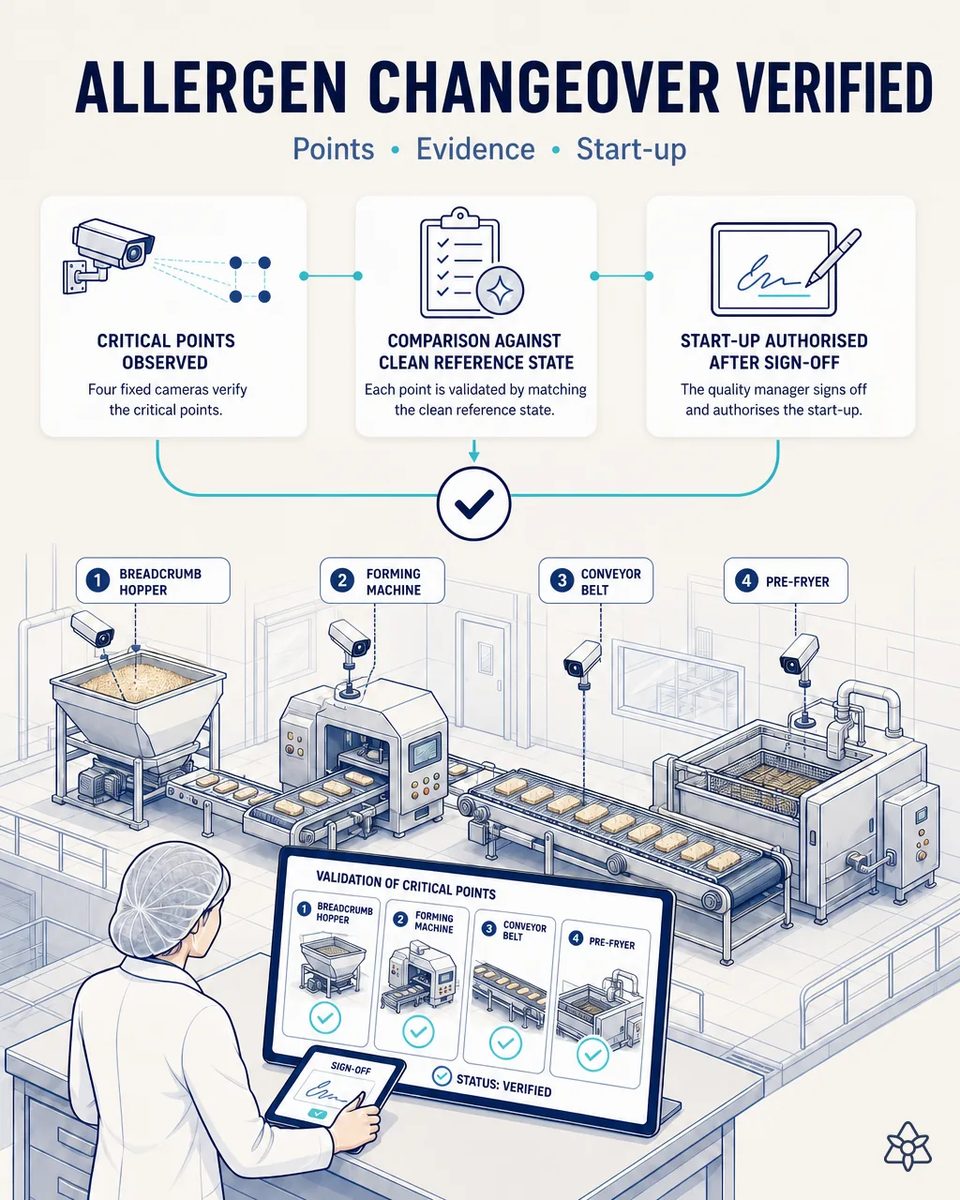
A run of prawn croquettes — crustacean — finishes and a spinach and cheese run comes in. The cleaning between the two is the only thing separating a correct product from an allergen incident, and today it closes with the signature of a person who has looked at the line with their own eyes. With Edge, fixed cameras compare each critical point against the clean reference state and the line does not start until every point clears and quality signs on that evidence.
The most dangerous moment of the day closes with a signature and no evidence.
With dozens of references sharing the same kettles, forming machines and breading lines, and a matrix including milk, gluten, egg, fish, crustaceans and molluscs, critical changeovers happen several times a day, every day. The signature that closes them is honest and expert. The problem is not the signature: it is that it leaves no objective evidence behind. If there is a complaint tomorrow, what exists is a signed box. And on a clean label product, without preservatives, there is no chemical safety net covering anything. Process hygiene and allergen control carry the whole weight, which makes the tolerance margin tighter than a conventional competitor's.
- A run of prawn croquettes — crustacean — finishes and a spinach and cheese run comes in. The cleaning between the two is the only thing separating a correct product from an allergen incident.
- With dozens of references sharing the same kettles, forming machines and breading lines, and a matrix that includes milk, gluten, egg, fish, crustaceans and molluscs, that transition happens several times a day, every day.
- The signature that closes it is honest and expert. The problem is not the signature: it is that it leaves no objective evidence behind. If there is a complaint tomorrow, what exists is a signed box.
- And on a clean label product, without preservatives, there is no chemical safety net: process hygiene and allergen control carry the whole weight, which makes the margin tighter than a conventional competitor's.
Edge with JIDOKA AI — the line does not start without conformity at every point and a signature.
Edge + JIDOKA AI.
The cameras do not decide alone: each one compares its critical point against the clean reference state for the recipe about to run, and it is the quality manager who signs on those images. What changes is not who decides, but what they decide on — evidence instead of memory.
- Fixed cameras on the critical points the plant defines: breadcrumb hopper, forming machine, belt, pre-fryer.
- Each camera compares the current state against the "clean and ready to run this recipe" reference state, with its own model and criterion: breadcrumb residue, dough stuck on the former, carry-over in the oil.
- JIDOKA AI prevents start-up until every point clears.
- The quality manager sees the images with their verdict and signs on evidence rather than on memory: the system does not replace the signature, it supports it.
- All images are archived and feed the evidence pack of case 11.
Today's changeover versus the verified changeover
| Aspect | Today | With iLEAN Edge |
|---|---|---|
| What closes the changeover | A signature on a form | Four critical points checked against reference, then a signature |
| Breadcrumb residue in the hopper | Depends on who looked | Compared against the clean state |
| Dough stuck on the former | Found on the next run, or not | Blocks start-up |
| Carry-over in the pre-fryer oil | Invisible | Its own model and criterion |
| Evidence after a complaint | A signed box | Images per point, archived automatically |
| Start-up under shift pressure | Depends on the workload | Blocked until every point clears |
Impact estimate — to be validated against your non-conformity history.
The block below is an estimate to be validated against your plant's actual data. We put it forward so the committee has an order of magnitude; we refine it during the assessment.
- Payback measured against a single allergen incident: recall, distributor penalty and reputational damage to a premium product. We give no month range here on purpose; the number depends on how many critical changeovers you run per week.
- Cross-contamination risk stops depending on the shift's workload: the start-up block is automatic, not a matter of who was in a hurry.
- Every changeover leaves images per critical point, archived and tied to the batch, which is the evidence the audit case then organizes.
- And SMED AI, in the flagship, makes sure that rigor does not penalize productivity: the sequence gets faster while the verification stays.
the return is measured against the cost of a single allergen incident — recall, distributor penalty and reputational damage to a premium product. The payback depends on the number of critical changeovers per week. *Estimate to be validated against the non-conformity history*.
And the fair question from the production manager
“What if the cameras block the line for no reason?” — that is the right objection, because the changeover sits on the shift's critical path. Each point is compared against the reference state for that specific recipe, and comparing a fixed scene against a trained reference is an anchored task, where the best models drop below 1.5% error [1]. In case of doubt the system does not block silently: it escalates the image to the quality manager, who signs or sends the point back for cleaning. It stops on a visible discrepancy, not on model uncertainty.
[1] OpenAI paper "Why Language Models Hallucinate", 2025 — on the reliability of AI in anchored tasks.
What people ask about verifying the allergen changeover
Which critical points are checked?
The ones your plant defines. The typical set on a breading line is the breadcrumb hopper, the forming machine, the belt and the pre-fryer, each with its own model and criterion: residue, stuck dough, carry-over in the oil.
Does it replace the validated cleaning procedure?
No. The cleaning stays as validated. What changes is that the result is checked against a clean reference state and the evidence is kept, instead of closing with a signature alone.
Does it make the changeover longer?
The check takes seconds per point. What lengthens a changeover today is the margin added for lack of evidence, and in the flagship SMED AI works on the sequence itself, so the rigor of the verification is paid for by a faster changeover rather than a slower one.
Can quality override a block?
An exception can be signed by the quality manager and it is recorded as such, with the image that was overridden. What cannot happen is a start-up with no trace of who decided.
What does the auditor see afterwards?
For every changeover, the before and after image of each critical point, the verdict and the signature with its timestamp. That is exactly what a signed box cannot show.
More cases from this series
- Non-conformities come from the gaps, not from the processEvery changeover and batch builds its dossier with photos, records and signatures, organized by…
- Four rings that verify each other, from recipe to palletFour verification rings cross-checking each other, from recipe to pallet, so the discrepancy is caught…
- The last machine to touch the product should not depend on typingLot, expiry and allergens travel from the work order to the coder by API, including in export market…
- The plant's most expensive asset is also its most silentAn external camera digitizes the freezing curve of a blast tunnel without touching the machine or…
- Traceability is born on the dock, and it is born in a hurryPhotograph the delivery note, the lot labels and the thermometer: goods receipt enters the ERP after one…
- The person who knows the plant best is the one who can log the leastThe supervisor dictates while walking with both hands busy: iLEAN listens, ties it to the active batch…
Tell us how many allergen changeovers you run per day and what evidence remains of each.
We work on your plant's real data, not ours. Assessment with no commitment.
Request estimated ROI within 48h ‹ See all cases of precooked frozen foods See food industry