The start of production stops living on three sheets of paper
In a precooked frozen food factory the day begins with three pieces of paper: the work order, the recipe sheet and the start-up log where the supervisor writes the real raw material lots by hand. Those papers define the entire batch and can sit undigitized for four to eight hours. With Connect, two or three photos at start-up are enough for the batch to exist in central memory at second zero.
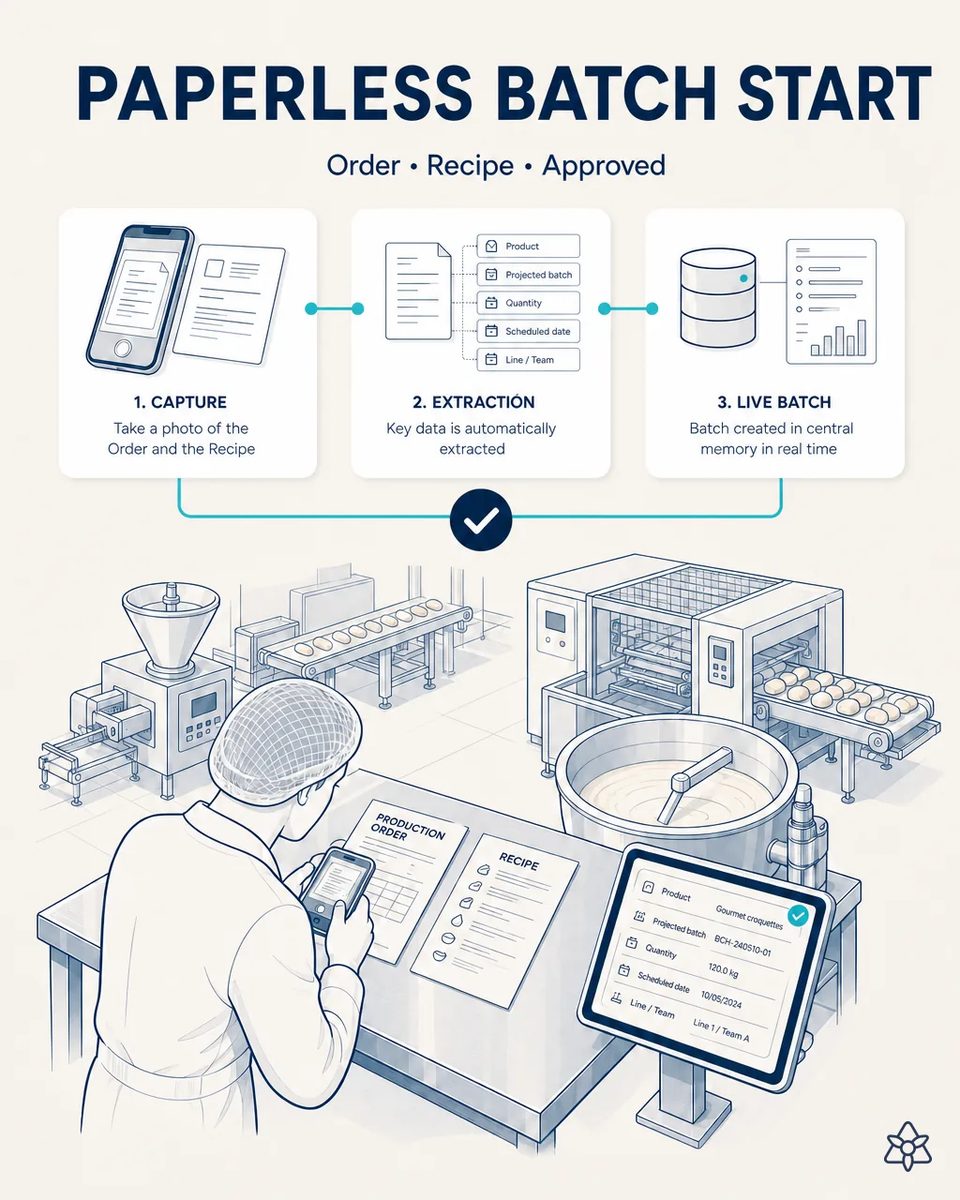
The batch is defined by three sheets of paper that nobody digitizes until the evening.
The work order is printed from the ERP in the morning, but what actually happens on the floor gets written on top of it by hand: a supplier swapped at the last minute, the milk or butter lot that was really opened, the note that the béchamel came out thicker than usual. That handwriting is the only faithful record of what happened, and also the most fragile one. It sits in a folder until somebody collects it at the end of the day. When an audit or a distributor complaint arrives, the shift has to be reconstructed one sheet at a time. The cost is not only the production manager's transcription time. It is that for hours the central system and the plant floor tell two different stories, and the true one is written in ballpoint pen.
- The work order prints from the ERP at seven in the morning. By eight it already carries handwriting: the butter lot that was really opened, the fish supplier swapped at the last minute, the note that this béchamel came out thicker than the recipe says.
- The recipe sheet and the start-up log are where the supervisor records what the kitchen actually did: which allergens went into the kettle, which forming machine was used, at what time the first tray reached the tunnel.
- Those three papers sit in a folder for four to eight hours, and over a weekend for two days. During that gap the batch exists physically and exists in no system anyone can query.
- When a retail complaint or an auditor asks what went into a batch, the shift is reconstructed one sheet at a time, and the only faithful version is in ballpoint pen.
Connect in photo mode — the kitchen keeps its papers and adds a photo.
Connect in "photo of the analog" mode.
It is the case with the least friction in the whole matrix, because it asks the kitchen to change nothing: the supervisor photographs what they already filled in. That is why it is usually the first one approved, and why it becomes the base that the allergen and labeling rings later rest on.
- The supervisor photographs the work order, the recipe sheet and the start-up log with a phone, exactly as they already do with everything else.
- A grounded language model extracts structured fields: reference, batch, line, recipe, raw material lots consumed, declared allergens and observations.
- The result passes through the early human validation screen (case 5) and only then enters the master.
- The batch sits in central memory with the photo of the original paper attached as evidence. No change of habit and no training.
Today's batch start versus the captured batch start
| Aspect | Today, on paper | With iLEAN Connect |
|---|---|---|
| When the batch exists in the system | 4-8 h later, more over a weekend | Second zero |
| Raw material lots actually opened | Handwritten on the order | Extracted and tied to the batch |
| Allergens declared for the recipe | On the recipe sheet, in a folder | A structured field per batch |
| Answering a distributor complaint | Reconstruct the shift sheet by sheet | One query by batch |
| Evidence behind the record | The paper, if it is found | The photo of the original paper |
| The supervisor's habit | — | Unchanged: two or three photos |
Impact estimate — to be validated with your numbers.
The block below is an estimate to be validated against your plant's actual data. We put it forward so the committee has an order of magnitude; we refine it during the assessment.
- Estimated payback 4-9 months, depending on batches and references per day.
- The production manager's transcription time recovered, which today goes into copying the day's orders into the ERP after the kitchen has closed.
- From four to eight hours of documentary lag down to second zero, batch after batch, including weekends.
- And the real milk, butter, egg and fish lots stop being a handwritten note and become the field that every later traceability query starts from.
estimated payback of 4 to 9 months depending on batches and references per day, plus the production manager's recovered transcription time. *Estimate to be validated*.
And the fair question from the production manager
“What if it misreads the lot number the supervisor wrote by hand?” — reading fields from a document with a known structure, even with handwriting on top, is an anchored task, where the best models drop below 1.5% error [1]. And there is a second net: the extraction goes to the line-side tablet and the supervisor confirms or corrects it before anything crosses into the master. A low-confidence lot is flagged, never assumed.
[1] OpenAI paper "Why Language Models Hallucinate", 2025 — on the reliability of AI in anchored tasks.
What people ask about digitizing the kitchen batch start
Do we have to change our work order or recipe sheet?
No. The model reads the documents exactly as they are printed from your ERP and as the kitchen annotates them. Asking the kitchen to fill in a new form is the fastest way to have it ignored.
Does it pick up the handwritten notes on top of the printed order?
Those are the most valuable part, because that is where what actually happened is written: the swapped supplier, the real lot, the béchamel that came out thicker. They are extracted like any other field and flagged when confidence is low.
What happens to the original paper?
It keeps being filed as it is today. What changes is that the photo of that paper is attached to the batch in central memory, so evidence exists even if the folder is lost.
Do we need to integrate the ERP from day one?
No. The batch lives in iLEAN's central memory from the first photo and the push to the ERP is connected later, once the kitchen has seen it work for a few weeks. Starting without the integration is also what keeps the first deployment to days rather than months.
Does it cover the start-up log as well as the order?
Yes, and that is the document that gives the real timeline: when the kettle started, when the first tray entered the tunnel, who was on the forming machine. Without it the batch has ingredients but no clock, and the tunnel curve of case 2 has nothing to be tied to.
More cases from this series
- Non-conformities come from the gaps, not from the processEvery changeover and batch builds its dossier with photos, records and signatures, organized by…
- Four rings that verify each other, from recipe to palletFour verification rings cross-checking each other, from recipe to pallet, so the discrepancy is caught…
- The last machine to touch the product should not depend on typingLot, expiry and allergens travel from the work order to the coder by API, including in export market…
- The plant's most expensive asset is also its most silentAn external camera digitizes the freezing curve of a blast tunnel without touching the machine or…
- Traceability is born on the dock, and it is born in a hurryPhotograph the delivery note, the lot labels and the thermometer: goods receipt enters the ERP after one…
- The person who knows the plant best is the one who can log the leastThe supervisor dictates while walking with both hands busy: iLEAN listens, ties it to the active batch…
Tell us how many hours pass today between the work order being written and reaching your system.
We work on your plant's real data, not ours. Assessment with no commitment.
Request estimated ROI within 48h ‹ See all cases of precooked frozen foods See food industry