The AI captures; the person signs
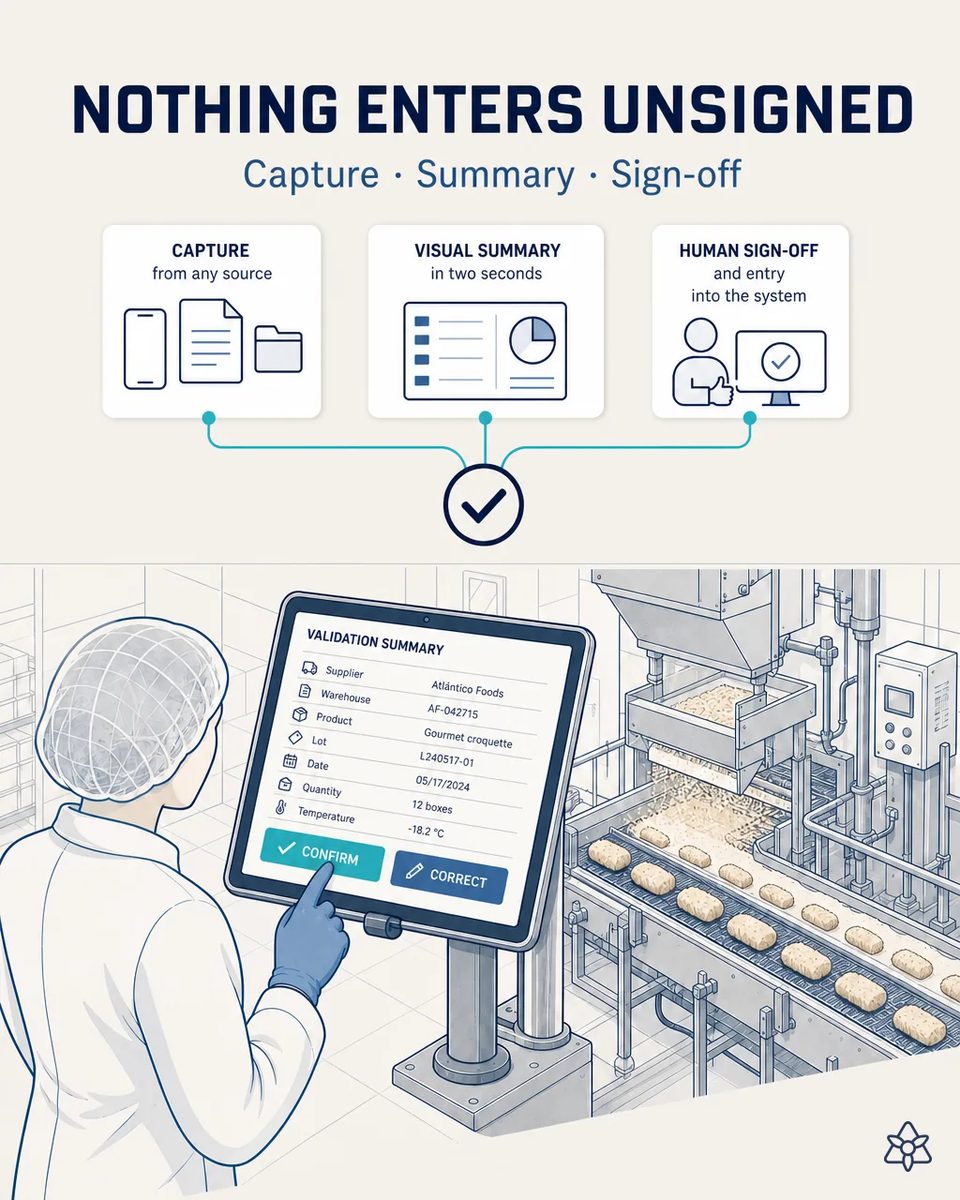
What separates iLEAN from an autonomous AI agent is a simple rule: nothing the system captures crosses into the central master without a human having seen it first. In a precooked food factory that takes the shape of an industrial tablet at the line, where every capture appears as a two-second visual summary and is confirmed or corrected in two taps.
If the machine enters the data, who is accountable for what is in the system?
In a food plant the real barrier to digitization is not technical. It is the legitimate question asked by whoever signs off every batch release: if the machine enters data by itself, who is accountable for what is in the system? And at the same time there is a second, equally firm truth: the operator does not want — and should not have — to spend their time typing. Any solution that fixes one of these by breaking the other fails on the floor. The usual result is a stalemate: either data is captured unvalidated and the master gets contaminated, or nothing is captured out of mistrust and everything stays on paper.
- In a food plant the real barrier to digitization is not technical. It is the legitimate question asked by whoever signs off every batch release: if the AI writes into the master, who answers for it on the day of the audit?
- And there is a second, equally firm truth: the operator does not want — and should not have — to spend their time typing. Any solution that fixes one of these by breaking the other fails on the floor.
- The usual result is a stalemate: either data is captured unvalidated and the master gets contaminated, or nothing is captured out of mistrust and everything stays on paper.
- Meanwhile the release signature proves that somebody signed, not what they saw when they signed.
Connect with early human validation — two taps at the line.
Connect in "early human validation" mode.
It is the piece that guarantees the master is not contaminated and that every datum has a responsible person by name. Without it, the other eleven cases do not get signed off in a food plant: nobody authorizes AI writing into the system a batch release depends on. And it is the same tablet for every source — the work order photo, the supervisor's dictation, the parsed supplier email, the tunnel panel reading — so the person at the line learns one screen, not five.
- An industrial tablet at the line or at the quality manager's station.
- Every capture — work order photo, voice dictation, parsed email, tunnel panel reading — appears as a visual summary designed to be read at a glance: extracted field, value, and the original photo or audio one tap away if there is doubt.
- Two taps: confirm, or correct before it enters.
- Only after sign-off does the data cross into the master.
- Corrections are stored as corrections and feed pattern learning.
Today's release versus the signed release
| Aspect | Today | With iLEAN |
|---|---|---|
| When the data enters | Hours later, typed | In seconds, confirmed at the line |
| Who appears as the author | Whoever typed it | Whoever looked at the batch |
| What the signature proves | That somebody signed | Which fields and which evidence they saw |
| Operator's time | Walk to a terminal | Two taps on the tablet |
| A capture that looks wrong | Enters anyway or is lost | Corrected before it enters |
| Who writes to the master | A person, typing | A person, confirming |
Impact estimate — to be validated with your numbers.
The block below is an estimate to be validated against your plant's actual data. We put it forward so the committee has an order of magnitude; we refine it during the assessment.
- No standalone payback: this is the enabling piece the rest of the matrix rests on, and it is strategic value rather than a case with its own return.
- What it guarantees is a clean master: no allergen declaration, lot or temperature enters without a named person having confirmed it.
- What it removes is the stalemate: the plant stops choosing between unvalidated data and no data at all.
- And every correction is stored as a correction, so the extraction improves exactly where your documents and your kitchen make it fail.
an enabling piece for the rest of the matrix rather than a case with its own payback: without early human validation, the other eleven cases do not get signed off in a food plant. *Strategic value, estimate to be validated*.
And the fair question from the production manager
“If a person signs in the end, what is the AI saving?” — the work is not in deciding, it is in assembling. Today somebody would have to go to a terminal, find the batch and type the fields. With the validation gate the summary arrives assembled — extracted field, value, original photo or audio one tap away — and the person only confirms or corrects. Extraction from a known document is an anchored task, where the best models drop below 1.5% error [1]; the two taps are there for the remaining fraction.
[1] OpenAI paper "Why Language Models Hallucinate", 2025 — on the reliability of AI in anchored tasks.
What people ask about line-side validation
How long does it take the person at the line?
Seconds. The summary is designed to be read at a glance: field, value, and the original photo or audio one tap away if there is doubt. Confirm or correct, and back to the line. A capture that raises no doubt takes less time than signing a paper form.
Can the AI write into the master on its own?
No, and it is not a setting: it is the architecture. Data crosses into the master only after human confirmation on the tablet.
Where does the tablet go?
At the line or at the quality manager's station, depending on who signs what. An industrial tablet in a washable housing, because it lives in the kitchen, not in an office.
What does it record?
Which summary was shown, who confirmed it, when, and what they corrected if anything. That is what an auditor asks for when they want to know who is accountable for a batch, and it is stored alongside the original evidence rather than in a separate log.
Is it mandatory before deploying the other cases?
In practice yes. It is what makes everything else approvable by quality, because it guarantees that nothing the AI captures reaches the master unvalidated.
More cases from this series
- Non-conformities come from the gaps, not from the processEvery changeover and batch builds its dossier with photos, records and signatures, organized by…
- Four rings that verify each other, from recipe to palletFour verification rings cross-checking each other, from recipe to pallet, so the discrepancy is caught…
- The last machine to touch the product should not depend on typingLot, expiry and allergens travel from the work order to the coder by API, including in export market…
- The plant's most expensive asset is also its most silentAn external camera digitizes the freezing curve of a blast tunnel without touching the machine or…
- Traceability is born on the dock, and it is born in a hurryPhotograph the delivery note, the lot labels and the thermometer: goods receipt enters the ERP after one…
- The person who knows the plant best is the one who can log the leastThe supervisor dictates while walking with both hands busy: iLEAN listens, ties it to the active batch…
Tell us who is accountable today for what enters your master data.
We work on your plant's real data, not ours. Assessment with no commitment.
Request estimated ROI within 48h ‹ See all cases of precooked frozen foods See food industry