What the ERP already had, finally fed
The ERP already has almost the entire data model needed for full traceability; what's missing is someone to feed it without manual typing. The iLEAN system coordinates 5 modules that cross-check each other.
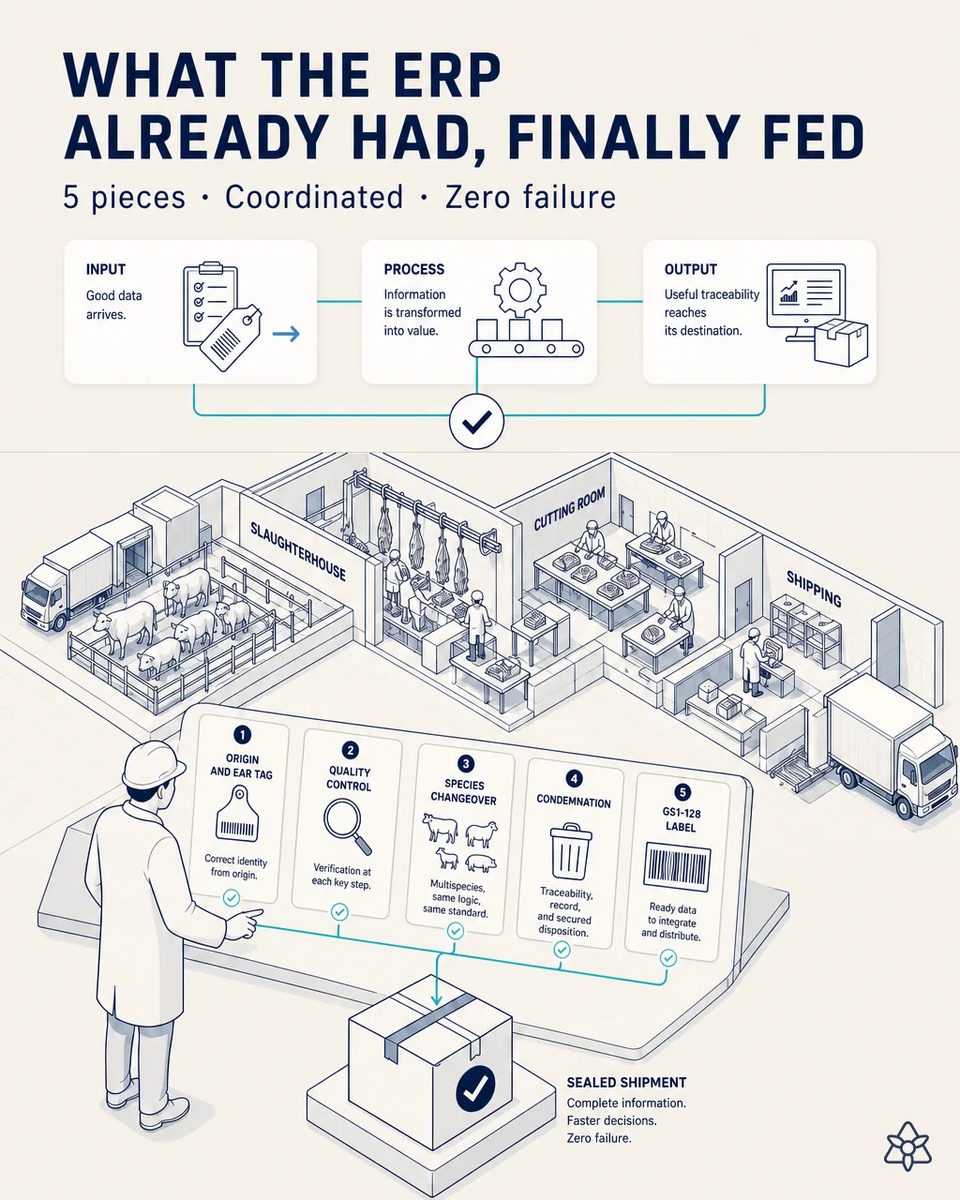
The model is already built. What is missing is anybody feeding it.
Traceability modules built but empty, with the risk of mixing different product flows in the same plant.
- Almost the entire data model for end-to-end traceability already exists in your ERP: origin, animal, carcass, batch, order, logistics unit.
- What is missing is not software, it is the feeding, and every year a plant spends deciding which new system to buy is a year the model it owns stays empty.
- On top of that sits the specific risk of running several commercial flows through one plant: own production and toll orders that must never mix, on the same species, on the same day.
- A traceability incident in this business is not a data problem. It is product on the market you cannot bound, with a single impact that runs above €100,000 once you count the recall, the customer and the lost status.
Five coordinated modules — origin, quality, changeover, condemnation, label.
Origin (certificate + ear tag) → Quality (real control) → Critical changeover (Edge + JIDOKA AI) → Condemnation (automatic dossier) → Shipping (GS1-128 label, no typing). SMED AI speeds up species/batch changeovers.
Origin and ear tag open the chain, quality control fills what the plant really checks, the changeover validation protects the boundary between species and clients, the condemnation dossier accounts for what leaves the chain, and the GS1-128 label closes it at the dock. SMED AI works on the changeovers themselves, so protecting the boundary does not cost throughput.
The five modules, and what each one closes
| Module | Which cases it draws on | What it closes |
|---|---|---|
| 1 · Origin | Origin certificate and ear tag (7) | Which animal, from which holding, entered |
| 2 · Quality | Quality module fed (6) + grading log (1) | What was checked, and on which carcass |
| 3 · Changeover | Species changeover validated (10) | The boundary between species and between clients |
| 4 · Condemnation | Condemnation dossier (11) | What left the chain, and where it went |
| 5 · Shipping | GS1-128 label (8) + grading support (9) | Which box carries which batch, to whom |
| Cross-check | All five, against each other | The gap no single module can see |
underused modules → real end-to-end traceability with the same ERP.
Impact estimate — to be validated with your numbers.
The block below is an estimate to be validated against your plant's actual data. We put it forward so the committee has an order of magnitude; we refine it during the assessment.
- Estimated payback 6-12 months, counting only the modules already paid for that start being used.
- Protection against a traceability incident whose single impact runs above €100,000, before counting what it does to your standing with the customer.
- From underused modules to end-to-end traceability on the same ERP, with no new platform to buy and maintain.
- And the scope of any withdrawal moves from a whole week of production to the exact batch, which is the difference between an incident and a crisis.
Protection against a traceability incident (single impact > €100,000) and monetization of the investment already made in the ERP. Estimated payback of 6-12 months. *Estimate to be validated*.
And the fair question from the production manager
“Do we have to deploy all twelve cases before any of this works?” — no, and framing it that way is the surest way never to start. The modules are built in layers and each case pays on its own from the first month. With the grading log and the origin capture you already hold module 1 and half of module 2, which is where most of the missing traceability actually sits. Each layer rests on the same verification gate, an anchored extraction where the best models drop below 1.5% error [1] with a person confirming before anything posts.
[1] OpenAI paper "Why Language Models Hallucinate", 2025 — on the reliability of AI in anchored tasks.
What people ask about the complete system
Where do you start?
With the layer that has fewest dependencies, which here is capture at reception and on the rail. What matters is that the first layer pays for itself while the next one is being prepared.
Does it replace our ERP?
No, and the whole case rests on not replacing it. The model you already licensed is the destination; what is added is the feeding and the cross-checking.
What does the cross-check give that each module does not?
The gap. A missing quality control, a carcass with no origin record, a box whose batch does not appear in the kill data: each module looks fine on its own and the mismatch only shows when they are compared.
How does it keep our production and toll orders apart?
The flow is carried from reception to the label and is confirmed by a person at the gate. It is never inferred at the end from what happens to be in stock.
Can the return be estimated before committing?
Yes: with your carcass volume, your receptions per week, the licenses in the receiving module and what your last traceability scare cost, the return of each layer can be estimated before the order is decided.
More cases from this series
- Paperless carcass grading logThe grader photographs the grading log and the carcass record already exists in the central system at…
- The chilling tunnel finally gets loggedAn external camera reads the chilling tunnel's temperature curve without touching the controller.
- Two taps before flows could mixNothing enters the ERP without a human seeing it first — prevents mixing own production and toll orders.
- The GS1-128 label fills itself inThe 20+ logistics label fields fill themselves in from the ERP's active batch.
- What's said between lines staysThe cutting-room lead dictates while walking between species and the AI structures, stores and replies…
- Origin docs and ear tag enter on their ownPhoto the health certificate and the ear tag: the animal traceability table fills itself in, ear tag…
Tell us which parts of your traceability model are built and still empty.
We work on your plant's real data, not ours. Assessment with no commitment.
Request estimated ROI within 48h ‹ See all cases of multi-species abattoirs See food industry