Clean before the next species
Every species or toll-client changeover requires certifiable cleaning. With iLEAN Edge, fixed cameras compare state against the reference and JIDOKA AI blocks startup until OK.
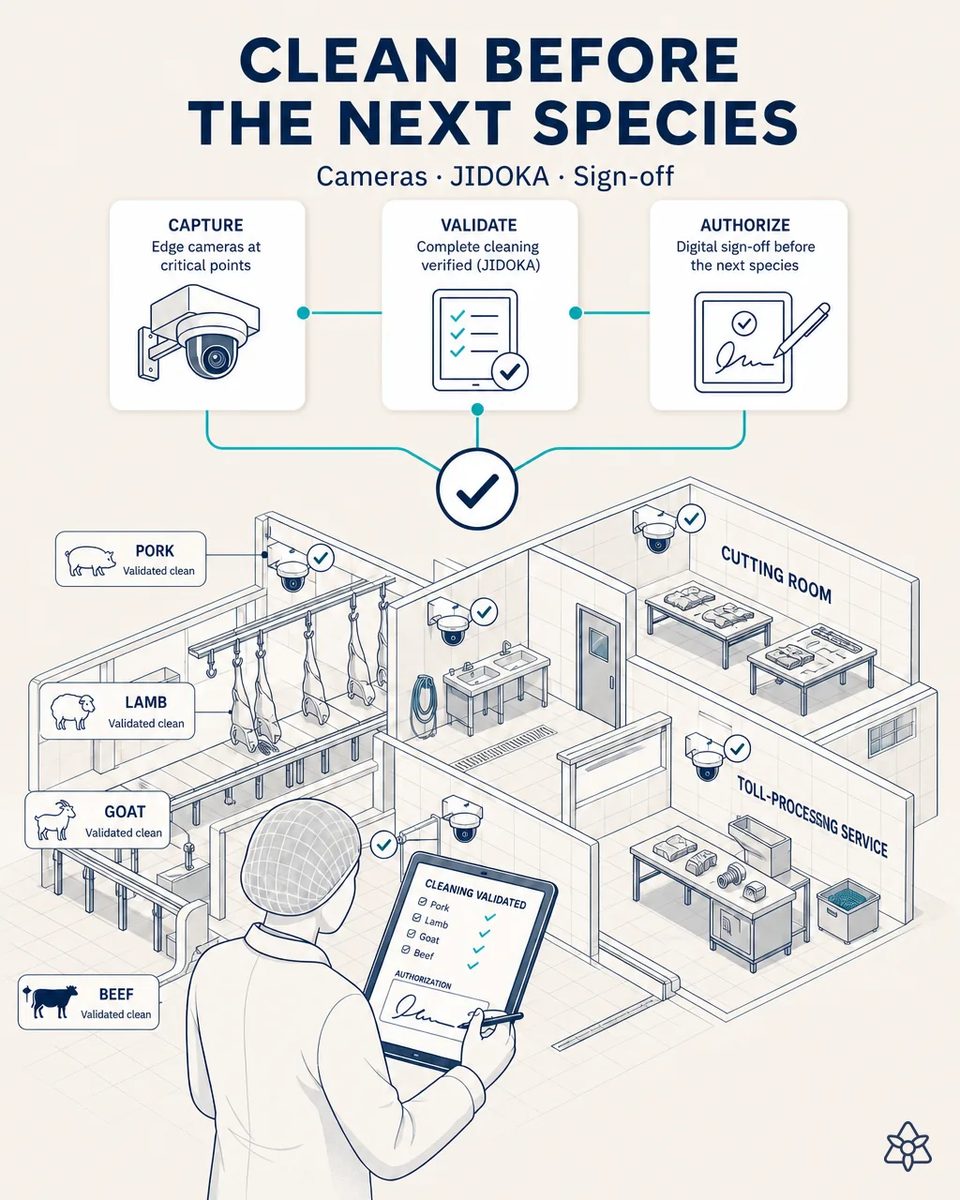
The sign-off that protects the next species is the one with least evidence behind it.
Today a supervisor signs off "clean" with no objective evidence.
- Every species change, and every switch between your own production and a toll client's animals, requires cleaning that has to be certifiable.
- Today a supervisor walks the line, looks, and ticks clean. That judgment is usually right and is almost never documented.
- When a complaint arrives weeks later, the tick proves that somebody signed, not what they saw, and the plant has no way to demonstrate the state of the line at that moment.
- Meanwhile the changeover sits on the shift's critical path, so the pressure to sign quickly is highest exactly where the evidence matters most. Everyone on the floor knows this, which is why the sign-off is the part of the procedure people are least comfortable defending.
Edge with JIDOKA AI — cameras compare against the reference state.
Edge + JIDOKA AI. Cameras with a CNN trained to recognize "clean vs. leftover from the prior species/batch".
Fixed cameras at the critical points compare what they see against the reference for a clean line, and flag anything that looks like residue from the previous species or the previous client's batch. Startup stays blocked until quality signs, and the signature now rests on images taken at that moment rather than on a memory of having walked past ten minutes earlier.
The changeover today versus the changeover with evidence
| Aspect | Today | With iLEAN Edge |
|---|---|---|
| Basis for the sign-off | A walk and a judgment | Images against the reference |
| Residue from the previous species | Found later, or never | Flagged before startup |
| What the tick proves | That somebody signed | What they were shown |
| Startup of the new species | On the supervisor's word | Blocked until signed on evidence |
| Between toll clients | Same tick | Same evidence, per client |
| Who signs | The supervisor | The supervisor, on the images |
blind sign-off → sign-off based on visual evidence.
Impact estimate — to be validated with your numbers.
The block below is an estimate to be validated against your plant's actual data. We put it forward so the committee has an order of magnitude; we refine it during the assessment.
- We do not attach a payback range to this one, and it is fairer to say so: its return depends on what a non-conformity or a toll-client complaint has actually cost you, which is a number your quality lead has and we do not.
- What it protects against is concrete: a non-conformity raised on a changeover, and a toll client claiming their animals ran on a line that was not clean.
- From a blind sign-off to a sign-off backed by images of each critical point, kept with the changeover record.
- And the changeover stops absorbing the extra margin that gets added today purely because nobody can prove the line was ready.
Protection against non-conformity or a toll-client complaint. *Estimate to be validated*.
And the fair question from the production manager
“What if the camera blocks a changeover for no good reason?” — that is the right objection, because the changeover is on the critical path. The comparison is made against the reference state for that specific point, and when there is doubt nothing is blocked silently: it escalates to the supervisor, who signs on the evidence in front of them. On the reading itself, a fixed point with controlled lighting is an anchored task where the best models drop below 1.5% error [1]. It stops on a verifiable discrepancy, never on model uncertainty.
[1] OpenAI paper "Why Language Models Hallucinate", 2025 — on the reliability of AI in anchored tasks.
What people ask about validating the species changeover
Which points get a camera?
The ones your cleaning procedure already calls critical: the rail, the cutting tables, the tubs, the conveyors and the corners where residue from the previous species actually hides. They are defined point by point with your quality lead at commissioning, not chosen from a generic list.
Does it replace the cleaning procedure?
No. The procedure stays; what changes is that its result is documented at the moment it is signed instead of being asserted afterwards.
Does it make the changeover longer?
The check takes seconds. What makes changeovers long today is the margin added for lack of certainty, and that is precisely what the evidence removes.
Can a changeover be released under pressure?
An exception can be defined with a named signature and it is recorded as an exception. What cannot happen is starting a new species with no trace of who decided to go.
Does it distinguish between species or just clean versus dirty?
It is trained on what leftover material from the previous species looks like at each specific point, which is a far more useful question than clean in the abstract and the one your quality lead is actually asking.
More cases from this series
- Paperless carcass grading logThe grader photographs the grading log and the carcass record already exists in the central system at…
- The chilling tunnel finally gets loggedAn external camera reads the chilling tunnel's temperature curve without touching the controller.
- Two taps before flows could mixNothing enters the ERP without a human seeing it first — prevents mixing own production and toll orders.
- The GS1-128 label fills itself inThe 20+ logistics label fields fill themselves in from the ERP's active batch.
- What's said between lines staysThe cutting-room lead dictates while walking between species and the AI structures, stores and replies…
- Origin docs and ear tag enter on their ownPhoto the health certificate and the ear tag: the animal traceability table fills itself in, ear tag…
Tell us how many species changeovers your plant signs off in a day.
We work on your plant's real data, not ours. Assessment with no commitment.
Request estimated ROI within 48h ‹ See all cases of multi-species abattoirs See food industry