Every condemnation gets its dossier
Every condemnation is classified into a regulated category. Today it depends on manual logging and rebuilding the history by hand. With Edge + Agents, every condemnation automatically generates its dossier.
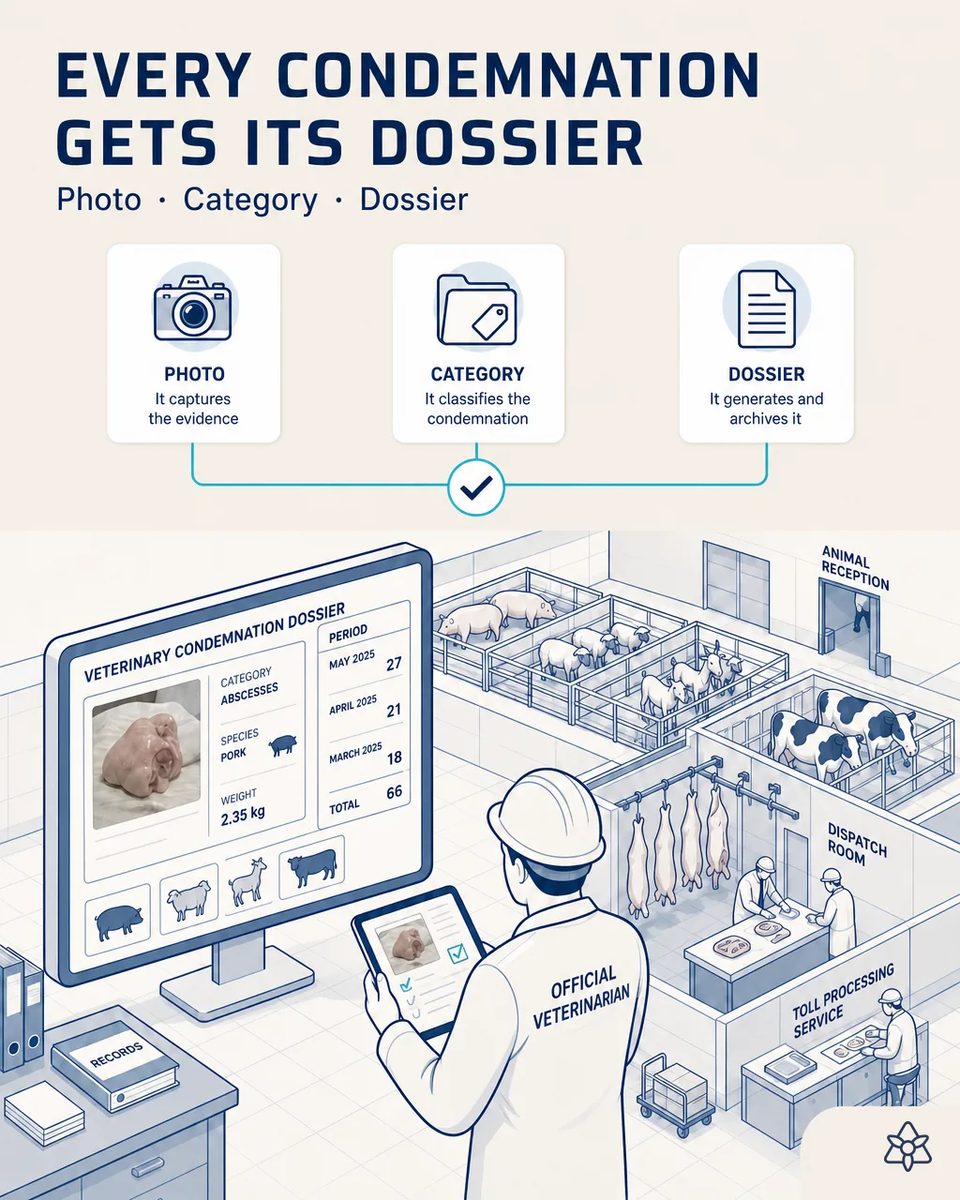
The history exists, scattered, and only gets assembled when somebody asks for it.
The official vet asks for a period's history and it has to be rebuilt piece by piece.
- Every condemnation is classified into a regulated category and has a destination that has to be documented, with its weight and its species.
- Today the record depends on somebody writing it down in the moment, in a book or a sheet, while the line keeps moving.
- When the official vet asks for a period's history, it is rebuilt piece by piece, and the reconstruction inherits every gap left by whatever nobody wrote.
- Worse, the pattern that would be most useful to the plant — which category rises, in which species, from which supplier — is never visible, because nobody assembles the history except under pressure. The record is kept as an obligation and never read as information, which is a waste of the only data that says something about the animals arriving at your ramp.
Edge captures in the moment, Agents organizes by period and category.
Edge captures photo and data at the moment; Agents organizes the dossier by period and category.
The photo and the data are taken where the decision is made, at the inspection point, not written up later from a note. Agents then keeps the dossier organized by period, species and category, so a request for a history stops being a project somebody has to clear a week for and becomes a query somebody runs while the vet is still in the room.
The condemnation record today versus the closed dossier
| Aspect | Today | With Edge and Agents |
|---|---|---|
| When the record is made | Afterwards, from memory | At the moment of the decision |
| What it contains | A line in a book | Photo, category, species, weight, destination |
| A history for a period | Rebuilt over days | Queried in minutes |
| A category rising over months | Nobody sees it | Visible as a trend |
| Destination of the material | Noted separately | Part of the same dossier |
| Who classifies | The official vet | The official vet, unchanged |
manual reconstruction → dossier available instantly.
Impact estimate — to be validated with your numbers.
The block below is an estimate to be validated against your plant's actual data. We put it forward so the committee has an order of magnitude; we refine it during the assessment.
- Estimated payback 6-12 months, depending on how often inspections and history requests actually land.
- From a manual reconstruction each time it is asked for, to a dossier that already exists when the question arrives.
- Days of somebody's week recovered every time a period history is requested, usually from the person you can least spare.
- And a category climbing in one species becomes visible while it is still a trend, which is when a conversation with the supplier is still worth having.
Estimated payback of 6-12 months depending on inspection frequency. *Estimate to be validated*.
And the fair question from the production manager
“Does an automatic dossier mean the vet's decision is being second-guessed?” — no, and the boundary is deliberate: the classification is the official vet's and the system records it, never proposes it. What the system does is make sure the photo, the weight, the species and the destination are attached to that decision. Recording those fields against a known structure is an anchored task where the best models drop below 1.5% error [1], and the record is confirmed before it closes.
[1] OpenAI paper "Why Language Models Hallucinate", 2025 — on the reliability of AI in anchored tasks.
What people ask about the condemnation dossier
Who decides the category?
The official vet, exactly as today. The dossier records the decision and attaches its evidence; it does not make the call, does not suggest one and is not built to. That boundary is what makes the record usable in front of the authority rather than a liability.
Does the photo have to be taken by hand?
No. The capture happens at the inspection point itself so the decision is never slowed down by the paperwork around it, and what the photo shows is the piece as it was at the moment the call was made, not as it looked in a tray half an hour later.
Can the history be filtered by supplier or holding?
Yes, and that is usually the filter with the most value, because it turns a regulatory record into an argument you can take to a livestock supplier.
What if a condemnation is recorded and later corrected?
The correction is kept alongside the original with its author and time. A history that quietly overwrites itself is worth very little in front of an inspector.
Does it cover partial condemnations as well as whole carcasses?
Yes, with the weight that was actually removed rather than the weight of the animal, which is what makes the monthly figures add up against the kill records instead of drifting apart a little every month.
More cases from this series
- Paperless carcass grading logThe grader photographs the grading log and the carcass record already exists in the central system at…
- The chilling tunnel finally gets loggedAn external camera reads the chilling tunnel's temperature curve without touching the controller.
- Two taps before flows could mixNothing enters the ERP without a human seeing it first — prevents mixing own production and toll orders.
- The GS1-128 label fills itself inThe 20+ logistics label fields fill themselves in from the ERP's active batch.
- What's said between lines staysThe cutting-room lead dictates while walking between species and the AI structures, stores and replies…
- Origin docs and ear tag enter on their ownPhoto the health certificate and the ear tag: the animal traceability table fills itself in, ear tag…
Tell us how long it takes you to rebuild a period of condemnations today.
We work on your plant's real data, not ours. Assessment with no commitment.
Request estimated ROI within 48h ‹ See all cases of multi-species abattoirs See food industry