A second objective reading
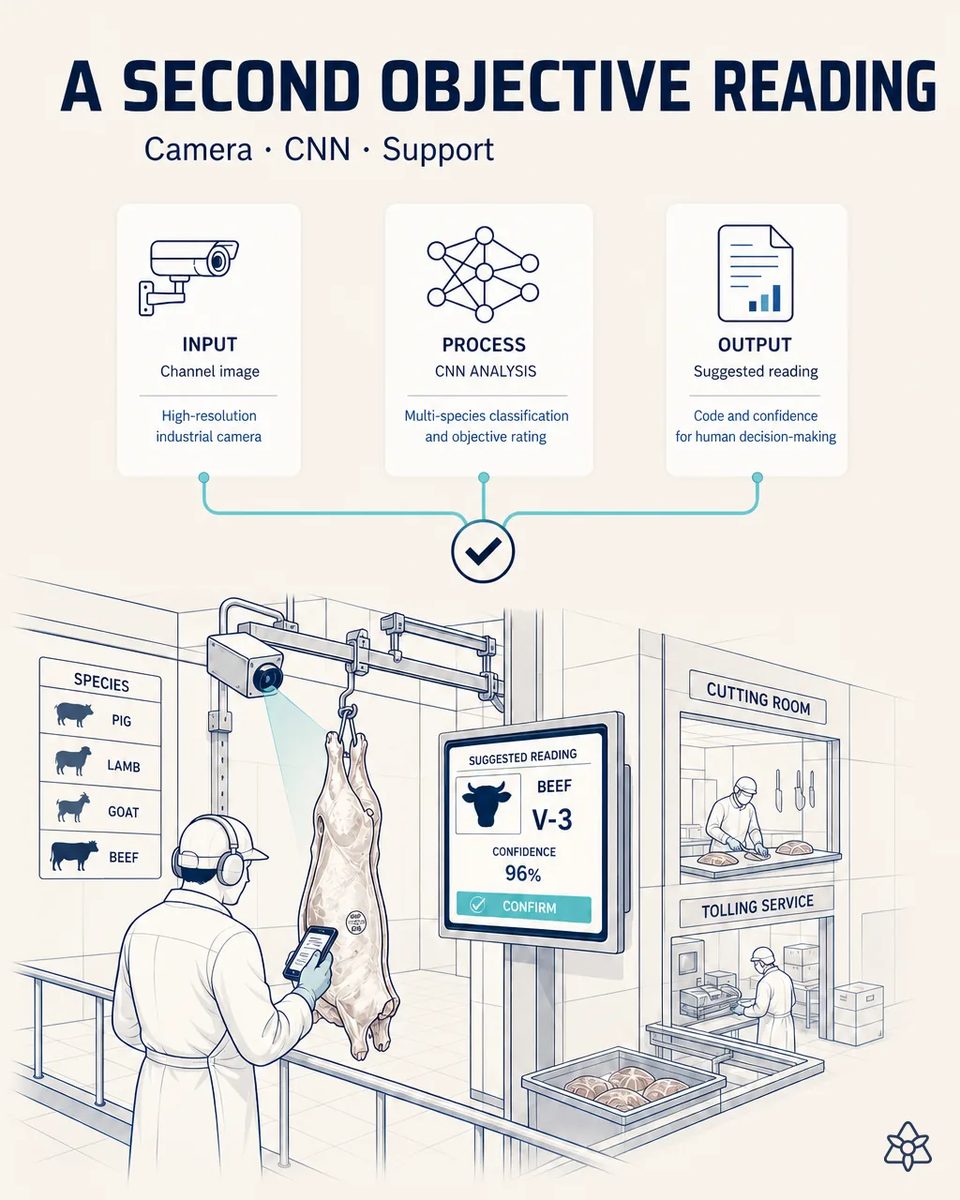
Carcass grading is subjective and affects price. Edge doesn't replace the grader — it gives a second objective on-screen reading, and does the same at shipping for piece and pack.
Grading is a judgment, and the judgment changes with the shift.
Two graders can score the same carcass differently; a mis-identified pack at shipping is a real risk with several product flows.
- Carcass grading is done by eye on a moving rail, under time pressure, and it directly sets what the carcass is worth.
- Two experienced graders can score the same carcass differently, and the same grader can drift across a long shift without anyone noticing.
- When a supplier or a toll client questions a grade, there is nothing to show beyond the grader's word, because no image of that carcass was kept.
- At the other end of the plant the same problem appears in another form: a pack loaded against the wrong delivery note, which with several product flows on one dock is a real risk rather than a theoretical one. Both cases share a root cause — a judgment made quickly, by eye, with nothing kept afterwards that would let anyone check it.
Edge on the rail — the grader decides, the camera gives a second opinion.
Camera + CNN trained on the real grading code. A second camera at shipping cross-checks piece/pack against the delivery note.
It does not replace the grader and it is not designed to. A camera trained on your own grading code proposes a reading with its confidence on screen, and the grader confirms or overrides in the same movement they already make. The override is stored too, with its author, which is how the model learns where your plant and it disagree and where the disagreement is systematic rather than occasional.
Grading today versus grading with a second reading
| Aspect | Today | With iLEAN Edge |
|---|---|---|
| The grade | One subjective judgment | A judgment plus an objective reading |
| Drift across a long shift | Invisible | Visible as divergence |
| Between two graders | Two criteria | One shared reference |
| A grade questioned later | The grader's word | Image, reading and who confirmed |
| Pack against delivery note | Checked by eye at the dock | Cross-checked before loading |
| Who has the final word | The grader | The grader, unchanged |
100% subjective grading → objective supporting reading.
Impact estimate — to be validated with your numbers.
The block below is an estimate to be validated against your plant's actual data. We put it forward so the committee has an order of magnitude; we refine it during the assessment.
- Estimated payback 5-12 months, depending on volume and on how much of your revenue moves with the grade.
- From fully subjective grading to a supporting reading that makes divergence measurable instead of anecdotal.
- A questioned grade gets answered with the carcass image and the reading taken at that moment, not with a recollection of a rail that moved on hours ago.
- And at dispatch, a pack that does not match its delivery note is caught before the truck leaves rather than at the customer's goods-in.
Estimated payback of 5-12 months. *Estimate to be validated*.
And the fair question from the production manager
“Is a camera going to grade better than a grader with twenty years on the rail?” — that is not the claim. The camera is consistent, the grader has judgment, and the two together are better than either alone. On a fixed rail with controlled lighting the reading is an anchored task where the best models drop below 1.5% error [1], and the system never posts a grade on its own: it proposes, the grader decides, and every override is kept.
[1] OpenAI paper "Why Language Models Hallucinate", 2025 — on the reliability of AI in anchored tasks.
What people ask about grading support
Is it trained on our grading code or a generic one?
On yours, with carcasses from your own rail, your lighting and your conformation mix. A model trained somewhere else would disagree with your graders for the wrong reasons, and a disagreement nobody can explain is worse than no second reading at all.
Does it handle four species on the same rail?
The species comes from the active kill batch and the reading is made against that species' criteria, which is the only way the numbers mean anything. A lamb is never read against the cattle scale because the system was told what is hanging.
What happens when the grader disagrees?
The grader's decision stands, always, and the disagreement is stored with it. Those cases are the most valuable material the model has, and a pattern in them usually says something about lighting or presentation rather than about the grader.
Does it slow the rail down?
No. The reading is ready by the time the grader looks at the screen, so it is one more thing in their field of view rather than one more step in the sequence. A case that costs rail speed does not survive its first week.
What does the dispatch camera actually check?
That the piece and the pack in front of it match the delivery note being loaded. It is the check that matters most when own production and toll orders share a dock, because that is the one place where two flows physically meet.
More cases from this series
- Paperless carcass grading logThe grader photographs the grading log and the carcass record already exists in the central system at…
- The chilling tunnel finally gets loggedAn external camera reads the chilling tunnel's temperature curve without touching the controller.
- Two taps before flows could mixNothing enters the ERP without a human seeing it first — prevents mixing own production and toll orders.
- The GS1-128 label fills itself inThe 20+ logistics label fields fill themselves in from the ERP's active batch.
- What's said between lines staysThe cutting-room lead dictates while walking between species and the AI structures, stores and replies…
- Origin docs and ear tag enter on their ownPhoto the health certificate and the ear tag: the animal traceability table fills itself in, ear tag…
Tell us how much of your invoicing moves with the carcass grade.
We work on your plant's real data, not ours. Assessment with no commitment.
Request estimated ROI within 48h ‹ See all cases of multi-species abattoirs See food industry