Four verification rings, from the vat sheet to the shipped pallet
A fresh cheese dairy's capital pain has a first and last name: a refrigerated, short-shelf-life product reaching the shelf with the wrong variety, expiry or traceability. In large retail that does not cost a batch: it costs the listing and the supplier approval. The flagship adds no new pieces — it coordinates the previous eleven into four rings where none lets through what the previous one has not confirmed.
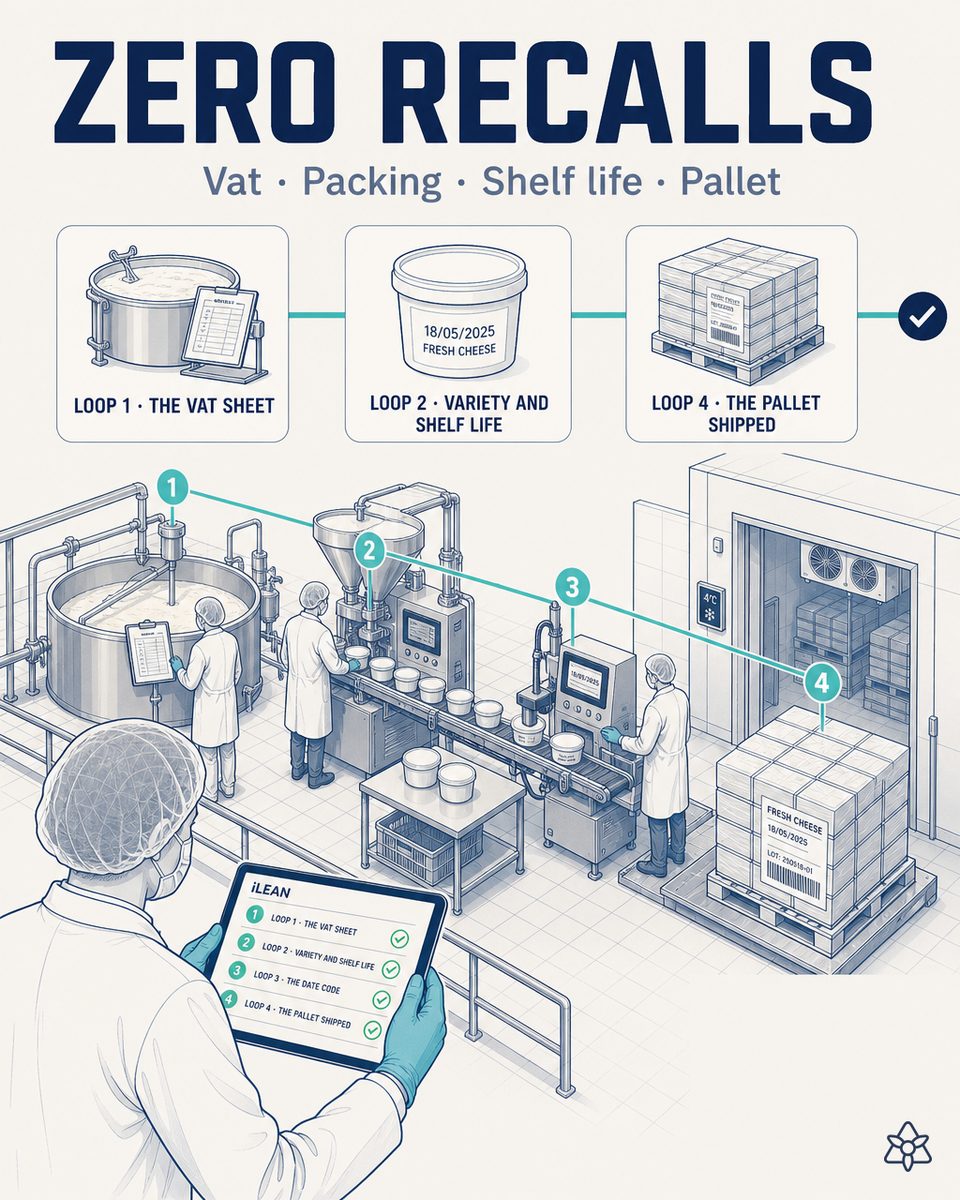
Today the defense against that risk is attentive people, in a hurry and with no comparable evidence.
Four manual checks at four different moments, each made by someone who is also doing something else. And it works almost always — the "almost" is the problem:
- A badly closed variety changeover or one extra typed date is enough — for a complete pallet to leave wrong. And it is discovered outside the plant, when nothing can be done.
- It is not an inventory problem — in a product with species and intolerance declarations it is a legal composition and food safety problem.
- And it is discovered in the worst possible place — the customer's platform, where the conversation is no longer about a batch but about the supplier approval.
That is why no isolated action solves the risk: the four checks exist, but they do not cross-check each other and leave no trace that later says what was really verified.
The four rings — none lets through what the previous one has not confirmed.
The flagship adds no new pieces: it coordinates the previous eleven. Each ring contributes part of the truth, and the value appears when they cross — because a discrepancy between two rings is an alert before it is a mislabeled pallet.
If something does not add up between the ERP, the mounted film, what the coder prints and what the camera sees, Agents detects it before the pallet leaves the dock and blocks the shipment, not the entire production.
The four rings, each with its pieces:
- Ring 1 · Origin (Connect) — the vat sheet, the pasteurization curve, the tanker receiving with its test results and the external notices define which milk, which blend and which thermal treatment gave rise to this batch. The lead's spoken observation adds the context no form collects.
- Ring 2 · Signature (Connect + human verification) — nothing captured enters the master without passing through the validation tablet. Variety, batch, expiry and format are confirmed with two taps, with a record of who signed and when.
- Ring 3 · Line (Edge + JIDOKA AI + legacy integration) — the line does not start until the cameras confirm the variety changeover and the correct film reel and quality signs. During production, the seal camera ejects the defective before the cold, the coder receives batch and expiry from the ERP with no typing, and the laboratory's data reaches the ERP the same day. SMED AI accelerates the changeovers so the coordination does not penalize productivity.
- Ring 4 · Evidence (Agents) — each ring deposits its proof into the batch's dossier. If something does not add up between the ERP, the mounted film, what the coder prints and what the camera sees, it is detected before the dock.
- IRIS's three safety rings, active in parallel — Connect transports, Agents interprets and proposes, and the person signs. The coordination does not replace that separation: it supports it.
Four manual checks vs. four coordinated rings
| Aspect | Attentive people, in a hurry | With the iLEAN flagship |
|---|---|---|
| Incidents with recall risk | The sub-sector's typical 1-3 a year | Zero |
| Where a labeling discrepancy is detected | At the customer's platform | At the plant's own dock |
| Response time to a traceability alert | Days | Minutes |
| Cross-check between ERP, film, coder and camera | Does not exist | Automatic and continuous |
| What gets blocked on detecting a discrepancy | Nothing — it is discovered later | The shipment, not the entire production |
| Evidence of what was verified | Scattered signatures | The batch's dossier, with every ring inside |
Impact estimate for your plant — to be validated with your own numbers.
The block below is an estimate to be validated against your plant's actual data. We put it forward so the committee has an order of magnitude; we refine it during the assessment.
- Fresh cheese dairy serving large retail, with several declarations on the same line and a short shelf life.
- Phased deployment: start with the shortest-payback Connect cases, raise rings 1 and 2, incorporate the Edge cameras and close with the evidence.
- A refrigerated product recall in large retail has an estimated direct impact above €100,000 between product, reverse logistics, communication and penalty — and a far greater indirect impact on the distributor relationship and the supplier approval.
- Estimated payback between 6 and 12 months against the first avoided recall. Estimate to be validated with the quality manager and general management.
- The effect that does not fit in the spreadsheet: the natural-product promise stops resting on trust and starts resting on auditable evidence.
And the fair question from general management
"Isn't this too much project to start with?" — you do not start here. The flagship is the destination, not the first step: you get there in phases, starting with the shortest-payback Connect cases, which finance the next ones. And on the reliability of the whole: everything the AI does in these four rings is an anchored task — reading a known data point, comparing against a reference state, cross-checking two records — where the best models brought the error below 1.5% [1], with a person signing every critical decision.
[1] OpenAI paper "Why Language Models Hallucinate", 2025 — on the reliability of AI in anchored tasks.
What people ask about the flagship deployment in a dairy
Do all twelve cases have to be deployed at once?
No, and it would not be advisable. The flagship describes the destination, not the starting point: it adds no new pieces, it coordinates the previous eleven. The usual sequence starts with the Connect cases — vat sheet, pasteurizer panel, collection notices, laboratory Excel, receiving and coder — because they have the shortest payback and demand no vision hardware investment. That return finances the next phase, the Edge cameras. The evidence closes at the end, when there are already recorded events to group. Each phase delivers value on its own even if the plant decided to stop there.
What does it mean that the rings "cross-check"?
That none lets through what the previous one has not confirmed. A concrete example: ring 1 knows which blend and which thermal treatment gave rise to this batch; ring 2 knows which variety and which expiry a person signed; ring 3 knows which film reel is mounted and what the coder is printing; ring 4 puts them side by side. If the ERP says "goat" and the mounted film says "cow", that jumps out — and it jumps out before the pallet leaves the dock. None of the four data points detects the problem separately; crossed, it is obvious.
Does the line stop when something does not add up?
No: the shipment is blocked, not the entire production. It is a deliberate distinction. Stopping a fresh line has an immediate and often unnecessary cost, because the discrepancy may affect only one pallet or one specific stretch. What matters is that that pallet does not leave the dock while unclear, and that can be done without stopping what comes behind. The only exception is the startup after a variety changeover, where the line is indeed held until the cameras confirm — because there the risk is that everything produced comes out wrong.
What does a recall really cost?
The estimated direct impact is above €100,000 between product, reverse logistics, communication and the chain's penalty. But that is the small part of the bill. The indirect impact — on the distributor relationship and the supplier approval — is far greater and is not recovered with a corrective action: in large retail, an incident of this kind does not cost a batch, it costs the listing. That is why the case is defended against the first avoided recall and not against a recurring saving.
Why is it a legal composition problem and not an inventory one?
Because the product carries species and intolerance declarations. A pallet leaving with the previous variety's film does not mean the inventory is off: it means there are packages on the shelf declaring "lactose-free" or "goat" over a product that is not. That stops being a management matter and becomes food safety, with the obligations that entails. And it is exactly the risk the four rings are designed to eliminate, because each verifies part of that chain and the fourth checks they all say the same thing.
More cases from this series
- The audit stops being a project and becomes a queryEvery batch and every changeover generate their dossier on their own: photos, thermal curve, test…
- Two modern machines that finally talk to each otherVariety, batch and expiry date travel from the ERP to the coder via API. Zero manual typing at the…
- The laboratory stops typing the same thing twiceiLEAN reads the quality control sheet when saved, ties it to the batch and feeds it into the ERP after…
- The notice read late today, resolved before the tanker arrivesThe collection center’s notice, cross-referenced with the vat plan and live orders, returns the…
- Traceability starts at the dock, not at the vatA photo of the delivery note and the test bulletin: receiving enters the ERP after one validation tap.…
- The AI proposes, the human signs, and only the signed crossesVariety, batch and expiry are confirmed on a tablet at the packing machine. Nothing enters the central…
Turn your natural-product promise into auditable evidence.
We work on your dairy's real data, not ours. We walk your flow and put numbers on each ring with quality and management. Assessment with no commitment.
Talk to a consultant about the four rings ‹ See all 12 fresh cheese cases See food industry