The AI proposes, the human signs, and only the signed crosses
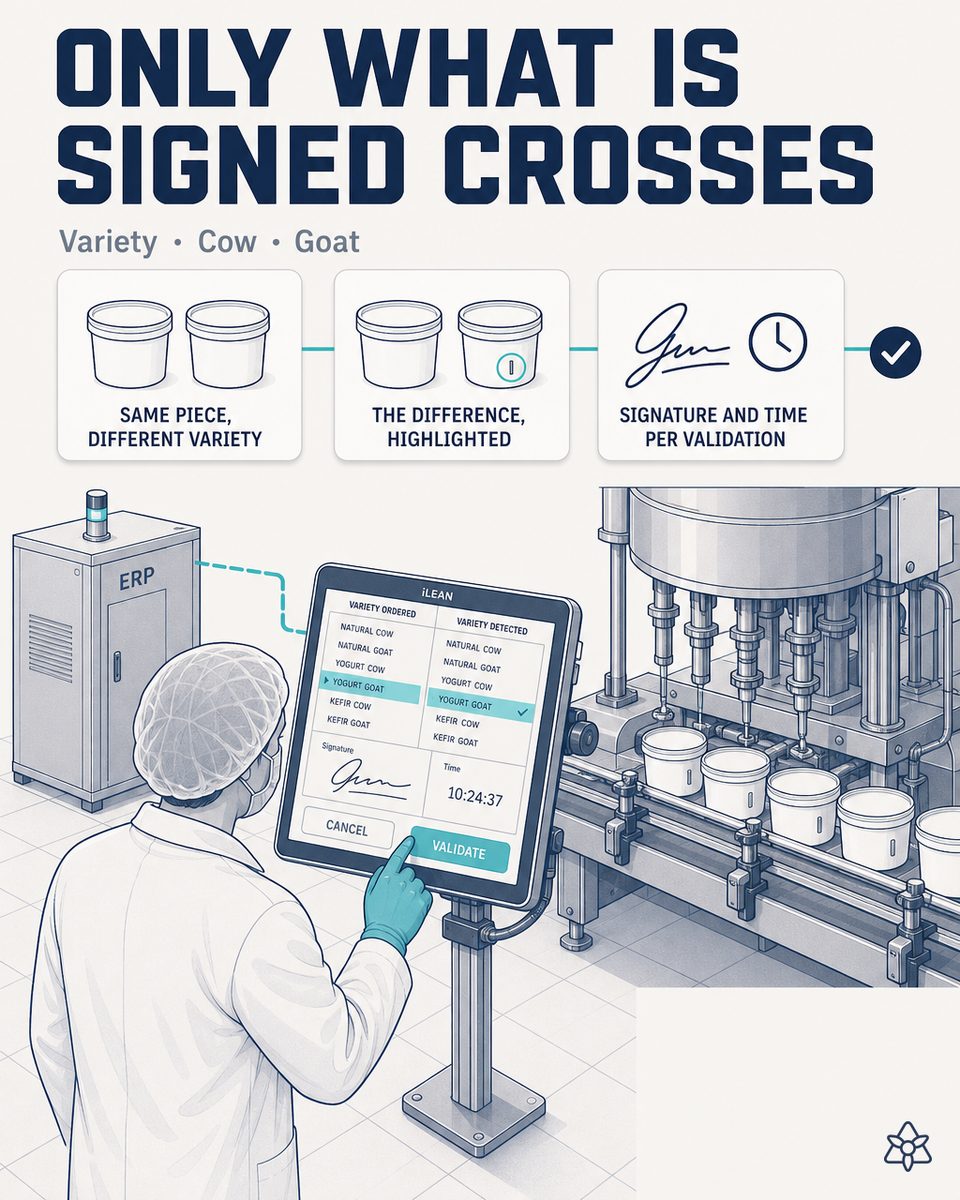
This is what separates iLEAN from an autonomous AI agent inserting unsigned data and ending up contaminating the master. In a fresh cheese dairy the dangerous data point is the variety: the same white 250 g piece can be cow, goat, blend, salt-free or lactose-free. Before that enters the system, it appears on a tablet at the packing machine and the operator confirms with two taps.
When a system is right 97% of the time, the problem is that nobody knows which the remaining 3% is.
In a fresh cheese dairy, the data point that does the most damage if it enters wrong is the variety — because the same white 250 g piece can be cow, goat, blend, salt-free or lactose-free. And without a human gate, the chain of consequences is direct:
- A variety recognition error enters the master — and from there it propagates to the labeling and appears on a retail chain's shelf, without anyone having seen it along the way.
- In a product with a declaration it is not an inventory failure — with an intolerance declaration (lactose-free) or a species one (goat), that error is a food safety incident, with everything that drags along.
- And the human gate cannot cost time — because if it costs time, on the line it gets skipped. It has to be faster than the alternative of not doing it.
Hence the answer is not choosing between automating and controlling, but separating the capture — which can be automatic — from the validation, which must be human but can take two seconds.
Early human verification — a validation screen, not a form.
The design key is in the verb. A data entry screen asks for writing and on the line gets abandoned. A validation screen shows what the AI understood and asks for a gesture. The first competes with the operator's work; the second takes less than checking the paper order.
A sealed tablet at the packing station, suited to the environment. It shows a visual summary: the photo of what was captured, the four fields that matter in large type — variety, batch, expiry, format — and the contrast with what the work order says. If they match, one tap.
How early human verification operates at packing:
- A visual summary, not a form — four fields in large type and the photo of what was captured beside them. No keyboard in the normal flow and no nested menus.
- Contrast against the work order — the screen does not show loose data: it confronts what was captured with what the order says it should be, which is exactly the check the operator already does mentally.
- One tap if it matches, field correction if not — when something disagrees, the operator corrects the specific field on the screen itself, they do not rewrite the whole record.
- The system learns from the correction pattern — if a field is always corrected at the same point, that signals the capture is badly calibrated there, not that the operator is wrong.
- It works for everything captured, wherever it comes from — photo, voice, folder reading or email: everything converges on the same screen, with a record of who signed and when.
Unsigned data vs. data validated in two taps
| Aspect | Automatic capture with no human gate | With iLEAN + validation tablet |
|---|---|---|
| Data entering the master unreviewed | Happens, and nobody knows which | Zero |
| Validation time per batch | — | Seconds |
| Variety errors | Detected on the customer's shelf | Detected on the line |
| Product with a species or intolerance declaration | Risk of a food safety incident | Confirmed by a person before labeling |
| Traceability of the signature | Does not exist | Who signed and when, on every data point |
| Quality's stance on the project | Blocking | Backing: there is a recorded human signature |
Impact estimate for your plant — to be validated with your own numbers.
The block below is an estimate to be validated against your plant's actual data. We put it forward so the committee has an order of magnitude; we refine it during the assessment.
- Fresh cheese dairy packing several varieties in the same format, with species and intolerance declarations on the label.
- Pilot of the sealed tablet at the packing station together with the first capture case. It is not deployed on its own: it is the piece that makes the others signable. First value expected within a few weeks.
- Indicative payback between 3 and 7 months. Estimate to be validated.
- It is the cheapest example to deploy and the one eliminating the most risk — and the one making the project defensible before quality and the auditor, because there is a recorded human signature on every data point that enters.
- The risk it avoids does not average out: a variety error in a product with an intolerance declaration reaching the shelf is a food safety incident, not a mismatch.
And the fair question from the line manager
"If every batch must be validated, don't we end up just as loaded?" — no, because validating and typing do not cost the same. Typing is tens of seconds plus the load of remembering what goes in each field; validating is looking at four fields in large type next to the photo and confirming. The interaction is designed to take seconds, because if it cost time it would get skipped. And it is precisely that validation which lets the AI work on anchored tasks safely: even with an error below 1.5% [1], that remainder never reaches the master.
[1] OpenAI paper "Why Language Models Hallucinate", 2025 — on the reliability of AI in anchored tasks.
What people ask about in-line human validation
Why not let the AI write directly into the system?
Because when a system is right 97% of the time, the problem is not that 97%: it is that nobody knows which the remaining 3% is. Without a human gate, a variety recognition error enters the master, propagates to the labeling and appears on a retail chain's shelf. And in a product with an intolerance or species declaration, that is not an inventory failure: it is a food safety incident. That is why in iLEAN human validation is not a configuration option but a design principle: capture can be automatic, entry into the master cannot.
How long does validating really take?
Seconds, and it is a design requirement more than an aspiration: if the human gate cost time, on the line it would get skipped, and then it would be useless. The screen is not a form but a visual summary: the photo of what was captured and four fields in large type — variety, batch, expiry, format — contrasted with what the work order says. If they match, one tap and on it goes. Only when something disagrees does correction come in, and the specific field is corrected, not the whole record.
What happens when the operator corrects?
The correction is recorded next to the original data, with who made it and when, and the system learns from the pattern. That matters for two reasons. The first is traceability: in a later claim it can be demonstrated what the system captured, what the person corrected and why. The second is calibration: if a field is always corrected at the same point of the line, that does not say the operator is wrong — it says the capture is badly tuned there, and what gets corrected is the capture. The correction stops being a patch and becomes the signal that refines the system.
Does the same tablet serve everything iLEAN captures?
Yes, and it is deliberate. The tablet is the convergence point: whether the data comes from a photo of the vat sheet, a dictation by the lead through the earpiece, the reading of the laboratory folder or an email from the collection center, everything is normalized to the same summary before being shown. The operator does not learn a different interface per origin or remember which channel demands which gesture. A single two-tap pattern, and a single boundary: what is not signed does not cross.
How does this help before an auditor?
Because it completes the chain that is normally broken. Every record keeps its origin (the photo, dictation or file it came from), the confidence level with which the AI interpreted it and the person who validated it, with their moment. Against the classic model — a transcribed data point with no record of where it came from or who entered it — the difference is substantial. And it is what lets the quality manager back the project instead of blocking it: they are not asked to trust the AI, they are given a gate they control.
More cases from this series
- The audit stops being a project and becomes a queryEvery batch and every changeover generate their dossier on their own: photos, thermal curve, test…
- Two modern machines that finally talk to each otherVariety, batch and expiry date travel from the ERP to the coder via API. Zero manual typing at the…
- The laboratory stops typing the same thing twiceiLEAN reads the quality control sheet when saved, ties it to the batch and feeds it into the ERP after…
- The notice read late today, resolved before the tanker arrivesThe collection center’s notice, cross-referenced with the vat plan and live orders, returns the…
- Traceability starts at the dock, not at the vatA photo of the delivery note and the test bulletin: receiving enters the ERP after one validation tap.…
- The pasteurizer stays the same — but now it talksAn external camera reads the HTST pasteurizer’s panel and digitizes the thermal curve per batch. Without…
Put a two-tap human gate on your packing line.
We work on your dairy's real data, not ours. We show you the validation working on your own captures. Assessment with no commitment.
Talk to an iLEAN consultant ‹ See all 12 fresh cheese cases See food industry