Traceability starts at the dock, not at the vat
The tanker arrives. The receiving manager takes a sample, waits for the inhibitor test, checks temperature, signs the delivery note, and then enters the ERP to type liters, origin, species, batch and results line by line. Either the carrier waits and bills the delay, or it is typed in a hurry and the batch ends up badly traced. With Connect: a photo of the delivery note, the bulletin and the labels, one validation tap, and into the ERP via API.
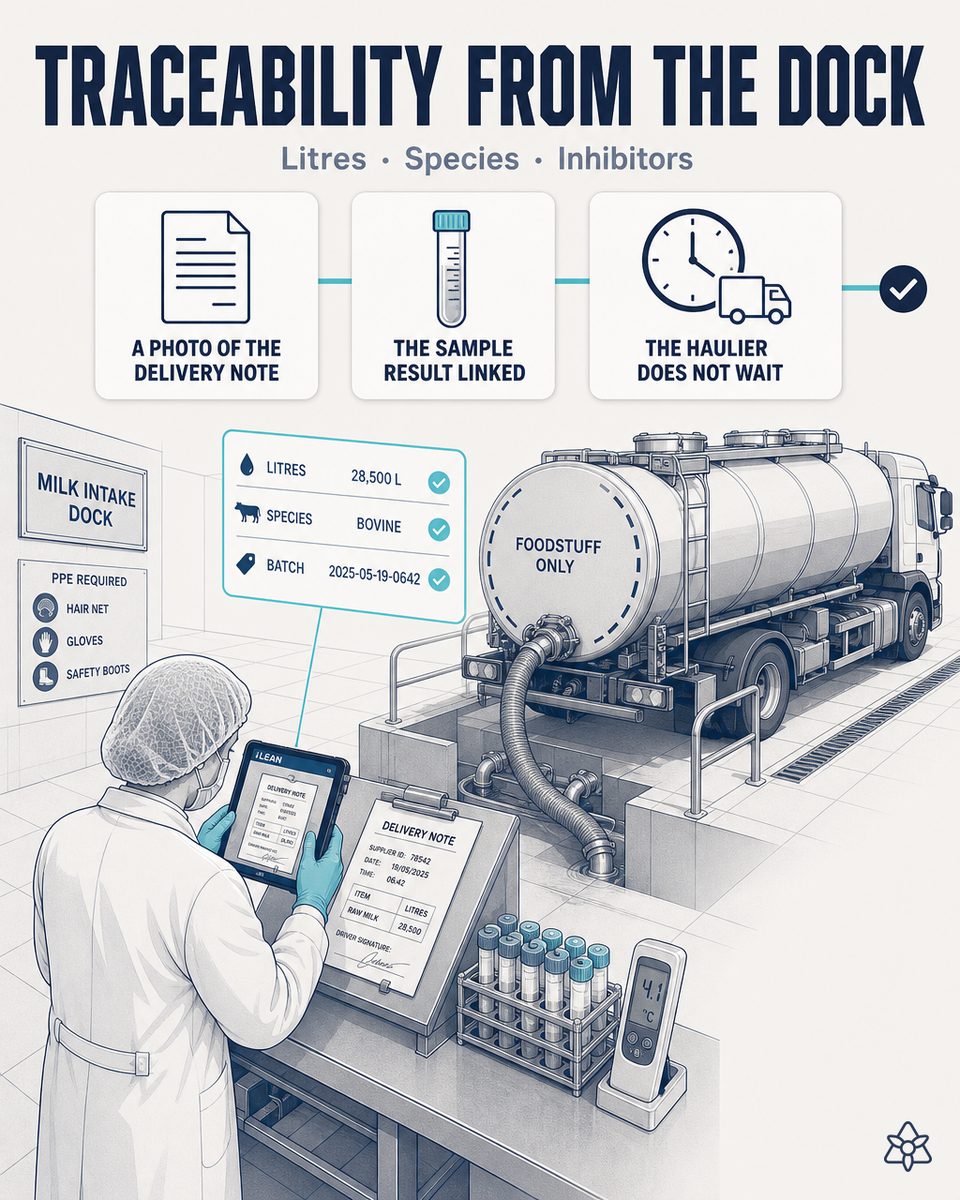
A dairy's traceability does not start at the vat: it starts at the dock.
If the association between tanker, milk batch and vat is made badly or late, the whole later chain drags the error. And it is exactly there that time pressure is highest:
- The carrier wants to leave and the milk wants to go into the cold — and the person typing is exactly the same one taking the sample and waiting for the inhibitor result.
- Either delay, or haste — either the carrier waits and bills, or it is typed in a hurry and the batch ends up badly associated. There is no third option with the current tools.
- The mismatch does not hurt the day it happens — it hurts three weeks later, the day you have to trace backwards from an incident. Which is the worst possible day to discover the association was wrong.
In the end receiving works because someone sustains it with craft and haste, and that craft is recorded nowhere — nor is it any use when what must be reconstructed is a batch from a month ago.
Connect photo-the-analog → ERP: the second typing disappears, not the control.
The necessary information is already printed: on the delivery note, the test bulletin and the labels. What is missing is the path from that paper to the ERP without passing through a keyboard with the tanker waiting.
A photo of the transport delivery note, the inbound test bulletin — inhibitors, somatic cells, fat and protein, cryoscopy, pH, arrival temperature — and the auxiliary material pallet labels. A summary on screen, one-tap validation and a feed into the ERP via API.
How Connect operates at the receiving dock:
- Any encoding — GS1-128, QR, barcode or plain text. Whatever is printed gets read without demanding a specific standard or asking the carrier for anything.
- Structured extraction of the whole bulletin — origin, species, liters, temperature, per-parameter results, carrier and time enter as fields, not as an archived image.
- One-tap validation — the receiving manager reviews the summary and confirms. They keep signing the paper delivery note as always: what disappears is the second typing, not the control.
- Photographic tanker-to-vat traceability — the association between tanker, milk batch and vat closes at the moment of unloading, with the original photo behind it.
- Entry in the moment, not "when I can" — the ERP receives the receiving while the tanker is still at the dock, not hours later.
Receiving typed twice vs. receiving with Connect photo
| Aspect | Classic double typing | With iLEAN Connect photo |
|---|---|---|
| Tanker time at the dock | High — the manager types while it waits | Estimated reduction ≥30% |
| Receivings with a badly associated batch | Happens, and surfaces weeks later | Zero |
| ERP entry | "When I can" | At the moment of unloading |
| Inbound test bulletin | Archived on paper | Structured fields per parameter |
| Purchasing/receiving module licenses | 3 users who only book entries | 1: the validating manager's |
| Signing the delivery note | On paper | On paper — unchanged |
Impact estimate for your plant — to be validated with your own numbers.
The block below is an estimate to be validated against your plant's actual data. We put it forward so the committee has an order of magnitude; we refine it during the assessment.
- Fresh cheese dairy with daily tanker receiving from several cooperatives and a paper inbound test bulletin.
- Connect photo pilot at the dock with an ERP feed via API after one-tap validation. Without changing the receiving circuit or the delivery note signature. First value expected within a few weeks.
- Economic angle — the staff who today enter the ERP only to book receivings consume purchasing/receiving module licenses. With Connect the validating manager's is enough: from 3 licenses to 1, that is −50% to −70% of that module's recurring spend.
- Estimated payback between 4 and 9 months, adding avoided carrier delays. Estimate to be validated.
- The lever that does not fit in the spreadsheet: photographic tanker-to-vat traceability. The day backward tracing is needed from an incident, either the trail is there or it is not.
And the fair question from the receiving manager
"What if it misreads a bulletin result and I clear milk that was not good?" — hallucination is a problem of free generation, not of anchored tasks. Reading a value printed on a bulletin and mapping it to a known field is an anchored task, and there the best models brought the error below 1.5% [1]. On top of that there are two nets underneath: doubtful lines arrive highlighted and nothing is fed in without a person confirming — the same one signing the delivery note today, who keeps signing it the same way.
[1] OpenAI paper "Why Language Models Hallucinate", 2025 — on the reliability of AI in anchored tasks.
What people ask about digitizing tanker receiving
Does signing the paper delivery note stop?
No. The receiving manager keeps signing the delivery note as always, with the carrier present, because that signature has a contractual value that does not change. What disappears is the second typing: the return to the ERP to enter liters, origin, species, batch and results line by line, which is where the minutes go and where the errors are made. The control is not relaxed, it moves: instead of typing twenty fields, a summary of what was extracted is reviewed and confirmed with one tap.
What exactly is photographed?
Three things: the transport delivery note, the inbound test bulletin — inhibitors, somatic cells, fat and protein, cryoscopy, pH and arrival temperature — and the auxiliary material pallet labels arriving in the same unload. From there origin, species, liters, temperature, per-parameter results, carrier and time are extracted in structured form, recognizing GS1-128, QR, barcode or plain text indistinctly. Neither the cooperative nor the carrier has to change anything of what they already print.
Why does it matter so much that the association happens at the dock?
Because a dairy's traceability does not start at the vat, it starts at the dock. If the association between tanker, milk batch and vat is made badly or late, everything that follows drags the error: the vat sheet, the pasteurization curve, the batch's test results and the packed product. The problem is that the mismatch does not bother anyone the day it happens — it bothers three weeks later, when backward tracing is needed from an incident, which is exactly the worst day to discover the trail leads nowhere.
How does it translate into ERP licenses?
By counting how many people need access to the purchasing and receiving module today only to book entries. Typically three. With Connect the entry happens via API and only the validating manager keeps the license: the usual reduction is between 50% and 70% of that module's recurring spend. It is an easy saving to audit because it comes from the number of contracted users versus those who really need to operate the module, and it is calculated against the ERP vendor's real invoice.
What happens if a bulletin result arrives doubtful?
It arrives highlighted on the validation screen and is the only thing demanding attention. The system does not hide its uncertainty to look more effective: if a value is printed on a wrinkled bulletin or with smeared ink, it flags it. The person corrects that specific field — not the whole record — and validates. It is an important difference versus typing in a hurry: when typing, the error also exists but nobody knows where it is; here the system points exactly where to look, and does so while the tanker is still at the dock.
More cases from this series
- The audit stops being a project and becomes a queryEvery batch and every changeover generate their dossier on their own: photos, thermal curve, test…
- Two modern machines that finally talk to each otherVariety, batch and expiry date travel from the ERP to the coder via API. Zero manual typing at the…
- The laboratory stops typing the same thing twiceiLEAN reads the quality control sheet when saved, ties it to the batch and feeds it into the ERP after…
- The notice read late today, resolved before the tanker arrivesThe collection center’s notice, cross-referenced with the vat plan and live orders, returns the…
- The AI proposes, the human signs, and only the signed crossesVariety, batch and expiry are confirmed on a tablet at the packing machine. Nothing enters the central…
- The pasteurizer stays the same — but now it talksAn external camera reads the HTST pasteurizer’s panel and digitizes the thermal curve per batch. Without…
How long does your tanker stand at the dock?
We work on your dairy's real data, not ours. We look at your real delivery notes and bulletins and calculate the case with you. Assessment with no commitment.
Reduce it with iLEAN Connect ‹ See all 12 fresh cheese cases See food industry