The pasteurizer stays the same — but now it talks
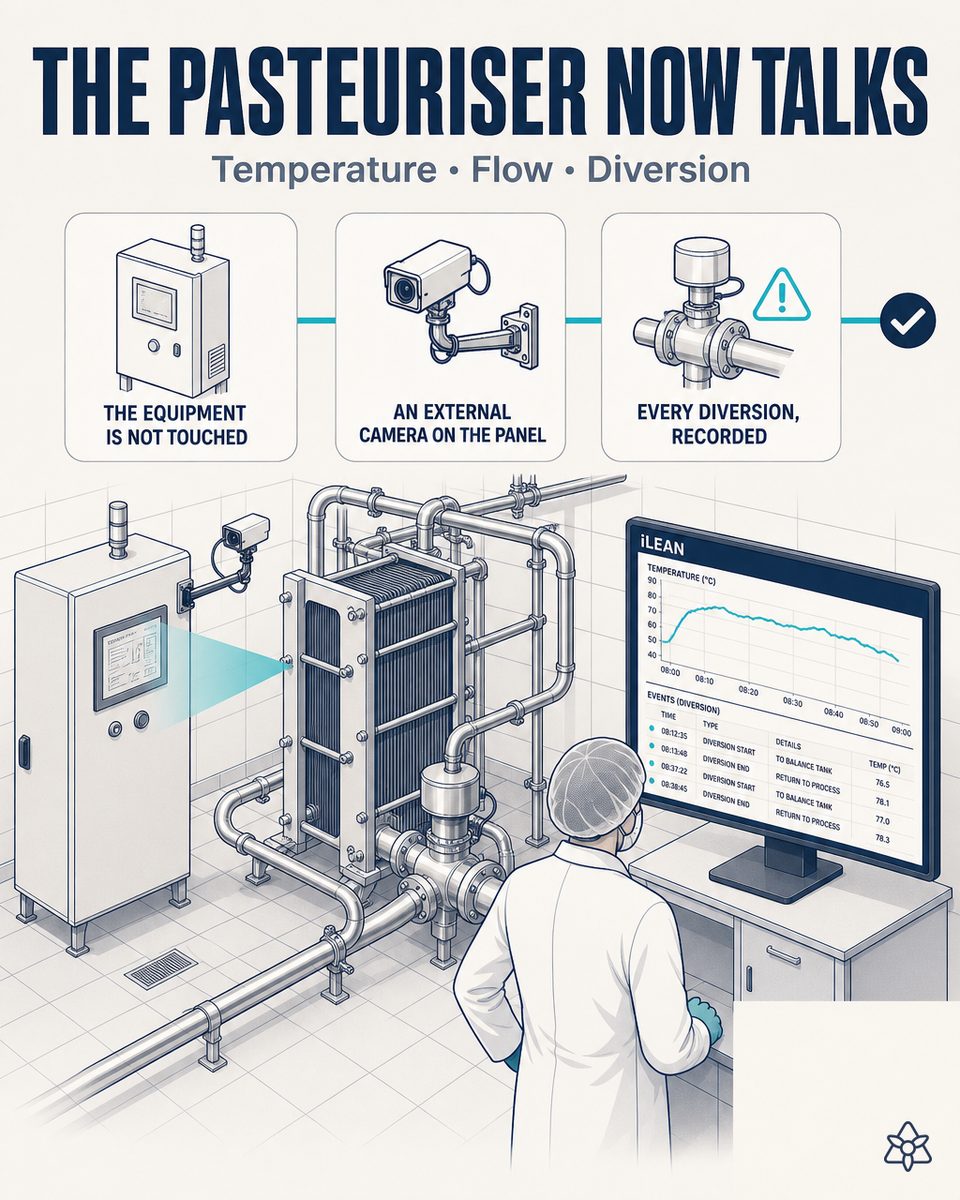
The pasteurizer is the asset a dairy's entire food safety depends on: 72 °C for 15 seconds and a flow diversion valve. Its panel shows temperature, flow rate, differential pressure and every diversion event, but it is usually 12 to 20 years old, lives isolated from the network and its record comes out on a paper chart. With iLEAN Connect an external camera aimed at the screen is enough: the machine is not touched and the thermal curve becomes a series queryable by batch.
The data food safety depends on is the data that circulates worst.
Did this milk reach 72 °C? Was there a flow diversion? How many times and for how long? Those are the questions defining the food safety of everything leaving the plant, and today they are answered on a paper roll:
- Proving a batch's curve forces reconstructing the thermal archive — by hand, finding the chart stretch matching that hour and cross-referencing it with what was passing through. In an audit, that is hours.
- Correlating a diversion with a microbiological deviation is archaeology — the diversion was marked on the paper, but knowing which milk was passing at that instant demands a manual exercise that rarely adds up one hundred percent.
- The obvious alternative is not viable — replacing the pasteurizer is hundreds of thousands of euros, weeks of stoppage and revalidating the equipment. And touching its program is not either: nobody wants to assume the regulatory risk of intervening in a validated machine.
So the plant lives with its most critical data on a medium that cannot be queried, and every audit and every investigation starts with the same manual work from scratch.
Connect in photo mode on the panel — looking at the screen, not intervening in the machine.
The missing information is already on the screen: the panel shows it every cycle. What does not exist is the path from that glass to the central system. Connect solves it from the side that touches nothing — by looking — and therefore without opening the equipment's network, without modifying its program and without needing to revalidate it.
A fixed industrial camera aimed at the screen, rated for a wet area. Non-intrusive installation: nothing is connected to the machine. Optical recognition with an anchored model builds the time series of outlet temperature, flow rate and flow diversion events, and cross-references it with the ERP and the vat sheet to know which milk was passing at each moment.
How Connect operates on the pasteurizer's panel:
- Non-intrusive installation, rated for a wet area — a mount is installed in front of the screen, with protection suited to the environment. Nothing is connected to the equipment: not the bus, not the cabinet, not the program. The pasteurizer's validation stays intact.
- OCR anchored to that specific panel — the model knows that screen's real layout: where the outlet temperature is, where the flow rate, where the differential pressure and where the diversion indicator. It reads values at known positions.
- A time series, not snapshots — the continuous reading is reconstructed as the cycle's curve. That is what lets you see how long a diversion lasted, not just that it happened.
- Associated with the batch, not the clock — the cross-reference with the ERP and the vat sheet says which milk was passing at each moment, so the curve stays tied to the batch. Without that cross-reference the series is a chart; with it, it is traceability.
- It feeds the auditable evidence pack — the batch's curve enters the dossier that later gets downloaded, instead of being reconstructed from the paper archive every time someone asks.
Paper thermal record vs. curve digitized with Connect
| Aspect | Archived paper chart | With iLEAN Connect on the panel |
|---|---|---|
| The batch's thermal curve | On paper, archived | A time series queryable by batch |
| Proving pasteurization to an auditor | Hours of archive work | Seconds |
| Detection of an anomalous flow diversion | "When reviewing the chart" | In the moment |
| Diversion ↔ microbiological deviation correlation | Documentary archaeology | A cross-referenced query per batch |
| Intervention on the equipment | Any integration demands touching and revalidating it | None — external camera, validation intact |
| Pasteurizer replacement | Hundreds of thousands of euros and weeks of stoppage | Deferrable indefinitely |
Impact estimate for your plant — to be validated with your own numbers.
The block below is an estimate to be validated against your plant's actual data. We put it forward so the committee has an order of magnitude; we refine it during the assessment.
- Dairy with a 12-to-20-year-old HTST pasteurizer, a network-isolated panel and a thermal record on a paper chart.
- Connect pilot on the panel: a wet-area-rated industrial camera, model anchoring to that specific screen and cross-reference with the ERP and the vat sheet. First value expected within a few weeks.
- Indicative payback between 5 and 10 months. Estimate to be validated.
- Add the indefinite deferral of the pasteurizer replacement CAPEX, which is usually the figure that moves the committee: the project is postponed without giving up the data that justified it.
- And the reduction of the risk of a major nonconformity for incomplete thermal traceability, which in a dairy is not a documentary matter: it is the permission to sell to certain customers.
And the fair question from the quality manager
"Does this force me to revalidate the pasteurizer?" — no. The camera is an independent device looking at the screen from outside: it does not connect to the equipment, shares no wiring and writes nothing into its logic. For the pasteurizer nothing has changed, so its validation remains in force. On the reading, hallucination is a problem of free generation, not of anchored tasks: reading a value at a known position on a known panel is where the best models brought the error below 1.5% [1], with time-redundant reading and discarding of frames that do not reach the confidence threshold.
[1] OpenAI paper "Why Language Models Hallucinate", 2025 — on the reliability of AI in anchored tasks.
What people ask about digitizing the pasteurizer without touching it
Is anything connected to the pasteurizer?
No, and that is exactly the approach. The industrial camera is an independent device on an external mount aimed at the screen from outside. It does not connect to the panel, shares no wiring with the machine and writes to no point of its control logic. It limits itself to photographing what the operator already sees. The pasteurizer remains exactly the same equipment, with the same program and the same validated parameters, without a single change in its configuration — which is the condition for nobody having to assume a regulatory risk.
Can the camera withstand a wet area's environment?
Yes: it is installed with protection suited to the environment, which is a starting requirement in a dairy, not an add-on. Calibration is verified continuously and, if a frame arrives degraded — condensation on the optics, a splash, a reflection — Connect discards it below the confidence threshold instead of forcing a value. Maintenance comes down to a periodic cleaning of the optics that is integrated into the area's cleaning routine, as one more point of the plan that already exists.
How is the curve associated with the batch and not just the hour?
By cross-referencing the time series with the ERP and the vat sheet, which are the ones that know which milk was passing at each moment. That cross-reference is what turns a chart into traceability: without it, you know there was a flow diversion at 11:40, but not which batch was affected. With it, the auditor's question — "show me this batch's pasteurization" — is answered with a query instead of a manual reconstruction of the thermal archive.
What exactly is gained with the flow diversion events?
They stop being discovered after the fact. Today a diversion is marked on the chart and is seen when reviewing the roll, usually when something else is already being investigated. With continuous reading, the diversion is recorded with its exact time, its duration and the affected batch, and a notice can go out in the moment. That changes the nature of the control: from documenting that there was a diversion to being able to decide what to do with the product passing through while it happened.
What if the panel changes view or someone navigates to another screen?
Connect detects it as a layout deviation and stops automatically structuring that reading until the model is re-anchored to the new arrangement — a documented configuration adjustment, not an intervention on the machine. In the meantime it invents no data: the capture is flagged for review and the earlier curve history remains intact and traceable per batch. On panels of this age, without firmware changes, it is an infrequent situation, but the system is designed to fail loudly instead of failing silently — which is the only acceptable behavior when we are talking about the food safety record.
More cases from this series
- The audit stops being a project and becomes a queryEvery batch and every changeover generate their dossier on their own: photos, thermal curve, test…
- Two modern machines that finally talk to each otherVariety, batch and expiry date travel from the ERP to the coder via API. Zero manual typing at the…
- The laboratory stops typing the same thing twiceiLEAN reads the quality control sheet when saved, ties it to the batch and feeds it into the ERP after…
- The notice read late today, resolved before the tanker arrivesThe collection center’s notice, cross-referenced with the vat plan and live orders, returns the…
- Traceability starts at the dock, not at the vatA photo of the delivery note and the test bulletin: receiving enters the ERP after one validation tap.…
- The AI proposes, the human signs, and only the signed crossesVariety, batch and expiry are confirmed on a tablet at the packing machine. Nothing enters the central…
How old is your pasteurizer's panel?
We work on your dairy's real data, not ours. We show you the reading working on your own panel, without touching the equipment. Assessment with no commitment.
See how we digitize its curve without touching it ‹ See all 12 fresh cheese cases See food industry