The notice read late today, resolved before the tanker arrives
At 06:40 a message enters from the collection center: the goat milk tanker is two hours late and 30% short on volume. It is read at 09:00, when the room has already planned the vats with milk that does not exist and there are committed retail orders. With iLEAN Connect the system reads the message on arrival, cross-references it with the vat plan and the ERP's live orders, and returns the concrete action.
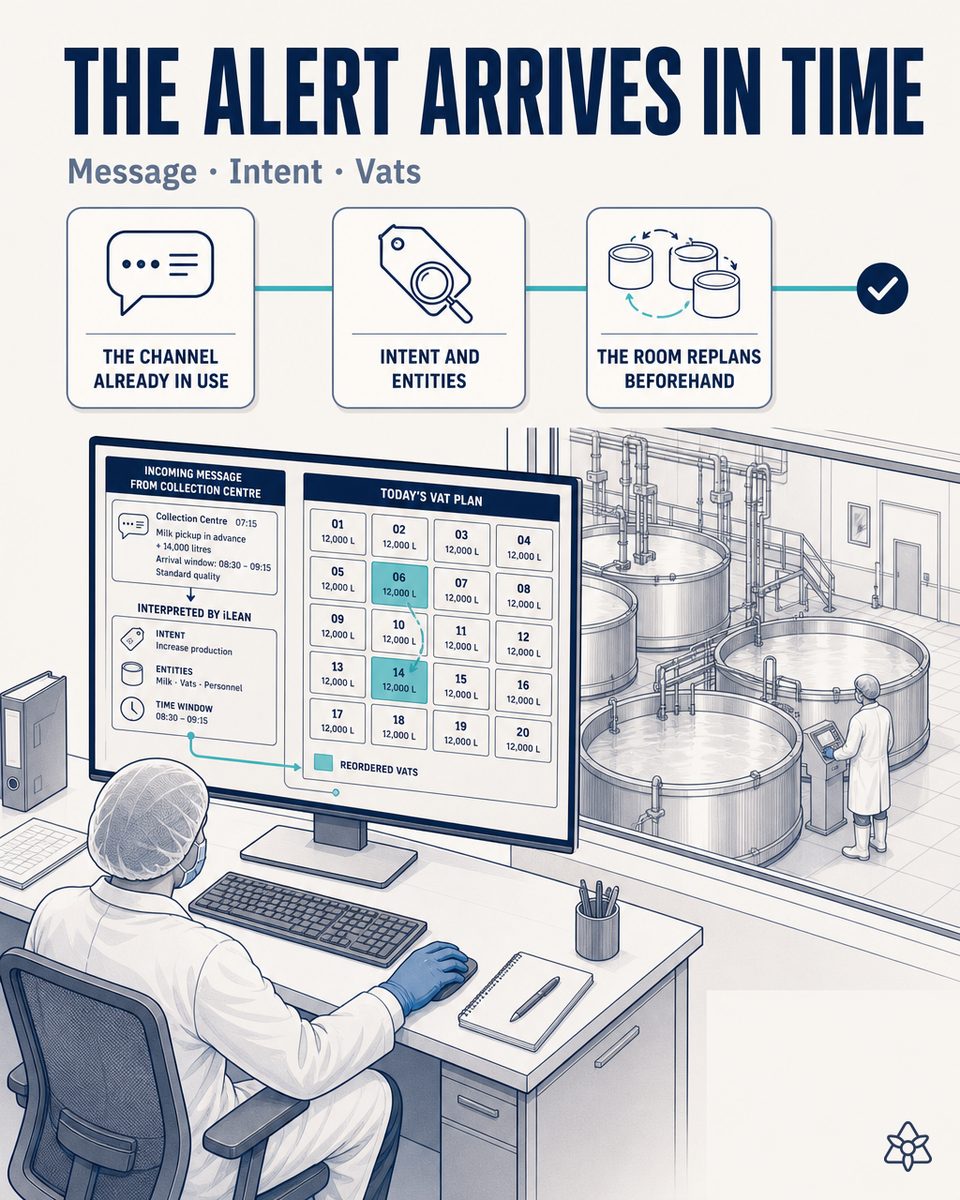
The milk entering today curdles today — and the notice that changes everything arrives through a human channel.
In a fresh cheese dairy the raw material comes from cooperatives and collection centers, not from a sister plant. The inbound variability — volume, time, quality, arrival temperature — is communicated through human channels: a call, a message, an email:
- Each notice lands on one specific person — who cannot watch the inbox in real time because they are in the room, at milk receiving or solving something else. Between arrival and reading, two or three hours pass.
- When it is read, the room has already decided — vats have been planned with milk that will not arrive, or will arrive different. Undoing that costs badly used room hours.
- And there is no cushion here — the milk entering today curdles today. Rescheduling for tomorrow is not an option: a late replanning is paid in orders shipped incomplete.
The planner knows it and does what they can, but they cannot live glued to three channels at once while the room starts up. The cost of that latency appears in no report: it dilutes into room hours and order shortfalls.
Connect in chaotic-sources mode — silently copied, 24/7, touching no personal channel.
A dairy's critical information does not arrive through the ERP: it arrives through whatever channel the cooperative chooses to write on. Connect does not try to change that habit — it gets copied on a dedicated mailbox and a business messaging number, and reads everything that enters.
As soon as the message enters, Connect extracts the intent — delay, volume change, quality incident, origin nonconformity — and the entities — origin, milk species, liters, expected time —, and cross-references them with the day's vat plan and the ERP's live orders. What it returns is not "a message has arrived", it is the concrete action.
How Connect operates on collection notices:
- A dedicated mailbox and a business number, silently copied 24/7 — no personal channel is intervened. The cooperative and the collection center keep writing where they write, with no new portal and asking nothing of them.
- Intent and entities, not keywords — the model tells a delay from a volume change and from a quality incident, and extracts origin, milk species, liters and expected time.
- Cross-reference with the vat plan and live orders — the notice is only worth something compared against what is committed today. That cross-reference is what turns a message into a calculated impact.
- A concrete action to the relevant role — which vats to reorder, which blend ratio is viable today with the milk actually coming in, which order to serve first.
- The human decides with the proposal assembled — Connect does not reorder the room on its own: it presents the already-calculated option and a person accepts, corrects or discards it.
Notices in an inbox vs. notices read and cross-referenced by Connect
| Aspect | Human channels with no cross-reference | With iLEAN Connect copied in |
|---|---|---|
| Notice → action latency | 2-3 h | Seconds |
| Basis of the replanning | The expected milk | The milk actually coming in |
| Critical notices lost in a group thread | Happens | Zero |
| Badly planned room hours | Accepted as part of the day | Recovered by replanning in time |
| Retail orders shipped incomplete | A permanent risk | Prioritized with the impact calculated |
| The cooperative's channel | You would have to ask it to change | It keeps writing where it writes |
Impact estimate for your plant — to be validated with your own numbers.
The block below is an estimate to be validated against your plant's actual data. We put it forward so the committee has an order of magnitude; we refine it during the assessment.
- Fresh cheese dairy receiving milk from several cooperatives and collection centers, with variability notices by call, message and email.
- Connect pilot on a dedicated mailbox and a business messaging number, cross-referenced against the vat plan and live orders. The ERP is not touched except on human confirmation. First value expected within a few weeks.
- Indicative payback between 4 and 8 months, counting room hours badly planned due to supply incidents and retail order shortfalls. Estimate to be validated.
- The easiest saving to measure is room hours: just compare how many days get replanned late today and how many would be replanned in time.
- The lever that does not fit in the spreadsheet: the retail order shipped complete. In fresh cheese, a shortfall is not recovered the next day because the product's shelf life is what it is.
And the fair question from the production manager
"What if the AI misreads a message and reorders my vats?" — it does not reorder them: it proposes. The replanning is not applied until a person signs it, and it arrives with the calculation visible to check in seconds. On the reading, hallucination is a problem of free generation, not of anchored tasks: extracting origin, species, liters and time from a message and cross-referencing them with the day's plan is where the best models brought the error below 1.5% [1]. And if the notice arrives ambiguous, it gets flagged instead of resolving itself.
[1] OpenAI paper "Why Language Models Hallucinate", 2025 — on the reliability of AI in anchored tasks.
What people ask about reading collection notices with AI
Do we have to ask the cooperative to change how it notifies us?
No, and it is the starting point. Asking a collection center or a cooperative to use a specific portal does not work in practice: each notifies the way it always has, and the one bringing you the least volume is the one least likely to change. Connect gets silently copied on a dedicated mailbox and a business messaging number, and works on what arrives as it arrives. Nobody's personal channel is intervened: what is watched is a company mailbox created for this, not a person's phone.
Does it tell a critical notice from a routine message?
Yes, because it does not look for keywords: it extracts intent and entities. An acknowledgment, a route confirmation and a notice that the tanker is coming 30% short read differently even if they share vocabulary. And above all, the notice is evaluated against the day's real plan: a change affecting no planned vat and no committed order generates no noise, while one breaking the planned blend goes up to the planner with the impact already calculated.
Can the system replan the vats on its own?
No. Connect proposes, the person decides. The replanning arrives as a concrete proposal — which vats to reorder, which blend ratio is viable with the milk actually coming in, which order to serve first — with the calculation in front to check in seconds. It is accepted, corrected or discarded. In a dairy, where reordering the room has an immediate cost and the day's milk does not wait, that boundary is not a nuance: it is the same principle governing the rest of the system.
What happens if the notice arrives incomplete or ambiguous?
It gets flagged as such instead of resolving on its own. If the message does not make clear how many liters are coming, of which species or at what time, the system presents it as doubtful data showing what it did understand and what it did not, for a person to complete. A notice saying "this seems to affect the 10 o'clock goat vat, confirm it" is preferable to a confident replanning built on a weak reading — above all when the cost of being wrong is a badly used room day.
How is this case's return measured?
With two figures the plant already has. First, how many days a month get replanned late because a supply incident was read hours behind, and what that means in room hours. Second, how many retail orders have shipped incomplete for the same reason. That second figure tends to weigh more than it seems: in fresh cheese it is not recovered the next day because the product's shelf life is what it is, and the conversation with the retail chain is not settled with a credit note.
More cases from this series
- The audit stops being a project and becomes a queryEvery batch and every changeover generate their dossier on their own: photos, thermal curve, test…
- Two modern machines that finally talk to each otherVariety, batch and expiry date travel from the ERP to the coder via API. Zero manual typing at the…
- The laboratory stops typing the same thing twiceiLEAN reads the quality control sheet when saved, ties it to the batch and feeds it into the ERP after…
- Traceability starts at the dock, not at the vatA photo of the delivery note and the test bulletin: receiving enters the ERP after one validation tap.…
- The AI proposes, the human signs, and only the signed crossesVariety, batch and expiry are confirmed on a tablet at the packing machine. Nothing enters the central…
- The pasteurizer stays the same — but now it talksAn external camera reads the HTST pasteurizer’s panel and digitizes the thermal curve per batch. Without…
Through how many different channels are you notified of a collection change?
We work on your dairy's real data, not ours. We show you the reading working on your own notices. Assessment with no commitment.
Get my channels in order with iLEAN Connect ‹ See all 12 fresh cheese cases See food industry