The laboratory stops typing the same thing twice
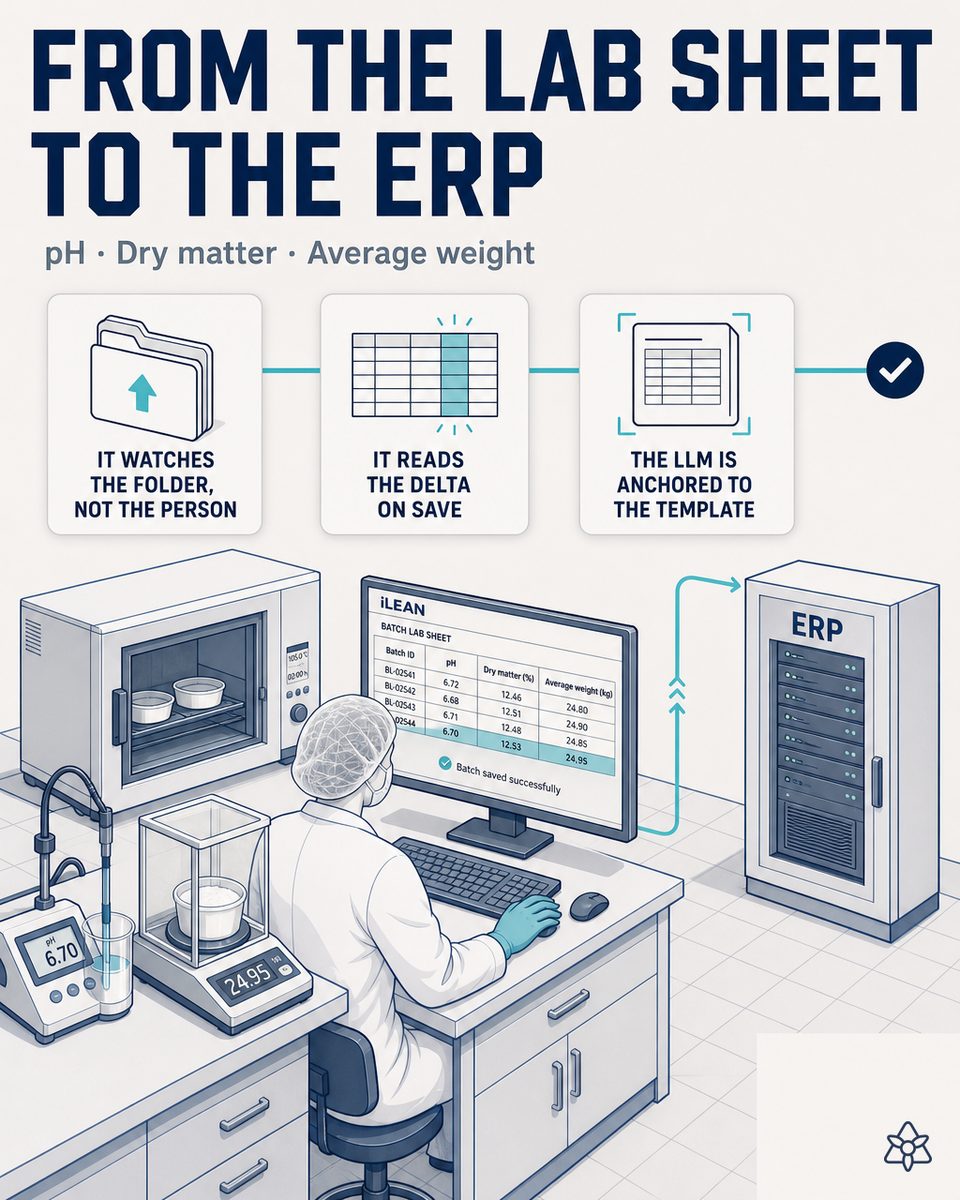
In the laboratory's shared folder lives the sheet where the technician notes, batch by batch, pH, dry extract, fat, moisture, average weight and microbiological results. Living data, measured with instruments. But the ERP demands someone type it again, and that happens at month end. Connect reads the file when it is saved, ties it to the batch and, after validation, feeds it into the ERP via API.
There are two truths about each batch's quality, and the official one runs a month behind.
The Excel's is real and same-day: a technician measures it with an instrument, batch by batch. The ERP's is late, transcribed and sometimes incomplete. And from that duplicity come three costs:
- Any decision taken from the ERP is taken with up to 30 days of lag — the system the organization considers "the truth" runs behind what the laboratory already knows.
- When a claim arrives, both sources must be cross-checked by hand — to know which is right. Exactly when there is the least time.
- And there is an invisible cost — half a day a month of pure transcription, plus the copying errors that transcription introduces precisely into the data that will be scrutinized most if something goes wrong.
Add the cost that appears on no process sheet: for that typing to be possible, several people need access to the ERP's quality module — not because they manage quality in the system, but because it is the only way to enter their own data.
Connect in inward-listening mode — a file is read, a person is not put under watch.
The laboratory's Excel does not need to disappear or change format. The data that already exists in it needs to reach the ERP without anyone typing it again. Connect watches the shared folder and acts when the file is saved.
An anchored model parses the structure — which changes from tab to tab and from year to year, like every real Excel —, normalizes units and ties each row to its batch. The quality manager validates in bulk from a summary screen, and only the validated is fed into the ERP via API.
How Connect operates on the quality control sheet:
- A file is read, nobody is put under watch — worth stating precisely: iLEAN watches a shared folder. Nothing is installed on the technician's computer, their activity is not logged and their performance is not measured.
- Anchored to the real Excel, quirks and all — the structure changes from tab to tab and from year to year, like every real Excel. The model anchors to that, instead of asking anyone to redo it.
- Units normalized and each row tied to its batch — the data enters the ERP linked to its batch, which is what later allows querying it without cross-checking anything by hand.
- Bulk validation — the quality manager confirms from a summary screen. A single person validates what several used to type.
- If there is a LIMS instead of an Excel, the case holds — the source changes, not the approach: if the LIMS is isolated from the ERP, the economic angle does not vary.
Disconnected Excel and ERP vs. automatic feed with Connect
| Aspect | Manual transcription at month end | With iLEAN Connect |
|---|---|---|
| Real data ↔ ERP data lag | Up to 30 days | Minutes |
| Transcription errors | Introduced right into the critical data | Zero |
| The laboratory's time | Half a day a month of pure typing | Recovered |
| Querying a batch's test results | Cross-checking two sources by hand | Immediate |
| Quality module licenses | 4-5 users who only enter data | 1: the validating manager's |
| The laboratory's habit | The usual Excel — plus the ERP | The usual Excel |
Impact estimate for your plant — to be validated with your own numbers.
The block below is an estimate to be validated against your plant's actual data. We put it forward so the committee has an order of magnitude; we refine it during the assessment.
- Dairy with its own laboratory, a quality control sheet in a shared folder and an ERP with the quality module billed per active user.
- Connect pilot on the laboratory folder with an ERP feed via API after validation. Without changing the Excel, the habit or asking anyone to learn a new tool. First value expected within a few weeks.
- Direct economic angle — the laboratory and quality staff who today enter the ERP solely to enter data consume full module licenses. With Connect only the validating manager needs a license: a typical ratio of 4-5 licenses to 1, that is −50% to −80% of that module's recurring spend.
- Estimated payback between 4 and 8 months. The exact amount must be calculated against the ERP vendor's real invoice. Estimate to be validated.
- A side lever: with the test results alive per batch, the cross-check done by hand today when a claim arrives becomes a query — and that offloaded work is not included in the license calculation.
And the fair question from the finance manager
"What if the model misreads a cell and an out-of-specification result enters as good?" — hallucination is a problem of free generation, not of anchored tasks. Here the AI reads cells from a known sheet and maps them to known fields, with plausible ranges defined: it is where the best models brought the error below 1.5% [1]. And that remainder does not reach the ERP: Connect holds the feed until the quality manager validates, and an out-of-range value gets flagged instead of slipping through.
[1] OpenAI paper "Why Language Models Hallucinate", 2025 — on the reliability of AI in anchored tasks.
What people ask about feeding the laboratory's Excel into the ERP
Does the laboratory's Excel have to change?
No. The approach is the opposite: the sheet stays as it is because it works and is tuned to how measuring is really done in that laboratory. The model anchors to its specific structure — which changes from tab to tab and from year to year, like every real Excel — instead of asking anyone to redo it. No columns to normalize, no tabs to add, no change to how pH or dry extract are noted. Nothing new to buy either: the goal is not replacing the laboratory's tool, but eliminating the later transcription.
Does Connect put the laboratory technician under watch?
No, and it is worth stating precisely: a file is read, a person is not put under watch. iLEAN watches a shared folder and detects when the file has been saved. No software is installed on the technician's computer, their activity is not logged and their performance is not measured. All that happens is that, on save, the system identifies which rows are new and processes them. It is an important distinction to frame well with the team: what is watched is a process file, and the goal is taking the transcription off their hands.
How does this translate into fewer ERP licenses?
By counting how many people enter the quality module today only to enter data. If it is four or five, that is four or five full licenses paid for a feeding function, not for using the system. With Connect the data enters via API and a single person validates: the rest no longer need access. The typical ratio is 4-5 licenses to 1, that is between 50% and 80% less recurring spend on that module. The exact amount must be calculated against your ERP vendor's real invoice — which is why the first step is doing that calculation on your numbers.
What if we have a LIMS instead of an Excel?
The case holds intact with the source changed. If the LIMS is isolated from the ERP — the usual situation — the problem is exactly the same: the real data lives in one system and the official one in another, with someone transcribing in between. Connect reads from the LIMS instead of the folder and the rest of the flow does not vary: parsing, batch association, the manager's validation and the API feed. The economic angle does not change either, because the licenses consumed for typing are consumed the same whether the data comes from a spreadsheet or a LIMS.
What does a claim analysis gain?
It stops starting with a manual cross-check of two sources. Today, when a claim arrives, someone has to put the laboratory's Excel next to what the ERP holds to know which is right — and do it exactly when there is the least time. With Connect, the laboratory's data and the official system's are the same data, tied to its batch from the minute it was measured. Querying a specific batch's test results becomes immediate, and it can be put next to that same batch's vat sheet and pasteurization curve with no prior work.
More cases from this series
- The audit stops being a project and becomes a queryEvery batch and every changeover generate their dossier on their own: photos, thermal curve, test…
- Two modern machines that finally talk to each otherVariety, batch and expiry date travel from the ERP to the coder via API. Zero manual typing at the…
- The notice read late today, resolved before the tanker arrivesThe collection center’s notice, cross-referenced with the vat plan and live orders, returns the…
- Traceability starts at the dock, not at the vatA photo of the delivery note and the test bulletin: receiving enters the ERP after one validation tap.…
- The AI proposes, the human signs, and only the signed crossesVariety, batch and expiry are confirmed on a tablet at the packing machine. Nothing enters the central…
- The pasteurizer stays the same — but now it talksAn external camera reads the HTST pasteurizer’s panel and digitizes the thermal curve per batch. Without…
How many of your ERP licenses are used only to type quality data?
We work on your dairy's real data, not ours. With your real ERP invoice we calculate the recurring saving. Assessment with no commitment.
Calculate my license savings with iLEAN ‹ See all 12 fresh cheese cases See food industry