The audit stops being a project and becomes a query
The day the auditor arrives — or a chain's supplier approval questionnaire — someone in quality spends one or two weeks reconstructing traceability. With iLEAN, every batch and every critical changeover generate their dossier on their own: pre/post photos, thermal curve, vat sheet, test results, timestamped signatures and line rejects. Agents organizes it by certifying standard and the auditor logs in and downloads.
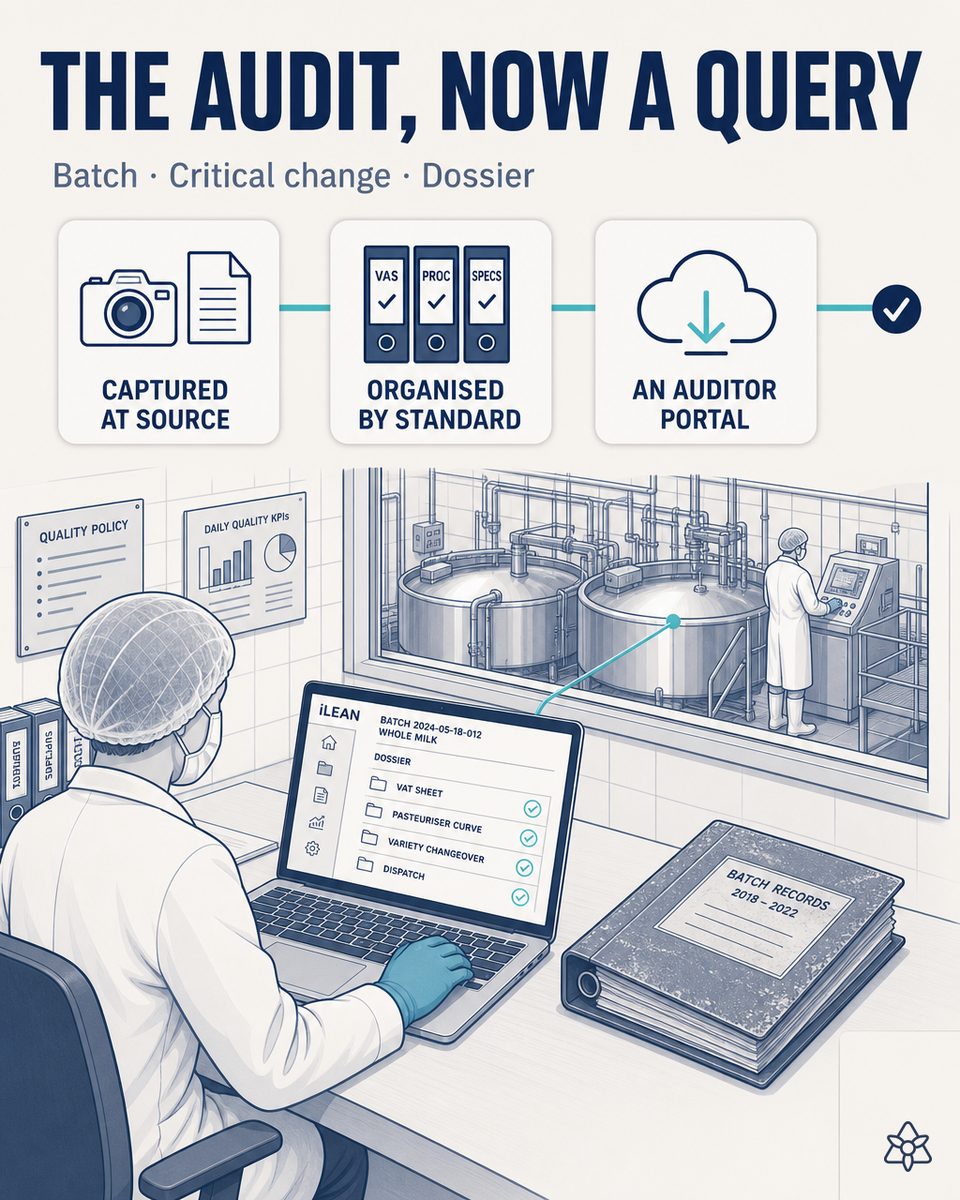
The evidence exists — but on five different media and none indexed by batch.
It sits in charts, sheets, spreadsheets and signatures. The problem is not that it is missing: it is that reconstructing a specific batch's complete traceability is a project, not a query:
- The auditor asks for proof, the plant shows papers — and the nonconformities end up coming from documentary gaps more than from real process failures.
- One or two weeks of quality work per audit — and it is the same people who should be improving the process who spend it searching and cross-referencing.
- And in large retail it does not happen once a year — supplier approvals and customer audits are recurring. It is not a one-off effort: it is a permanent tax on the quality department.
The consequence is that a dairy's quality is measured to a large extent by its ability to reconstruct papers, when it should be measured by its ability to control the process.
Agents over central memory — the evidence is already inside, it only has to be ordered.
The way for audit preparation to cost hours instead of weeks is for every critical event to deposit its proof the moment it happens. The previous cases do that; Agents only has to group and map.
Every event — vat sheet, pasteurizer curve, tablet-signed validation, laboratory result, seal camera rejects, variety changeover photos — enters central memory with its batch, its time and its signature. Agents groups them by batch, by critical changeover and by period, and maps them against each standard's requirements.
How a batch's evidence pack is composed:
- Everything enters with batch, time and signature — the condition that makes the rest possible. A data point without a batch is not evidence, it is a note.
- Grouping by batch, by critical changeover and by period — the three views asked for in practice: a specific batch's traceability, a variety changeover's evidence and a date range's history.
- Mapping against each standard — what IFS Food asks, what BRCGS asks and what that chain's specific questionnaire asks. The same evidence, presented as each framework demands.
- A downloadable, navigable package — with the pieces of evidence linked to each other, so from a batch's test results you reach its vat sheet and its pasteurization curve.
- The gaps, flagged before the auditor does — if a batch is missing a proof, the pack marks it while it can still be corrected. It is the difference between a correction and a nonconformity.
A hand-reconstructed audit vs. an evidence pack generated at the source
| Aspect | Manual reconstruction | With iLEAN Agents |
|---|---|---|
| Audit preparation | 1-2 weeks of quality work | Hours |
| Answering an approval questionnaire | Days | The same day |
| Nonconformities for incomplete traceability | Come from the gaps | Estimated reduction ≥60% |
| A specific batch's traceability | A project | A query |
| Adaptation to IFS, BRCGS or a chain questionnaire | The dossier is redone | Same evidence, different mapping |
| Detecting a documentary gap | The auditor does it | The system does it, earlier |
Impact estimate for your plant — to be validated with your own numbers.
The block below is an estimate to be validated against your plant's actual data. We put it forward so the committee has an order of magnitude; we refine it during the assessment.
- Fresh cheese dairy with large-retail certifications and recurring approval questionnaires from several chains.
- Deployment resting on the Connect and Edge cases already running: they deposit the evidence, Agents groups and maps it. First value expected within a few weeks of events being recorded.
- Indicative payback between 6 and 12 months counting only the quality hours freed. Estimate to be validated with the real number of audits and questionnaires per year.
- The real value is commercial, not savings: being able to answer a purchasing center fast and with evidence is a sales argument. In large retail, response speed to a questionnaire is part of the supplier evaluation.
- And the effect on the team: quality stops being a function that reconstructs papers and goes back to being one that controls the process.
And the fair question from the quality manager
"Will an auditor accept a dossier assembled by AI?" — the auditor does not accept the dossier, they accept the evidence: the photo, the curve, the test result, the signature and the time, which are the same ones previously scattered. Agents generates no new content: it groups and maps existing evidence against a known standard, which is an anchored task — where the best models brought the error below 1.5% [1]. And if a proof is missing, the pack flags it as a gap instead of disguising it.
[1] OpenAI paper "Why Language Models Hallucinate", 2025 — on the reliability of AI in anchored tasks.
What people ask about a dairy's evidence pack
Why does reconstructing traceability cost one or two weeks?
Because a batch's evidence is spread across five different media and none indexed by batch: the pasteurizer's curve on a paper chart, the vat sheet in a folder, the test results in a spreadsheet, the validation in a signature and the line rejects in the machine itself. Gathering all that for a specific batch forces cross-referencing dates and times by hand, and trusting it adds up. It is not a tidiness problem: no system was designed to answer the question "show me this batch".
Does the AI write the evidence?
No: it groups and maps it. Every element of the package is a record that already existed — a photo captured by Edge at the variety changeover, a curve read from the pasteurizer's panel, a test result fed from the laboratory folder, a signature from the validation tablet — and is traceable to its origin. There is no free content generation: there is classification of existing documents against a known index. And before the package leaves the plant, quality reviews it, just as they would review one prepared by hand.
How does it adapt to IFS, BRCGS and each chain's questionnaires?
By maintaining a single source of evidence and several views. The base proof — the thermal curve, the vat sheet, the batch's test results, the changeover's signature — is the same regardless of who asks for it; what changes is how it must be ordered and what counts as sufficient in each framework. Agents maps the same evidence against each one's requirements, so the same batch serves IFS Food, BRCGS and a chain's specific questionnaire without reassembling anything from scratch.
What happens if a batch is missing a proof?
The pack marks it as an explicit gap and does so before the auditor arrives — which is this case's most valuable function. Today documentary gaps appear with the auditor present, and at that moment they are a nonconformity. With the evidence deposited at the source, the system can warn that a batch is missing the signed variety changeover validation while the exception can still be documented or the process that caused it corrected. A visible, explained gap is manageable; a dossier that looks complete without being so is what triggers a major nonconformity.
Why do you say the value is commercial and not only savings?
Because in large retail the response speed to an approval questionnaire is part of the supplier evaluation. A purchasing center that asks for evidence and receives it the same day, complete and navigable, gets a different signal from a supplier that takes a week to gather it. The saving in quality hours is real and can be calculated, but the lever that moves management is usually the other one: being able to enter an approval, or defend a listing, with the evidence already made.
More cases from this series
- Two modern machines that finally talk to each otherVariety, batch and expiry date travel from the ERP to the coder via API. Zero manual typing at the…
- The laboratory stops typing the same thing twiceiLEAN reads the quality control sheet when saved, ties it to the batch and feeds it into the ERP after…
- The notice read late today, resolved before the tanker arrivesThe collection center’s notice, cross-referenced with the vat plan and live orders, returns the…
- Traceability starts at the dock, not at the vatA photo of the delivery note and the test bulletin: receiving enters the ERP after one validation tap.…
- The AI proposes, the human signs, and only the signed crossesVariety, batch and expiry are confirmed on a tablet at the packing machine. Nothing enters the central…
- The pasteurizer stays the same — but now it talksAn external camera reads the HTST pasteurizer’s panel and digitizes the thermal curve per batch. Without…
How many weeks a year does your quality team spend preparing audits?
We work on your dairy's real data, not ours. We review what evidence you generate today and what would be missing to download the package. Assessment with no commitment.
Recover them with iLEAN Agents ‹ See all 12 fresh cheese cases See food industry