The line does not start until there is evidence, not just a signature
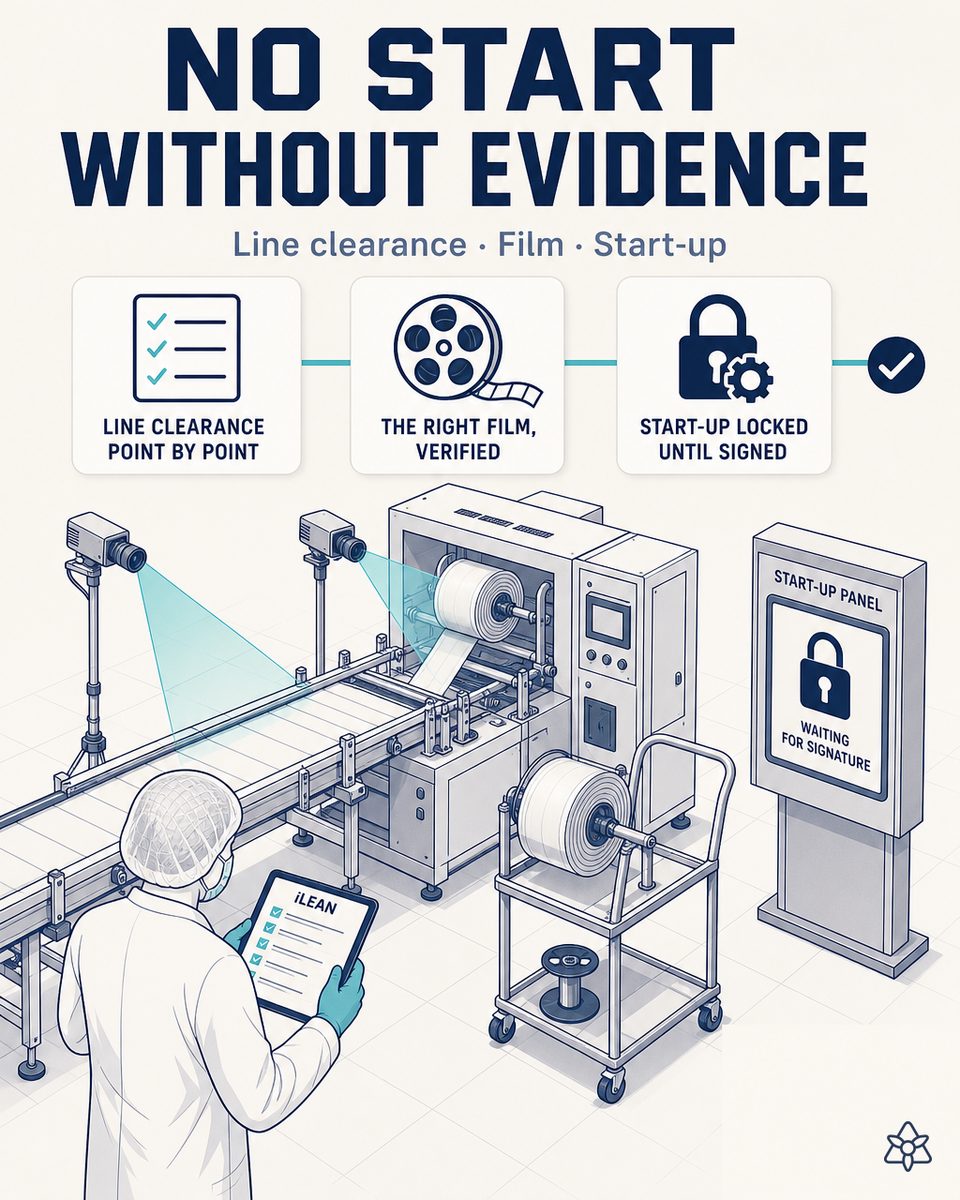
In a fresh cheese dairy the critical changeover is not gluten: it is going from cow to goat, from salted to salt-free, or from lactose to lactose-free on the same line. The physical difference between a correct product and a declared-intolerance incident lies in which film reel is mounted and what the coder prints. With Edge cameras at the critical points, the line does not start until all give OK and quality signs.
The same white 250 g piece exists in at least five different declarations.
Every jump between them demands a CIP cleaning and a change of film reel, signage and parameters — all manual changes, made in a hurry, between two productions:
- Permission to start depends on a signature — a human signs that the line is clean and ready. That signature is honest, but it is not evidence: nobody can demonstrate two months later exactly what was seen at startup.
- If the start goes wrong, the first pallet leaves with the previous variety's film — that is, with a milk or lactose declaration that does not correspond to the product inside.
- And that is not an inventory error — in a product with a species or intolerance declaration, it is a legal composition and food safety incident.
The risk concentrates there and only there: with the variety in steady state the line is stable. The problem is that that instant repeats several times a week, in a hurry and leaving no comparable trace.
Edge + JIDOKA AI — the AI does not authorize the startup: it prepares it so a human authorizes it with grounds.
The solution is not a longer checklist for the quality manager: it is giving them objective visual evidence of each point before they sign, and making the line unable to start while that evidence is incomplete.
Fixed Edge cameras at each critical point: dosing hopper, molds, belts, sealer head, mounted film reel and in-line variety signage. iLEAN compares the current image with the reference for the "clean and ready" state of that specific variety, including the film reel and its readable text.
How Edge operates on the variety changeover:
- Comparison against that variety's reference state — not a generic cleanliness check: the current image against how that point must look when the line is ready for that specific declaration.
- The film reel, with its readable text — it is the point where the legal declaration is decided, so it is verified that the mounted reel is the right one and that what it prints matches.
- If any point does not match, the line does not start — and the screen indicates exactly which one and why, instead of a generic "nonconforming" that forces reviewing everything.
- The AI prepares the decision, the human takes it — the quality manager receives the set of evidence and signs. The AI does not authorize the startup: it prepares it so a human authorizes it with grounds. Humans in command.
- And afterwards, SMED AI — once the cycle stabilizes, it identifies which changeover steps can overlap, so verifying is not paid for in line time.
A signature with no evidence vs. a changeover validated point by point
| Aspect | Classic variety changeover | With iLEAN Edge + JIDOKA AI |
|---|---|---|
| Basis of the startup authorization | An honest signature, with no backing | Visual evidence per critical point |
| Mounted film reel | Checked by eye, in a hurry | Verified against the variety, with its readable text |
| First pallet with the previous labeling | Happens | Zero |
| Startup with a nonconforming point | Possible | Blocked, indicating which one and why |
| Evidence of the startup | A signature on paper | An automatic photographic dossier |
| Changeover time with full validation | The current manual cycle | Estimated reduction ≥25% |
Impact estimate for your plant — to be validated with your own numbers.
The block below is an estimate to be validated against your plant's actual data. We put it forward so the committee has an order of magnitude; we refine it during the assessment.
- Fresh cheese dairy packing at least five different declarations on the same line, with CIP cleaning and a reel change between productions.
- Edge + JIDOKA AI pilot on the changeover's critical points, with startup blocking and a photographic dossier. Without changing the changeover procedure or who signs. First value expected within a few weeks.
- Indicative payback between 5 and 11 months on recovered changeover time alone. Estimate to be validated.
- The real value lies in the avoided recall, which is not counted here to avoid duplicating it: it is counted in the flagship case.
- A benefit that appears on its own: the startup's evidence goes from a paper signature to a photographic dossier that later feeds the evidence pack with no extra work.
And the fair question from the production manager
"Won't this lengthen every changeover?" — the opposite: the starting estimate is a 25% reduction of the changeover time with full validation, because the verification replaces the repeated checks and the post-startup readjustments. And on reliability, comparing a point's image against its validated reference state is an anchored task, where the best models brought the error below 1.5% [1]. The AI authorizes nothing: it prepares the decision so quality signs it with grounds.
[1] OpenAI paper "Why Language Models Hallucinate", 2025 — on the reliability of AI in anchored tasks.
What people ask about validating the variety changeover
Which points exactly are verified?
The ones determining whether the product about to leave corresponds to the declaration printed on it: the dosing hopper, the molds, the belts, the sealer head, the mounted film reel and the in-line variety signage. Each has its camera and its separate verdict, because if something fails you must know which point to redo without redoing the whole changeover. The list is tuned at the assessment to the real line, since not all plants have the same points where the changeover goes wrong.
Why is the film reel so critical?
Because it is where the legal declaration materializes. In a fresh cheese dairy, the same white 250 g piece can be cow, goat, blend, salt-free or lactose-free, and the physical difference between a correct product and a declared-intolerance incident lies literally in which reel is mounted and what the coder prints. That is why the verification does not stop at "there is a reel mounted": it checks it is the one corresponding to that variety and that its text is readable and matches. It is the point where an oversight stops being an inventory matter and becomes food safety.
Does the AI authorize the startup?
No, and the distinction is deliberate: the AI does not authorize the startup, it prepares it so a human authorizes it with grounds. The cameras verify point by point and JIDOKA AI keeps the line held while something does not match, but the one who signs is still the quality manager. What changes is not who decides, but with what: today "the line is clean and ready" is signed with nothing behind it but the visual check itself, done in a hurry; with Edge it is signed on the set of evidence of each point. Humans in command, with better information.
Doesn't this lengthen the changeover time?
The starting estimate is the opposite: a reduction of at least 25% in the changeover time with full validation versus the current manual cycle. The reason is that the verification is not added to the changeover, it replaces something else — the repeated "just in case" checks and, above all, the post-startup readjustments when something was off. Furthermore, once the cycle stabilizes, SMED AI identifies which changeover steps can overlap. It is an estimate to be validated with your line's real times.
What is recorded of each changeover?
An automatic photographic dossier: the image of each critical point, each one's verdict, the time and the signature of whoever authorized. That replaces the paper signature which today is all that remains. The difference shows two months later, when someone asks exactly what was seen at that startup: today the answer is that it was signed, and with Edge the answer is the images. That same dossier later feeds the batch's evidence pack without anyone preparing it, which is where this case connects with the rest of the matrix.
More cases from this series
- The audit stops being a project and becomes a queryEvery batch and every changeover generate their dossier on their own: photos, thermal curve, test…
- Two modern machines that finally talk to each otherVariety, batch and expiry date travel from the ERP to the coder via API. Zero manual typing at the…
- The laboratory stops typing the same thing twiceiLEAN reads the quality control sheet when saved, ties it to the batch and feeds it into the ERP after…
- The notice read late today, resolved before the tanker arrivesThe collection center’s notice, cross-referenced with the vat plan and live orders, returns the…
- Traceability starts at the dock, not at the vatA photo of the delivery note and the test bulletin: receiving enters the ERP after one validation tap.…
- The AI proposes, the human signs, and only the signed crossesVariety, batch and expiry are confirmed on a tablet at the packing machine. Nothing enters the central…
How many variety changeovers do you run a week?
We work on your dairy's real data, not ours. With your changeover frequency we calculate the case with you. Assessment with no commitment.
Turn them into auditable evidence with iLEAN Edge ‹ See all 12 fresh cheese cases See food industry