The defect invisible here and visible at the customer’s home
Fresh cheese releases whey. If a drop stays on the seal flange, if the film wrinkles or if a piece of curd gets in the way, the weld does not close well. The package looks correct leaving the machine and loses vacuum days later, already on the shelf. With an Edge camera and millisecond inference, the defective tub is ejected before entering the cold room.
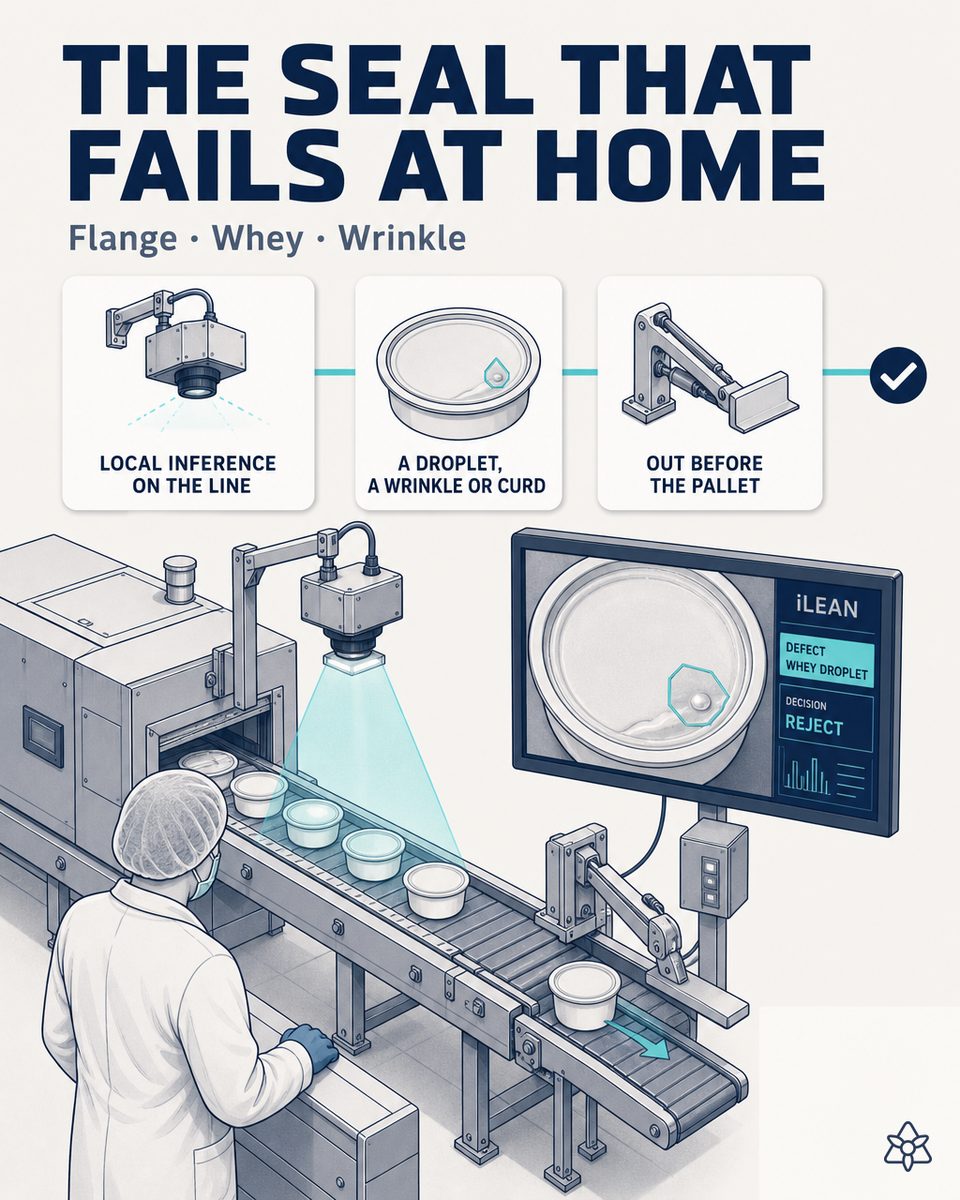
The wet fresh product's characteristic defect: invisible here and visible at the customer's home.
The sealing failure has the worst possible property for a refrigerated product — it manifests far from where it is produced, and by then there is nothing to be done:
- At line rate the human eye cannot reliably tell a slightly damp flange from a dry one. It is not a lack of attention: it is a physical limit, just as you cannot read at conveyor speed.
- It manifests as a return, a retail chain claim and shrinkage — days later, when the package loses vacuum on the shelf and the product is already in the distributor's hands.
- And it attacks the brand argument — in a product sold under the promise of natural and preservative-free, a package losing vacuum is not a packaging defect: it is a contradiction of the promise.
What makes this defect especially expensive is that it gives no signal in the plant. The pallet leaves looking correct, the cold and the transport get paid, and the problem appears when the cost is already fully spent.
Edge — in-line AI vision, local inference and ejection before the cold.
The problem is not one of judgment but of rate and resolution: every flange has to be looked at, always the same way, at the machine's speed. That is exactly where machine vision does not tire.
An industrial camera over the tray sealer's exit with controlled lighting. A network trained on the plant's real images: clean flanges, with whey, wrinkled film, shifted film, trapped curd. Local inference in milliseconds and an ejection signal before entry into the cold room.
How Edge operates on the tray sealer:
- Controlled lighting — half the problem of seeing whey on a flange is the light. Own, stable lighting makes the drop look the same on the shift's first tub and its last.
- Trained on your plant's real images — not a generic catalog: clean flanges, flanges with whey, wrinkled film, shifted film and trapped curd, as they occur on your line with your product.
- Local inference, not depending on the cloud — in milliseconds, with no network latency. If the plant loses connectivity, the line keeps inspecting and ejecting.
- Ejection before the cold — the defective piece never even gets palletized. The cost of chilling it, transporting it and collecting it later is avoided.
- Every reject with its image — which lets you see whether the defect clusters by film reel, by format change or by time slot, and act on the cause instead of the piece.
Sealing with no in-line control vs. 100% Edge inspection
| Aspect | Human control at rate | With iLEAN Edge |
|---|---|---|
| Detecting whey on the flange | Not reliable at real rate | On every tub, in milliseconds |
| Where the defect manifests | On the shelf, days later | At the sealer's exit |
| Sealing defects reaching the customer | The ones sampling misses | Estimated reduction ≥70% |
| Returns and packaging claims | A recurring cost | Estimated reduction ≥50% |
| Cost of the rejected piece | Cold, transport and reverse logistics | Only the tub, before the cold |
| Root cause by reel or by change | Invisible | Evident: every reject with its image |
Impact estimate for your plant — to be validated with your own numbers.
The block below is an estimate to be validated against your plant's actual data. We put it forward so the committee has an order of magnitude; we refine it during the assessment.
- Fresh cheese tub packing line with a tray sealer and vacuum-loss returns.
- Edge pilot on the tray sealer's exit: camera with controlled lighting, local inference and an ejection actuator before the cold room. First value expected within a few weeks.
- Indicative payback between 6 and 12 months depending on line rate and the current cost of returns. Estimate to be validated with the real claim and packaging shrinkage figures.
- The return appearing after the first month is the cause map: with rejects grouped by reel, by format change and by time slot, you stop acting on the piece and start acting on what produces it.
- And the lever that goes unaccounted: in a product sold as natural and preservative-free, a package losing vacuum attacks the brand argument, not only the margin.
And the fair question from the line manager
"What if the camera ejects good tubs and sinks my yield?" — the right concern, and that is why the threshold is calibrated with real images from your line, not from the factory. Hallucination, moreover, is a problem of free generation: classifying an image against a pattern trained on your own product is an anchored task, where the best models brought the error below 1.5% [1]. And since every reject keeps its image, checking whether the threshold is well set is a matter of looking, not arguing.
[1] OpenAI paper "Why Language Models Hallucinate", 2025 — on the reliability of AI in anchored tasks.
What people ask about seal inspection with AI vision
Why can't a person on the line detect it?
Because it is not an attention problem but a physical limit. At a tray sealer's rate, reliably telling a slightly damp flange from a dry one, tub after tub, is beyond the human eye — just as you cannot read a text at conveyor speed. And the defect does not help: a drop of whey on the flange does not alter the package's appearance, so there is not even an obvious visual signal to look for. The package leaves looking correct and loses vacuum days later, already on the shelf.
What exactly does the camera detect?
The real failure modes of sealing in a wet fresh product: whey on the flange, wrinkled film, shifted film and trapped curd in the weld area. The network is trained with images from your own plant — clean flanges and flanges with each of those defects — because what is tolerable depends on the format, the film and the product. A generic packaging defect catalog does not know those borders and produces two problems at once: it ejects the good and lets the bad through.
Can it keep up with the line's rate?
Yes, because inference happens locally, on a terminal at the line, and is counted in milliseconds per tub. That is the reason for not using the cloud: neither the latency nor the cost of continuously uploading images fits a packing machine's pace. It also has a welcome effect: if the plant loses connectivity, the line keeps inspecting and ejecting, because the critical cycle does not depend on the network. What syncs afterwards is the reject record, not the decision.
Why eject before the cold room?
Because it is the last point where the defective tub costs only what the tub is worth. From there on it accumulates cold, palletizing, transport and, if it reaches the customer, reverse logistics and claim handling. Ejecting before the cold means the piece never even gets palletized: nothing is paid to chill, move or recover a package already known to be defective. It is the same logic of stopping the defect where it is born, applied to the exact point where the cost is still minimal.
How is the cause attacked and not just the piece?
Because every reject is recorded with its image and its context — time, format, film reel in use. With that, the question stops being how many tubs were ejected and becomes where they cluster: whether the defects concentrate on a specific reel, right after a format change or in a given time slot. Those three groupings point to different causes — film quality, changeover adjustment, temperature or wear — and each has a different action. Without that granularity, all you can do is keep ejecting.
More cases from this series
- The audit stops being a project and becomes a queryEvery batch and every changeover generate their dossier on their own: photos, thermal curve, test…
- Two modern machines that finally talk to each otherVariety, batch and expiry date travel from the ERP to the coder via API. Zero manual typing at the…
- The laboratory stops typing the same thing twiceiLEAN reads the quality control sheet when saved, ties it to the batch and feeds it into the ERP after…
- The notice read late today, resolved before the tanker arrivesThe collection center’s notice, cross-referenced with the vat plan and live orders, returns the…
- Traceability starts at the dock, not at the vatA photo of the delivery note and the test bulletin: receiving enters the ERP after one validation tap.…
- The AI proposes, the human signs, and only the signed crossesVariety, batch and expiry are confirmed on a tablet at the packing machine. Nothing enters the central…
How many returns a year do you have for defective packaging?
We work on your dairy's real data, not ours. With images from your own line we show you what it detects. Assessment with no commitment.
Put an Edge camera over my sealer ‹ See all 12 fresh cheese cases See food industry