The vat sheet stops living in a lab coat pocket
In a fresh cheese dairy, the vat sheet is the batch's DNA: liters, the day's cow and goat ratio, rennet dose, curdling temperature and time, cutting time and draining pH. Today that paper spends six to ten hours in a lab coat pocket before someone transcribes it — if they transcribe it. With iLEAN Connect, the cheesemaker takes a photo when the vat opens and the batch already exists in the central system at second zero.
The day's real recipe is decided by hand — and stays on the paper.
In fresh cheese, the milk ratio is adjusted daily according to how the raw material comes in, so each day has a real recipe different from the ERP's theoretical one. That artisanal decision — the one that homogenizes the flavor all year round — is noted by hand and stays there:
- The paper lives in a wet area, handled with gloves — it gets wet, smudged and sometimes disappears. Nobody counts how many sheets are lost per year, simply because there is nothing to compare against.
- Six to ten hours of latency, with luck — the sheet is transcribed at the end of the shift, the next day, or not at all. In that stretch, what happened in the vat and what the system knows do not match.
- "A bit more goat" is not a queryable data point — it is a handwritten note. And it is exactly the information that would explain a texture deviation three weeks later.
When a texture claim arrives from a retail chain, the only way to know what was done that day is hunting for a paper in a folder. The correlation between blend, texture and claim simply does not exist.
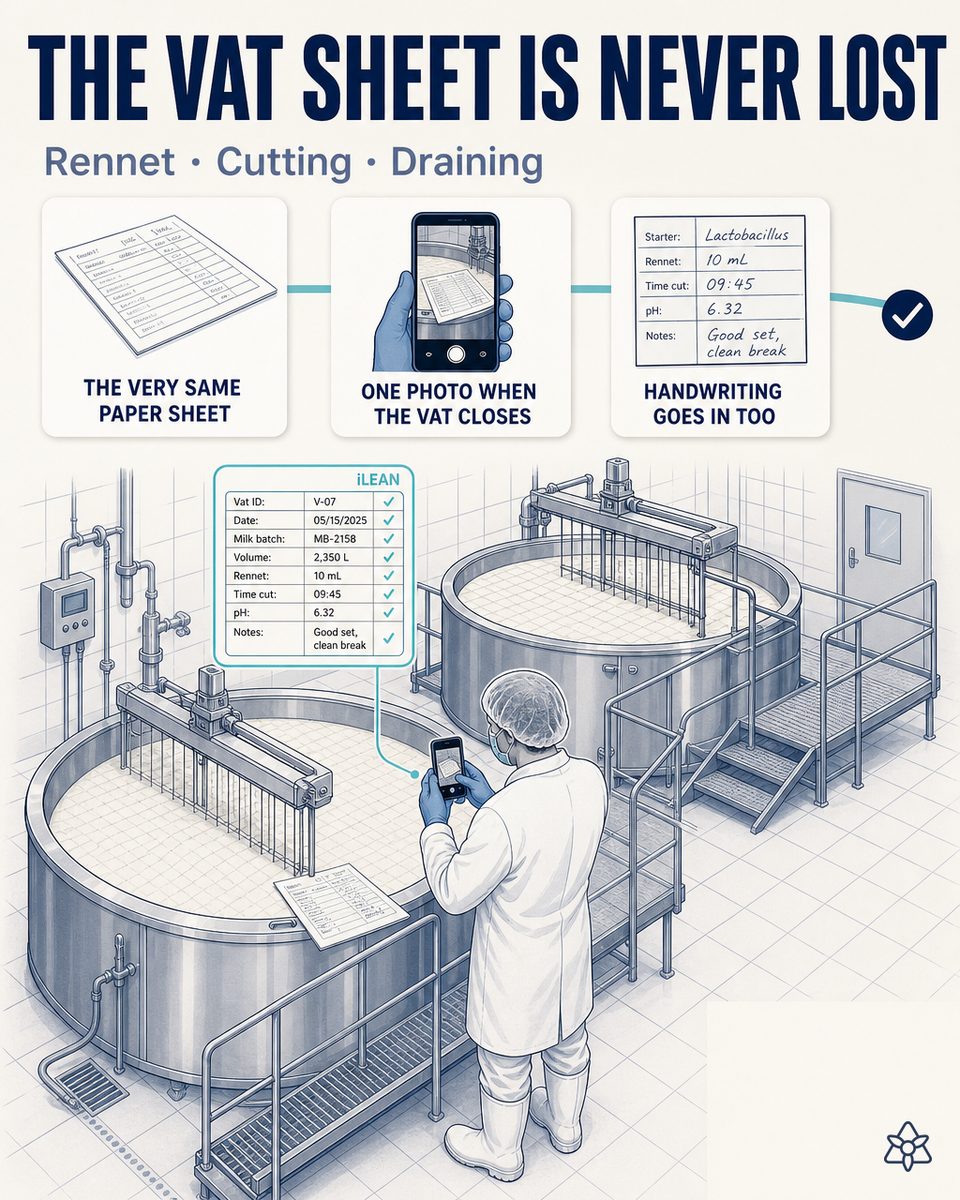
Connect in photo-the-analog mode — the same sheet, plus a photo when the vat opens.
Digitizing the vat sheet does not demand redesigning it or asking the master cheesemaker to type with gloves in a wet area. It demands that what is already written reaches central memory the moment it is written. That is what Connect in photo-on-paper mode is for.
The master cheesemaker photographs the sheet with the phone or an industrial tablet when opening the vat. One gesture, two seconds. An anchored model recognizes the sheet's structure and extracts vat, liters, cow and goat percentage, source milk batch, rennet dose, curdling temperature and time, cutting time, pH and the incidents noted in the margin.
How Connect photo operates on the vat sheet:
- Zero habit change — the cheesemaker keeps writing the sheet as always. What changes is that the paper stops being the only medium where the data exists.
- Anchored to the house's real sheet — the model knows that sheet's specific structure: which box holds the liters, which the percentage of each milk, which the draining pH. It does not do generic OCR: it extracts known fields.
- The margin incidents enter too — "a bit more goat", "the milk came in cold" — are kept as searchable text tied to the batch. It is what later explains the "why" when the number only says the "how much".
- Associated with the batch from the first minute — the fields enter central memory tied to the batch, not to the clock, which is what allows crossing them later with anything else.
- Crossable with everything downstream — the pasteurization curve, the laboratory's test results and the product's final outcome. The blend ↔ texture ↔ claim correlation goes from impossible to immediate.
Paper vat sheet vs. sheet digitized with Connect
| Aspect | Classic handwritten sheet | With iLEAN Connect photo |
|---|---|---|
| Sheet → central memory latency | 6-10 h, or total loss of the sheet | Second zero — a photo when the vat opens |
| Reconstructing a specific day | Digging through a folder | A per-batch query in seconds |
| Blend ↔ texture ↔ claim correlation | Impossible | Immediate |
| The day's real recipe (cow/goat) | An artisanal decision that dies on the paper | A structured field per batch |
| Sheets lost in the wet area | Happens and goes uncounted | The photo survives even if the paper does not |
| The master cheesemaker's habit | The same paper — and a late transcription | The same paper — plus a photo |
Impact estimate for your plant — to be validated with your own numbers.
The block below is an estimate to be validated against your plant's actual data. We put it forward so the committee has an order of magnitude; we refine it during the assessment.
- Fresh cheese dairy with several vats a day, a handwritten sheet in the wet area and a milk ratio adjusted daily.
- Connect photo pilot on the vat sheet — with the phone or the industrial tablet already in the plant, without redesigning the sheet or changing the standard. First value expected within a few weeks.
- Indicative payback between 4 and 9 months depending on the number of vats per day, counting the transcription time recovered by the production manager and the quality technician, plus the sheets lost today. Estimate to be validated.
- The lever that weighs most is not the typing saved: it is that the artisanal decision gets recorded. The daily blend adjustment is what homogenizes the flavor all year round, and today it lives only in the cheesemaker's head and hand.
- It is also the enabler of the rest of the matrix: without the batch existing in central memory from second zero, no downstream analysis — pasteurization curve, test results, evidence pack — starts from real data.
And the fair question from the quality manager
"What if the model misreads the cheesemaker's handwriting or confuses a pH?" — hallucination is a problem of free generation, not of anchored tasks. Here the AI limits itself to recontextualizing what is already written against the house's real template: it is the class of task where the best models brought the error below 1.5% [1]. And even then, a doubtful field is held and a person confirms before the record counts. The three safety rings are there precisely for this.
[1] OpenAI paper "Why Language Models Hallucinate", 2025 — on the reliability of AI in anchored tasks.
What people ask about digitizing the vat sheet
Does the vat sheet have to be redesigned?
No, and it is a design condition. The sheet stays exactly as it is because it works and is tuned to how that dairy really operates: its boxes, its order, its space for margin notes. The model anchors to that specific structure, not the other way round. Nothing to normalize and nothing different for the master cheesemaker to fill in. Since the change to the standard is minimal — a photo when the vat opens — the habit holds after the pilot without auditing discipline, which is where most wet-area digitizations fail.
Does it work with the wet or smudged paper of a wet area?
It is the normal scenario and that is why the model is anchored: it knows what data to expect in each box, so it can resolve a partially smudged digit leaning on context — a draining pH has a plausible range, a vat's liters do too. When a field still arrives doubtful, it does not invent: it is held and flagged for a person to confirm. And there is an effect usually overlooked: the photo is taken when the vat opens, when the paper is clean and freshly written, not at the end of the shift when it has spent hours in a coat pocket.
What happens with the notes written in the margin?
They are kept, and they tend to be the most valuable part. "A bit more goat", "the milk came in cold", "the curd took longer today" are the notes that truly explain what happened that day, and they are exactly the ones that fit in no ERP field and vanish in transcription. Connect stores them as searchable text tied to the batch. It does not try to turn them into a number or interpret them: it presents them as observations and keeps them available for whenever someone investigates that day or that claim.
How is this correlated with a texture claim?
Because the sheet stops being a loose paper and becomes a crossable record. When a claim arrives from a retail chain three weeks later, the question is always the same: what was done that day. With Connect, that batch's real cow-goat blend, rennet dose, temperature and draining pH are in central memory, and they can be put next to the pasteurization curve and the laboratory's results. The correlation between blend, texture and claim goes from nonexistent to a query.
How long until it delivers value?
A pilot on one vat line can deliver value within a few weeks: anchor the model to the house's sheet and start accumulating days. The first deliverable is not a dashboard, it is something simpler: being able to answer, for a specific date, with which blend and which parameters each vat was made, without hunting a single paper. From there, every week of history makes the correlation between the day's real recipe and the product's outcome more solid — which is the base Edge inspection and the batch evidence pack later rest on.
More cases from this series
- The audit stops being a project and becomes a queryEvery batch and every changeover generate their dossier on their own: photos, thermal curve, test…
- Two modern machines that finally talk to each otherVariety, batch and expiry date travel from the ERP to the coder via API. Zero manual typing at the…
- The laboratory stops typing the same thing twiceiLEAN reads the quality control sheet when saved, ties it to the batch and feeds it into the ERP after…
- The notice read late today, resolved before the tanker arrivesThe collection center’s notice, cross-referenced with the vat plan and live orders, returns the…
- Traceability starts at the dock, not at the vatA photo of the delivery note and the test bulletin: receiving enters the ERP after one validation tap.…
- The AI proposes, the human signs, and only the signed crossesVariety, batch and expiry are confirmed on a tablet at the packing machine. Nothing enters the central…
How many vat sheets are written per day in your plant?
We work on your dairy's real data, not ours. We show you the reading working on your own vat sheet. Assessment with no commitment.
Calculate my return with an iLEAN consultant ‹ See all 12 fresh cheese cases See food industry