Busy hands, free voice: the shift’s knowledge stops evaporating
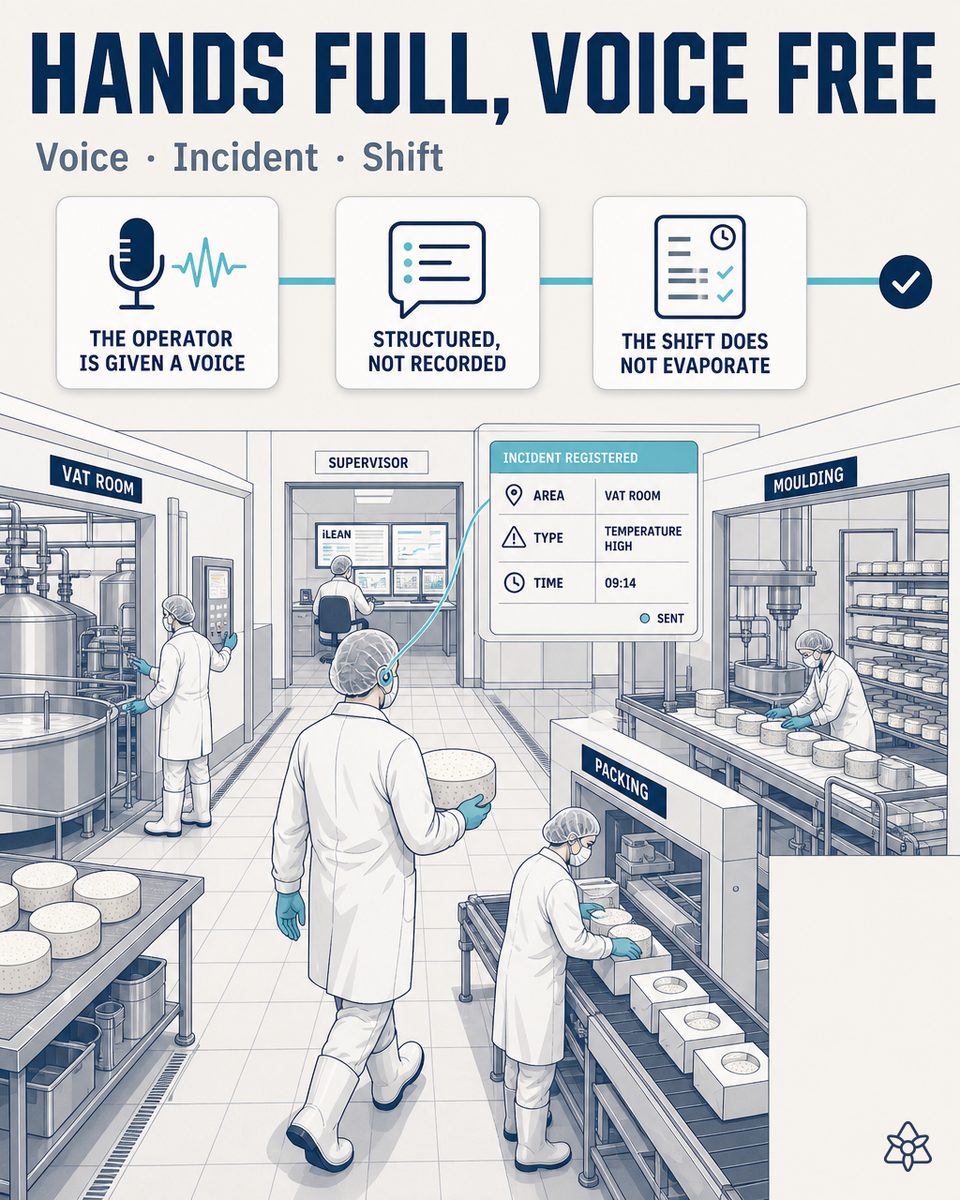
The room lead is the person who knows most about what is happening in the plant right now, and all that information dies at the end of the shift or gets summarized into three lines of a report. With an earpiece and Connect in voice mode, they talk to the AI without stopping walking; it listens to what they decide to tell it, structures it against the active batch and returns support in seconds.
The reason that knowledge reaches no system is physical, not cultural.
In a production room you work with gloves, with wet hands and in an environment where every surface is a hygiene concern. There, any interface demanding writing loses the game before it starts:
- Typing on a tablet is awkward and impractical — it is not a matter of will or training: the environment forbids it. A system asking for writing in the moment simply does not get used.
- Information is passed on orally at handover and evaporates — what gets told in five minutes next to the vats stays nowhere, and of the entire shift three or five lines of a report survive.
- What gets lost is exactly what would be needed later — "this morning's vat drained oddly" is exactly the observation that would explain a texture claim next week. And it was not recorded.
When someone asks three weeks later, the answer starts with "I seem to remember that day". It is nobody's failure: the system was asking for something incompatible with working in a dairy room.
Connect in voice mode — the room lead is given a voice, not put under watch.
The difference between recording and capturing is structure and control. The earpiece does not listen to the room: it listens to what the room lead decides to tell it, and turns it into a record tied to the active batch and vat.
A Bluetooth earpiece compatible with the hygiene equipment, under the hairnet or cap. The room lead dictates what they want to record while walking — a process observation, a notice to quality, a machine incident — and iLEAN structures it against the active batch and vat and returns spoken support in seconds.
How Connect operates in voice mode in a production room:
- Compatible with the hygiene equipment — the earpiece is worn under the hairnet or cap, without compromising the area's standard. Nothing to take off and no surface to touch.
- It listens to what is addressed to it — the operator is not put under watch, they are given a voice. The room lead decides what to tell and when; outside that, nothing is transcribed or stored.
- Structured against the active batch and vat — the system already knows which vat and batch are running, so "this one drained oddly" lands tied to its place on its own, without the lead reciting references.
- A spoken return in seconds — it confirms the record, notifies the right role and answers context queries without a trip to the office. A system that only stores gets abandoned; one that returns something useful sustains itself.
- An immediate notice to quality or maintenance — what today waits for "when I see them" reaches the relevant role in seconds, with the batch and vat already attached.
Knowledge that evaporates vs. knowledge that enters the system
| Aspect | Without voice capture | With iLEAN Connect voice |
|---|---|---|
| Observations recorded per shift | The 3-5 lines of a report | The dozens actually produced |
| Latency of a notice to quality or maintenance | "When I see them" | Seconds |
| Lead's time out of the room to leave a record | Piles up every shift | Practically zero |
| Link to batch and vat | Depends on someone remembering | Automatic, the system knows what is active |
| Observation ↔ later claim correlation | "I seem to remember that day" | A per-batch query |
| Compatibility with the room's hygiene | Typing with wet gloves | Hands-free, under the cap |
Impact estimate for your plant — to be validated with your own numbers.
The block below is an estimate to be validated against your plant's actual data. We put it forward so the committee has an order of magnitude; we refine it during the assessment.
- Fresh cheese dairy with a room lead walking between vats all shift, with gloves and busy hands.
- Connect voice pilot with an earpiece for the lead, anchored to the active batch and vat. First value expected within a few weeks: the volume of what surfaces always surprises.
- Indicative payback between 5 and 10 months, through early detection of deviations that today are only seen in the final product and through the lead's recovered hours. Estimate to be validated.
- The honest way to size it is empirical: one month of earpiece and counting how many observations surfaced that were not recorded before and how many were recurring.
- A side benefit that tends to weigh: when the veteran lead retires or changes shift, part of their judgment stays in the system instead of leaving with them.
And the fair question from the works council
"Is this an open microphone over the room?" — no, and the distinction is exactly the opposite: the operator is not put under watch, they are given a voice. The earpiece captures what the lead decides to dictate, just as if they wrote it in a notebook; it does not listen continuously and does not pick up conversations with anyone. What is stored are process observations tied to the batch and the vat. And reliability plays on anchored ground: structuring a short dictation against a known context is the class of task where the best models brought the error below 1.5% [1].
[1] OpenAI paper "Why Language Models Hallucinate", 2025 — on the reliability of AI in anchored tasks.
What people ask about voice capture in a dairy room
Does the earpiece listen the whole shift?
No. iLEAN listens to what the lead addresses to it: they decide when to speak to it and what to tell it, just as they would decide what to jot in a notebook. There is no continuous listening of the room, no conversations with colleagues are picked up and their activity is not logged. What stays in the system are process observations tied to the active batch and vat. It is a distinction worth making clear with the works council before the pilot, and it holds up technically: outside what they address to the system, nothing is transcribed or sent.
Is it compatible with the room's hygiene standard?
Yes, and it is a starting requirement, not an add-on. The earpiece is a Bluetooth device worn under the hairnet or cap, not exposed and forcing no surface contact during the shift. That detail is exactly what makes capture viable in a production room: any solution demanding pulling a phone from a pocket, removing a glove or handling a tablet with wet hands does not get used, however good it is. Here the gesture is speaking, which is the only thing the environment allows at no cost.
How is it different from recording a voice memo?
In structure and in context. A voice memo is a file that has to be listened to again, transcribed and classified, and that in practice nobody reopens. Connect turns the dictation into a structured record tied to the active batch and vat, so "this one drained oddly" stays tied to a specific vat, an hour and a batch — without the lead reciting any reference. That is what later allows counting how often something repeats, grouping it by milk origin or crossing it with a claim. An audio file allows none of that.
What does the system return besides storing?
Support in the moment, which is what makes the lead really use it. It confirms the record is made, notifies the right role — quality or maintenance — with the batch already attached, and answers context queries without a trip to the office. The practical difference is big: today, to leave a record of something or look up a data point, the lead has to leave the room, and that costs minutes each time and breaks the shift. A system that only stored would be abandoned in two weeks; one returning something useful in seconds sustains itself.
How is it justified if there is no obvious saving?
With two effects that are measured. The first is early detection: observations like "this vat drained oddly" today only materialize in the product's final outcome, weeks later; recorded in the moment and crossed with the batch, they allow acting earlier. The second is the lead's hours that today go into leaving the room to record something or look up a data point. The honest way to size it is empirical: a one-month pilot and counting what surfaced that was not recorded before, and how much of it was recurring.
More cases from this series
- The audit stops being a project and becomes a queryEvery batch and every changeover generate their dossier on their own: photos, thermal curve, test…
- Two modern machines that finally talk to each otherVariety, batch and expiry date travel from the ERP to the coder via API. Zero manual typing at the…
- The laboratory stops typing the same thing twiceiLEAN reads the quality control sheet when saved, ties it to the batch and feeds it into the ERP after…
- The notice read late today, resolved before the tanker arrivesThe collection center’s notice, cross-referenced with the vat plan and live orders, returns the…
- Traceability starts at the dock, not at the vatA photo of the delivery note and the test bulletin: receiving enters the ERP after one validation tap.…
- The AI proposes, the human signs, and only the signed crossesVariety, batch and expiry are confirmed on a tablet at the packing machine. Nothing enters the central…
How much does your room lead know that is in no system?
We work on your dairy's real data, not ours. A short pilot with one lead is enough to see the volume of what is lost today. Assessment with no commitment.
Try it with a voice capture pilot ‹ See all 12 fresh cheese cases See food industry