Visual control that never tires at industrial speed
100% human visual control of bags isn't sustainable at industrial speed. An Edge camera with CNN vision catches the defect in milliseconds and ejects it before palletizing.
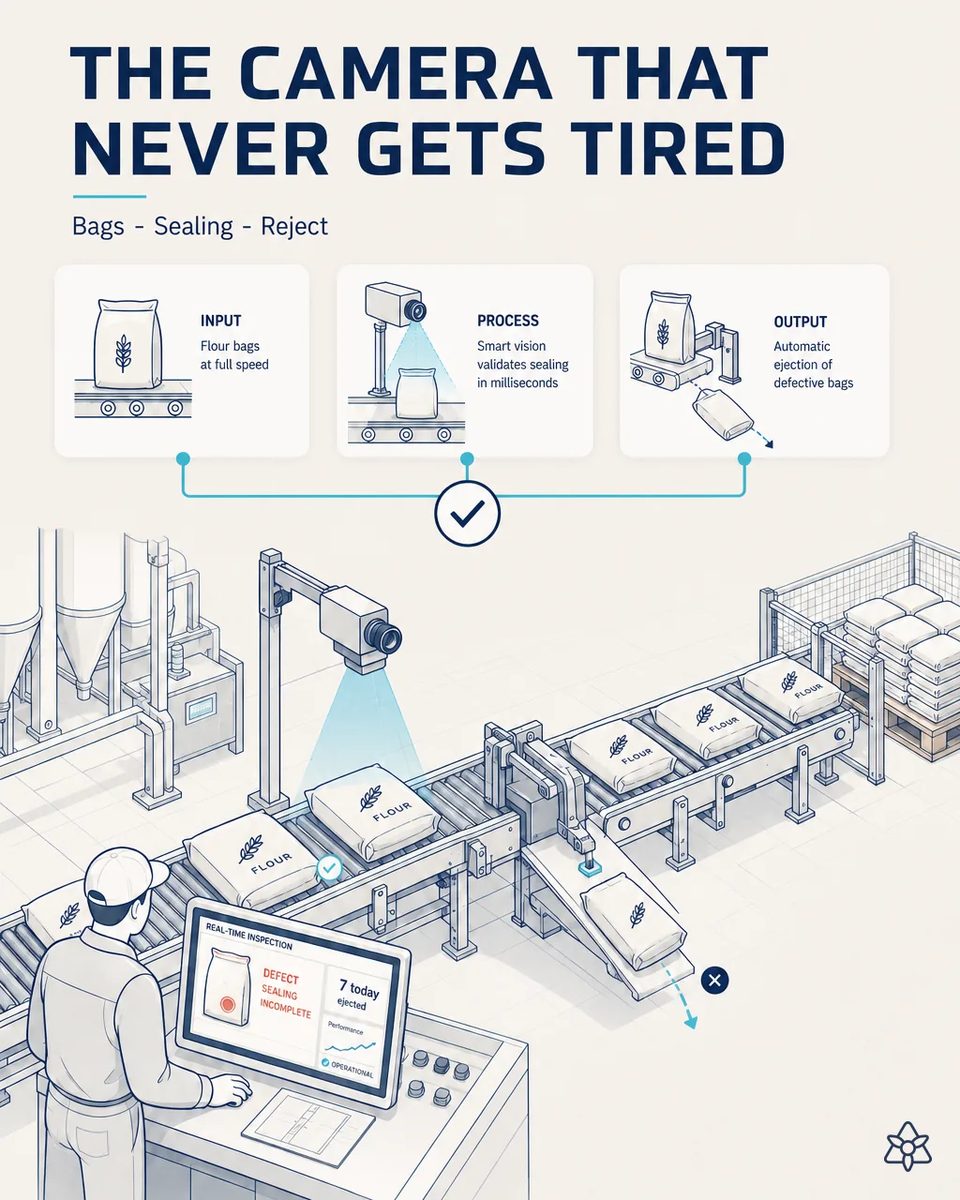
At bagging speed, inspection is done by sampling.
At industrial speed, 100% visual control is done by sampling, letting occasional sealing, palletizing or label defects reach the industrial bakery customer.
- A bagging line fills and seals bags faster than any person can check them one by one, so visual inspection is done by sampling. One bag in fifty, or a check every half hour, is the norm.
- Between samples, the occasional defect passes: an open valve or bad seal, a crooked or missing label, a deformed bag that will break the pallet. None of them is frequent; all of them are expensive when they reach the customer.
- Those defects reach the industrial customer, who sees flour spilled on the pallet or a lot code they cannot read.
- Every one of them is a complaint, a return or a credit note, and a mark against the mill in the customer's supplier rating. That rating weighs on the next annual contract.
Edge — a CNN trained on your bags, inference in milliseconds.
Edge camera over the line + a CNN trained on good/bad examples of that specific bag. Inference in milliseconds, automatic ejection of the defective unit.
The model is not generic: it is trained on good and bad examples of the specific bag on that line, with that lighting. That is what keeps false rejects low enough for the line to accept it. A system that rejects good bags gets switched off within a week; this one is tuned so that does not happen.
Bag inspection today versus Edge vision
| Aspect | Today | With iLEAN Edge |
|---|---|---|
| Coverage at the flour mill | Sampling | 100% of bags |
| Valve or seal failure | Found on the pallet | Ejected before palletizing |
| Missing or unreadable lot code | Found by the customer | Rejected in line |
| Deformed bag | Breaks the pallet pattern | Diverted |
| Inspector fatigue at the flour mill | Grows over the shift | None |
| Evidence per reject | None | Image stored with the batch |
From sampling-based control, to 100% unit control at line speed, with no fatigue.
Impact estimate — to be validated with your numbers.
The block below is an estimate to be validated against your plant's actual data. We put it forward so the committee has an order of magnitude; we refine it during the assessment.
- Estimated payback 5-10 months, depending on the volume of the bagging line.
- Fewer returns and complaints from industrial customers caused by sealing, palletizing or label defects. The defect is removed before the pallet is strapped, not after it is delivered.
- From sampling-based control to unit control at line speed, with no fatigue. The camera at the end of the night shift sees exactly what it saw at the start.
- And an image of every rejected bag stored with its batch, useful when a complaint has to be answered.
Estimated payback of 5-10 months depending on line volume, from fewer returns and complaints from industrial customers. Estimate to validate.
And the fair question from the production manager
"What if it rejects good bags and slows the line?" — the false positive is the real risk of any vision system, which is why the model is trained on your own bags. Classifying a seal or a label against known examples is an anchored task, where the best models drop below 1.5% error [1]. Borderline cases go to a separate lane for a person to decide, and each decision feeds the training. The reject rate is tracked from day one so the team can see whether the camera earns its place.
[1] OpenAI paper "Why Language Models Hallucinate", 2025 — on the reliability of AI in anchored tasks.
What people ask about inspecting flour bags
Does it keep up with the bagging line's speed?
Yes. Inference runs on a local device next to the line and resolves in milliseconds per bag, without depending on the network. The bag never has to slow down for the camera. The ejector is timed to the conveyor, so the defective bag leaves without stopping the flow.
How many bags are needed to train it?
A few hundred examples of good and defective bags of each format are usually enough to start, collected on your own line. Rare defects are added as they appear, and the model improves with each one. Training data is collected during normal production, without stopping the line.
Does flour dust on the bag confuse the camera?
Dust is part of the training data: the model learns that a dusty but well-sealed bag is good. Lighting is set up to keep dust from hiding the seal area. A camera that needs cleaning reports it before its accuracy drops. The housing is designed for the dust levels of a bagging area.
Can it check the printed lot and best-before date?
Yes. It reads the printed code and compares it with the active order, so an unreadable or wrong code is rejected. That protects traceability at the exact point it leaves the mill.
Does it work for small retail packs too?
Yes, with a model per format. Switching format on the line switches the model automatically. The operator does not have to select anything. Each format keeps its own reject history, so you can compare lines and shifts.
More cases from this series
- Lab data, from spreadsheet to ERP with no transcriptioniLEAN reads the quality lab's spreadsheet and pushes it validated into the ERP, saving up to 80% on…
- Wheat receiving, from double-keying to one tapA photo of the delivery note and analysis report: iLEAN pushes it to the ERP with the silo already…
- What the mill supervisor notices no longer gets lostA headset and Connect voice mode capture what the mill supervisor observes while walking the floor,…
- The packaging line and the ERP stop typing separatelyiLEAN stitches the automatic packaging and palletizing line to the ERP, replacing nothing, and ends…
- The mill's control panel, untouched, now talksAn external camera reads the milling line's control panel without touching it: tonnage, extraction and…
- The wheat supplier alert, handled at zero lagiLEAN reads a wheat supplier's alert at zero lag, cross-checks it against the planned blend and suggests…
Tell us how many bag-related complaints your mill received last year.
We work on your plant's real data, not ours. Assessment with no commitment.
Request estimated ROI within 48h ‹ See all cases of flour milling See food industry