What the mill supervisor notices no longer gets lost
The mill supervisor covers silos, the milling line and packaging with hands full all day. With a headset and Connect voice mode, every observation gets structured and actioned in seconds.
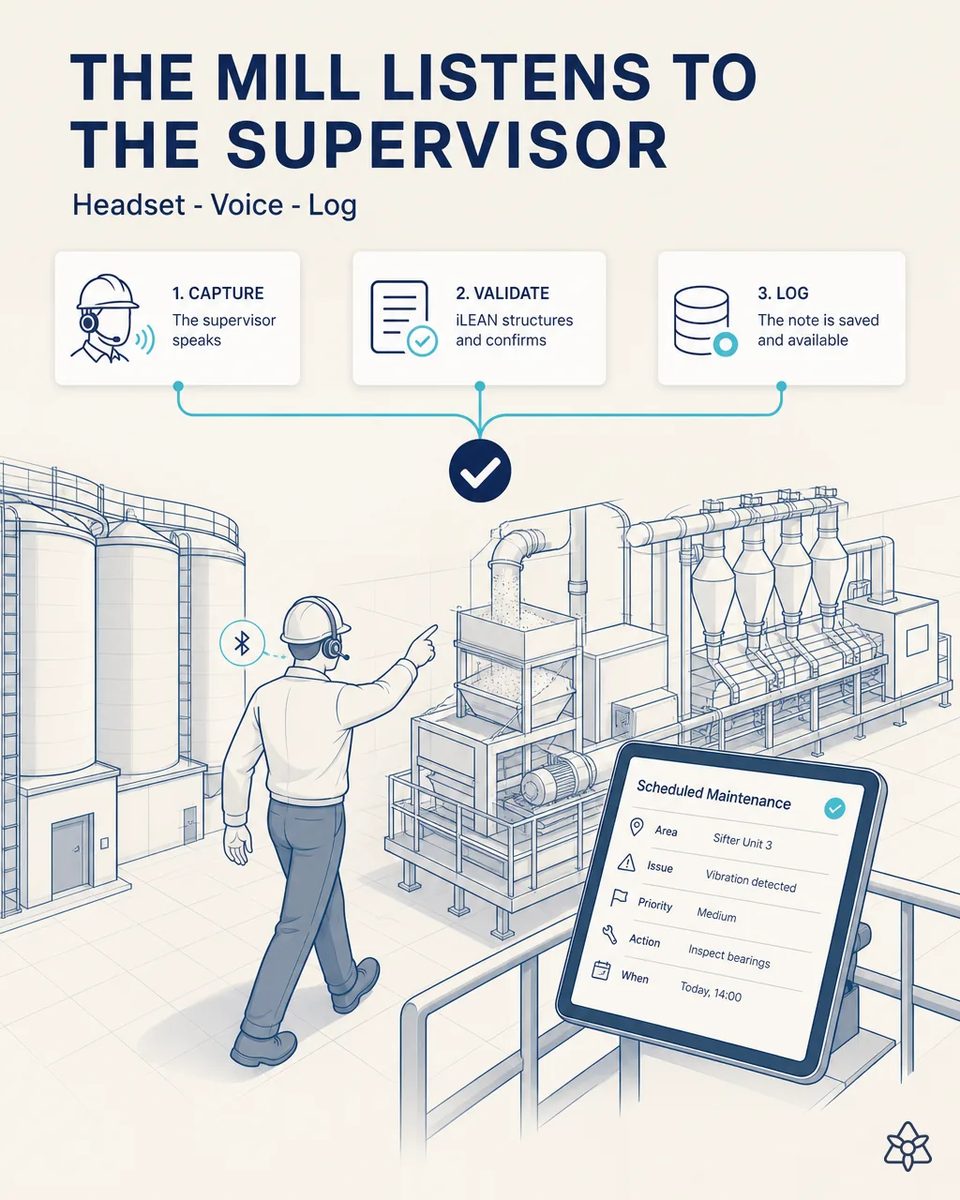
The person who knows the mill best has the least time to write it down.
The role that accumulates the most tacit knowledge about the mill's real state also has the least time to type. That knowledge disappears shift after shift.
- The mill supervisor walks silos, conditioning, the roller mill floors, plansifters and bagging every shift, with hands busy and dust everywhere. On a multi-floor mill, a full round can take most of an hour.
- They notice what no sensor reports: a sifter vibrating differently, a bearing getting warm, a choked spout, a leak at a pneumatic conveying line. Small things, until they are not.
- That knowledge is lost by the end of the shift, because writing it down means stopping, finding a terminal and typing. On a milling floor, the nearest terminal is often two floors away, and the next problem is already waiting.
- So the small defect noticed on Monday becomes the corrective maintenance stop on Thursday. And the next supervisor starts the shift without knowing any of it.
Connect in voice mode — the supervisor speaks, the system structures.
Bluetooth headset + Connect voice mode. The AI transcribes, classifies by category (maintenance, quality, safety) and routes the action to the right role without opening any app.
The supervisor does not open an app or fill in a form: they say what they see in their own words. The AI turns it into a classified, actionable entry and sends it to whoever has to act. Over months, the log shows which sifter or which spout keeps coming back, which no shift report ever made visible.
The rounds today versus the rounds being heard
| Aspect | Today | With iLEAN Connect |
|---|---|---|
| An observation on the sifter floor | Remembered, maybe | Logged in seconds |
| Classification | None | Maintenance, quality or safety |
| Who gets it | Whoever the supervisor meets | The responsible role, directly |
| Supervisor's hands | Need to stop and type | Stay free |
| Knowledge at shift change | Verbal, partial | A structured log |
| Recurring issues | Invisible | Visible as a pattern |
From observations lost by the end of the shift, to a structured, actionable log in seconds.
Impact estimate — to be validated with your numbers.
The block below is an estimate to be validated against your plant's actual data. We put it forward so the committee has an order of magnitude; we refine it during the assessment.
- Estimated payback 4-8 months, from fewer corrective maintenance incidents caught too late. A stop on the roller mill bank costs tonnage that cannot be recovered later in the shift.
- Observations stop being lost at shift change and become a structured log in seconds. The next shift starts with a list of open points instead of a hurried verbal handover.
- Maintenance receives early warnings on roller mills and sifters it would otherwise only see as a stop. A warm bearing reported on Monday is a planned intervention, not a breakdown on Thursday.
- And the tacit knowledge of the mill's most experienced role starts to stay in the plant. When that supervisor retires or moves on, what they knew does not leave with them.
Estimated payback of 4-8 months from fewer corrective-maintenance incidents caught late. Estimate to validate.
And the fair question from the production manager
"With the noise of a milling floor, will it understand anything?" — the headset's microphone is directional and filters ambient noise, and turning a spoken observation into category, equipment and action is an anchored task, where the best models drop below 1.5% error [1]. When confidence is low, the system reads back what it understood and asks for confirmation. Nothing reaches maintenance or quality as an order until the classification is clear.
[1] OpenAI paper "Why Language Models Hallucinate", 2025 — on the reliability of AI in anchored tasks.
What people ask about the mill supervisor's headset
Does the supervisor need to learn commands?
No. They speak naturally, as they would to a colleague. The system extracts equipment, issue and urgency from the sentence. If something is missing, such as which roller mill, the system asks a short follow-up question.
Does it know the names of our machines?
Yes, once the plant's equipment list is loaded: roller mill numbers, sifter units, silos and conveyors are recognized by the names your team uses. Local nicknames for equipment are added to the vocabulary during commissioning.
Is the headset safe in an ATEX zone?
The device is chosen to match the zone classification of your mill, as with any electronic equipment on the floor. Your safety officer validates the model before deployment.
Is everything the supervisor says recorded?
No. Only what is said after the activation gesture is processed. There is no continuous recording of conversations. This is agreed with the works council before the first headset is handed out.
Can it open a work order in the maintenance system?
Yes, if there is an API. Otherwise the ticket lives in iLEAN and the maintenance lead receives it on their phone. Either way the ticket keeps the supervisor's original words for context. And the supervisor can ask by voice what is still open on a given machine.
More cases from this series
- Lab data, from spreadsheet to ERP with no transcriptioniLEAN reads the quality lab's spreadsheet and pushes it validated into the ERP, saving up to 80% on…
- Wheat receiving, from double-keying to one tapA photo of the delivery note and analysis report: iLEAN pushes it to the ERP with the silo already…
- The packaging line and the ERP stop typing separatelyiLEAN stitches the automatic packaging and palletizing line to the ERP, replacing nothing, and ends…
- The mill's control panel, untouched, now talksAn external camera reads the milling line's control panel without touching it: tonnage, extraction and…
- The wheat supplier alert, handled at zero lagiLEAN reads a wheat supplier's alert at zero lag, cross-checks it against the planned blend and suggests…
- Humans in command: the blend is validated before the ERPNothing iLEAN captures enters the central system without the mill supervisor confirming it with two taps.
Tell us how many floors your mill supervisor covers on each round.
We work on your plant's real data, not ours. Assessment with no commitment.
Request estimated ROI within 48h ‹ See all cases of flour milling See food industry