The packaging line and the ERP stop typing separately
The automatic packaging, palletizing and strapping line usually has its own API, but stays isolated from the ERP. Connect stitches both systems together: what the ERP publishes reaches the line alone, replacing nothing.
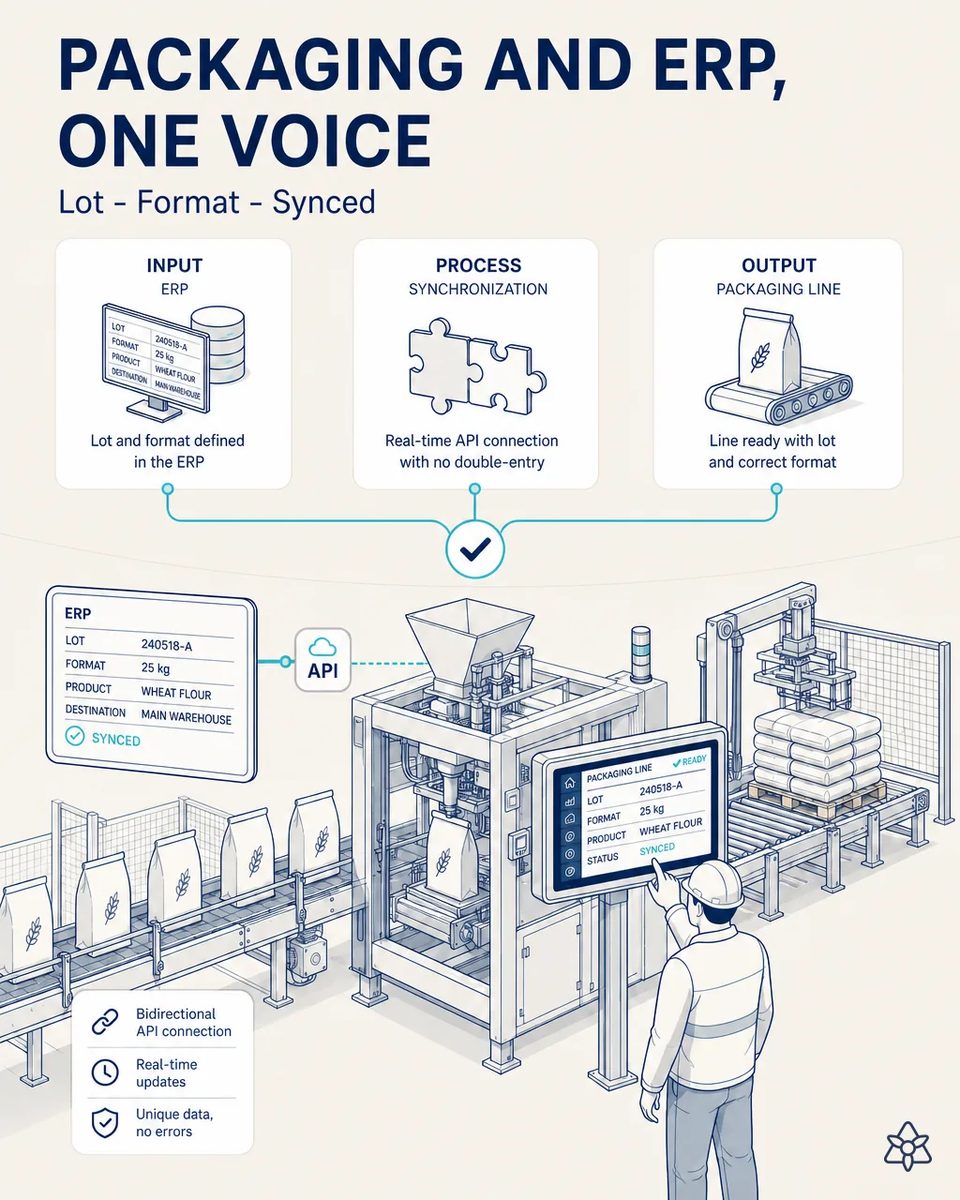
Every order change is typed twice: once in the ERP, once on the bagging panel.
Every production order change gets typed twice -once in the ERP, again on the line's panel- with the risk of a mis-set format or lot.
- The automatic bagging, palletizing and strapping line usually has its own API, but in most mills it has never been connected to the ERP. It was installed as a machine, not as part of the information system.
- So every change of production order is typed twice: in the ERP, and again on the line's panel — lot, bag format, flour type, best-before date. The same data, typed by two different people, sometimes minutes apart.
- A mis-set lot or date on a bag is a labeling error that travels on every pallet of that run.
- And each manual reconfiguration is a stop on a line that also has to alternate between bag formats and bulk loading. Every one of those stops is time the line is not bagging.
Connect via API — the ERP publishes, the bagging line receives.
Connect integrates the ERP and the packaging line via API. Lot, format and best-before date sync automatically.
Nothing is replaced: the line keeps its controller and the ERP keeps its screens. What disappears is the person in between copying data from one to the other, and with them the chance of a wrong lot on a bag. On a line that changes format several times a day, that chance adds up fast.
Bagging today versus bagging stitched to the ERP
| Aspect | Today | With iLEAN Connect |
|---|---|---|
| Order change | Typed in the ERP and on the panel | Published once, synced |
| Lot printed on the bag | Depends on who typed it | The ERP's lot, always |
| Best-before date | Calculated by hand | Synced from the order |
| Switch from 25 kg to 1 kg format | Manual reconfiguration stop | Parameters arrive with the order |
| Labeling error from desync | Possible on every change | Removed |
| Bagging line controller | — | Untouched, nothing replaced |
From double-keying on every order change, to automatic sync. The risk of labeling error from desync is removed.
Impact estimate — to be validated with your numbers.
The block below is an estimate to be validated against your plant's actual data. We put it forward so the committee has an order of magnitude; we refine it during the assessment.
- Estimated payback 4-9 months.
- Fewer stops for manual reconfiguration at every order change. On a line that alternates formats and flour types several times a day, those minutes add up.
- Fewer labeling errors caused by a lot or date typed differently on the panel and in the ERP. A wrong date on a pallet of 25 kg bags means relabeling or a customer complaint.
- And every bag and pallet carries exactly the lot the ERP knows, which closes the last link of traceability.
Estimated payback of 4-9 months from fewer manual reconfiguration stops and fewer labeling errors. Estimate to validate.
And the fair question from the production manager
"What if the integration sends the wrong format to the line?" — mapping fields between two systems with known APIs is an anchored task, where the best models drop below 1.5% error [1], and here the mapping is set once and tested at commissioning. Each order is also checked against the formats the line accepts, and the operator still confirms the start of every run. If the line rejects a parameter, the order stays on hold and the shift lead is told why.
[1] OpenAI paper "Why Language Models Hallucinate", 2025 — on the reliability of AI in anchored tasks.
What people ask about connecting the bagging line
Our bagging line is not new — does it have an API?
Many lines from the last fifteen years do, even if nobody uses it. We check it in the first visit; if there is none, the panel can be read by camera. Either way, the line itself is not modified. The first visit also tells you how much of the line's data could be used beyond orders.
Does it cover bulk loading as well as bags?
Yes. A bulk order carries lot and destination like a bag order, and the loading record is synced with the ERP the same way. That closes the gap that often exists between bagged and bulk traceability.
What about the palletizer and strapping machine?
If they expose parameters, the pallet pattern and labels are sent with the order. If not, they keep running as today. The pallet label can still carry the ERP lot through the line's printer.
Do we have to touch the line's PLC program?
No. Connect uses the interface the manufacturer already provides; the line's control logic is not modified. The manufacturer's warranty and support remain as they are.
What happens if the ERP is down?
The line keeps the last order received and continues. Changes made during the outage are reconciled when the connection returns. Nothing printed on a bag is lost from the record. The operator sees on the panel which order is active and where it came from.
More cases from this series
- Lab data, from spreadsheet to ERP with no transcriptioniLEAN reads the quality lab's spreadsheet and pushes it validated into the ERP, saving up to 80% on…
- Wheat receiving, from double-keying to one tapA photo of the delivery note and analysis report: iLEAN pushes it to the ERP with the silo already…
- What the mill supervisor notices no longer gets lostA headset and Connect voice mode capture what the mill supervisor observes while walking the floor,…
- The mill's control panel, untouched, now talksAn external camera reads the milling line's control panel without touching it: tonnage, extraction and…
- The wheat supplier alert, handled at zero lagiLEAN reads a wheat supplier's alert at zero lag, cross-checks it against the planned blend and suggests…
- Humans in command: the blend is validated before the ERPNothing iLEAN captures enters the central system without the mill supervisor confirming it with two taps.
Tell us which line in your mill already has an API nobody is using.
We work on your plant's real data, not ours. Assessment with no commitment.
Request estimated ROI within 48h ‹ See all cases of flour milling See food industry