The wheat supplier alert, handled at zero lag
An email from a cooperative warning of a delay or quality deviation in a wheat lot can sit unread for hours, while a blend already depends on that lot. iLEAN Connect catches it instantly and alerts with the concrete action.
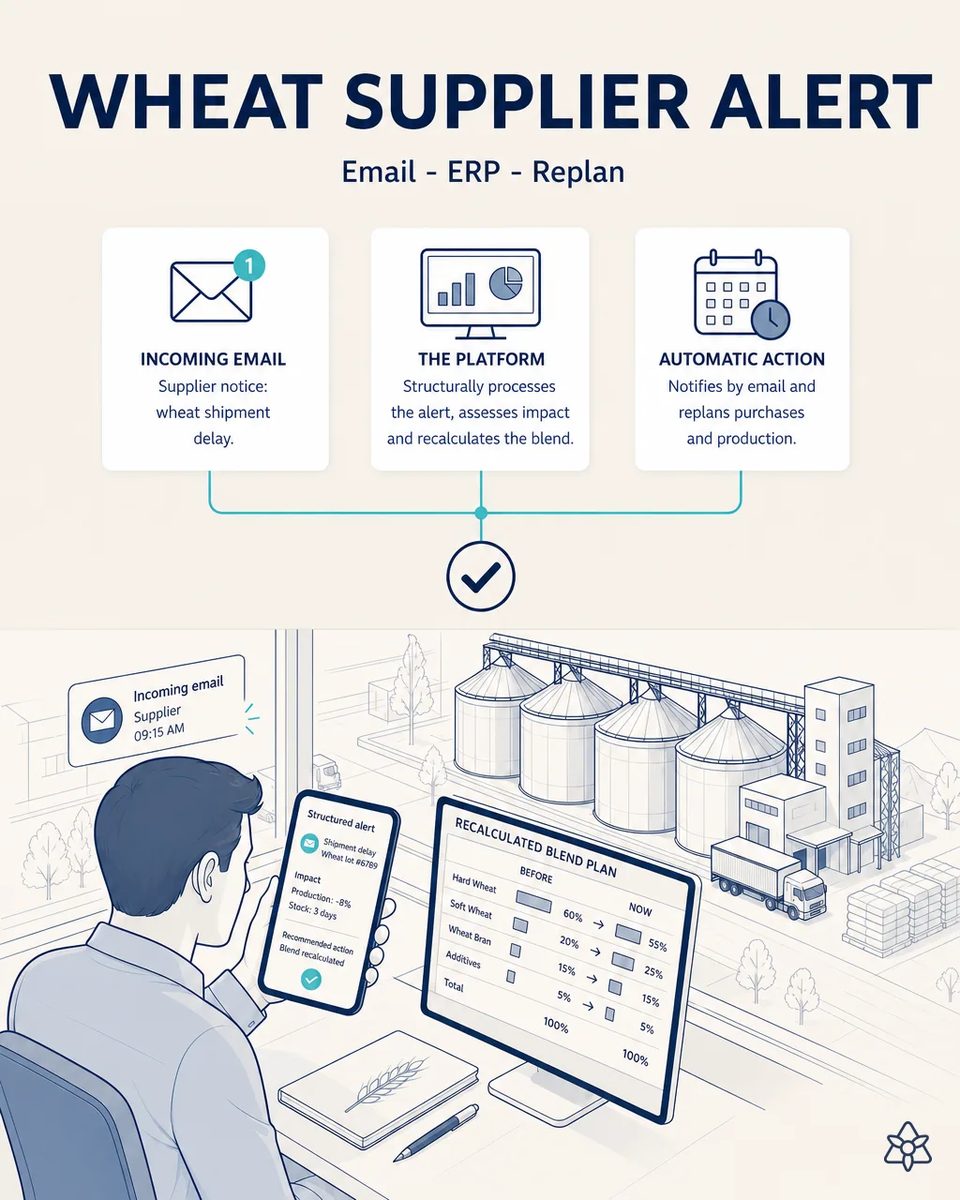
The email that changes tomorrow's blend lands in an inbox nobody is watching.
Critical supplier alerts land by email with specific people who can't watch the inbox in real time. By the time they're read, the blend is already planned or running with a different wheat profile than expected.
- Cooperatives and grain traders warn about a delayed truck, a lot with lower protein or higher moisture than agreed, or a mycotoxin result above the contract limit — by email, in free text. Sometimes in the body, sometimes in an attached certificate, sometimes in a forwarded thread.
- Those messages reach one or two specific people who are also on the phone, at the weighbridge or in a meeting. They are read hours later. Nobody is at fault: the channel was never designed for urgent decisions.
- By then the blend is already planned, or already running, with a wheat profile different from the one assumed.
- A deviation caught the day before is a change of silo in the plan; caught after milling starts, it is an off-spec batch or an unplanned stop. The same email, read at the right time, costs nothing.
Connect in chaotic-sources mode — a mailbox in silent copy, 24/7.
Connect chaotic-sources mode — a mailbox in silent copy 24/7. A grounded LLM extracts the intent (delay or quality deviation), the affected lot and the dates, cross-checks the ERP, and returns a concrete action to the right role.
Nobody has to change how suppliers write. The mailbox receives what it already receives; what changes is that the alert reaches the person who decides the blend while there is still time to swap a silo. Hours of latency become seconds, and the blend is planned with the wheat that will really be there.
Today's supplier inbox versus the inbox being read
| Aspect | Today | With iLEAN Connect |
|---|---|---|
| Delayed truck notice | Read when the buyer gets to it | Detected in seconds |
| Protein or moisture off contract | Discovered at intake | Crossed with the planned blend |
| Mycotoxin result above limit | Buried in an attachment | Flagged with the affected lot |
| Who acts | Whoever reads the email | The role that owns the blend |
| Blend recalculation | With yesterday's data | With the real lot profile |
| Replies to the supplier | Manual | Still manual, nothing sent out |
From hours of human latency, to seconds. Blends recalculated with real-time data, not with what was read hours earlier.
Impact estimate — to be validated with your numbers.
The block below is an estimate to be validated against your plant's actual data. We put it forward so the committee has an order of magnitude; we refine it during the assessment.
- Estimated payback 3-7 months, depending on how often critical supplier alerts occur.
- Off-spec blends avoided because the change in wheat profile is known before milling. A silo swap planned the day before costs nothing; an off-spec batch costs a downgrade or a rework.
- Fewer unplanned stops caused by a truck that does not arrive when the silo was counting on it. The plan adapts to the real arrival time instead of discovering it at the weighbridge.
- And human latency reduced from hours to seconds, without anybody having to watch the inbox.
Estimated payback of 3-7 months depending on how often critical alerts occur, avoiding off-spec blends and unplanned stops. Estimate to validate.
And the fair question from the production manager
"Is the AI going to answer the cooperative on our behalf?" — no. It writes nothing outwards and confirms nothing. Extracting the intent, the lot and the dates from an email that is already in front of it is an anchored task, where the best models drop below 1.5% error [1]. What it does is prepare the decision and put it in front of the person who plans the blend, who decides. Every alert is stored with the original email, so the decision can always be traced back to its source.
[1] OpenAI paper "Why Language Models Hallucinate", 2025 — on the reliability of AI in anchored tasks.
What people ask about supplier alerts in a mill
Does it understand attachments like lab certificates?
Yes. A PDF with the protein, moisture or mycotoxin results of a lot is read like the body of the email and tied to the same alert. Scanned certificates are read too, as long as the scan is legible to a person.
How does it know which blend is affected?
It crosses the lot or contract mentioned in the email with the ERP and the planned blends, and tells you which batches depend on that wheat. If the lot is already in a silo, it also tells you which silo and how much of it is left.
Do we need to give access to the buyer's personal mailbox?
No. A dedicated address is added in silent copy, or a forwarding rule is set for the supplier domains you choose. Internal email and personal messages are never read.
What if the email is ambiguous?
It says so. An alert with low confidence is routed to a person as a question instead of as a recommended action. It never invents a lot number or a date to fill a gap.
Does it also work with messages in other languages?
Yes, which matters for mills buying imported wheat: the intent is extracted the same way whatever the language of the trader. The alert itself always reaches your team in their own language.
More cases from this series
- Lab data, from spreadsheet to ERP with no transcriptioniLEAN reads the quality lab's spreadsheet and pushes it validated into the ERP, saving up to 80% on…
- Wheat receiving, from double-keying to one tapA photo of the delivery note and analysis report: iLEAN pushes it to the ERP with the silo already…
- What the mill supervisor notices no longer gets lostA headset and Connect voice mode capture what the mill supervisor observes while walking the floor,…
- The packaging line and the ERP stop typing separatelyiLEAN stitches the automatic packaging and palletizing line to the ERP, replacing nothing, and ends…
- The mill's control panel, untouched, now talksAn external camera reads the milling line's control panel without touching it: tonnage, extraction and…
- Humans in command: the blend is validated before the ERPNothing iLEAN captures enters the central system without the mill supervisor confirming it with two taps.
Tell us how many supplier notices about wheat lots you received last month.
We work on your plant's real data, not ours. Assessment with no commitment.
Request estimated ROI within 48h ‹ See all cases of flour milling See food industry