The mill's control panel, untouched, now talks
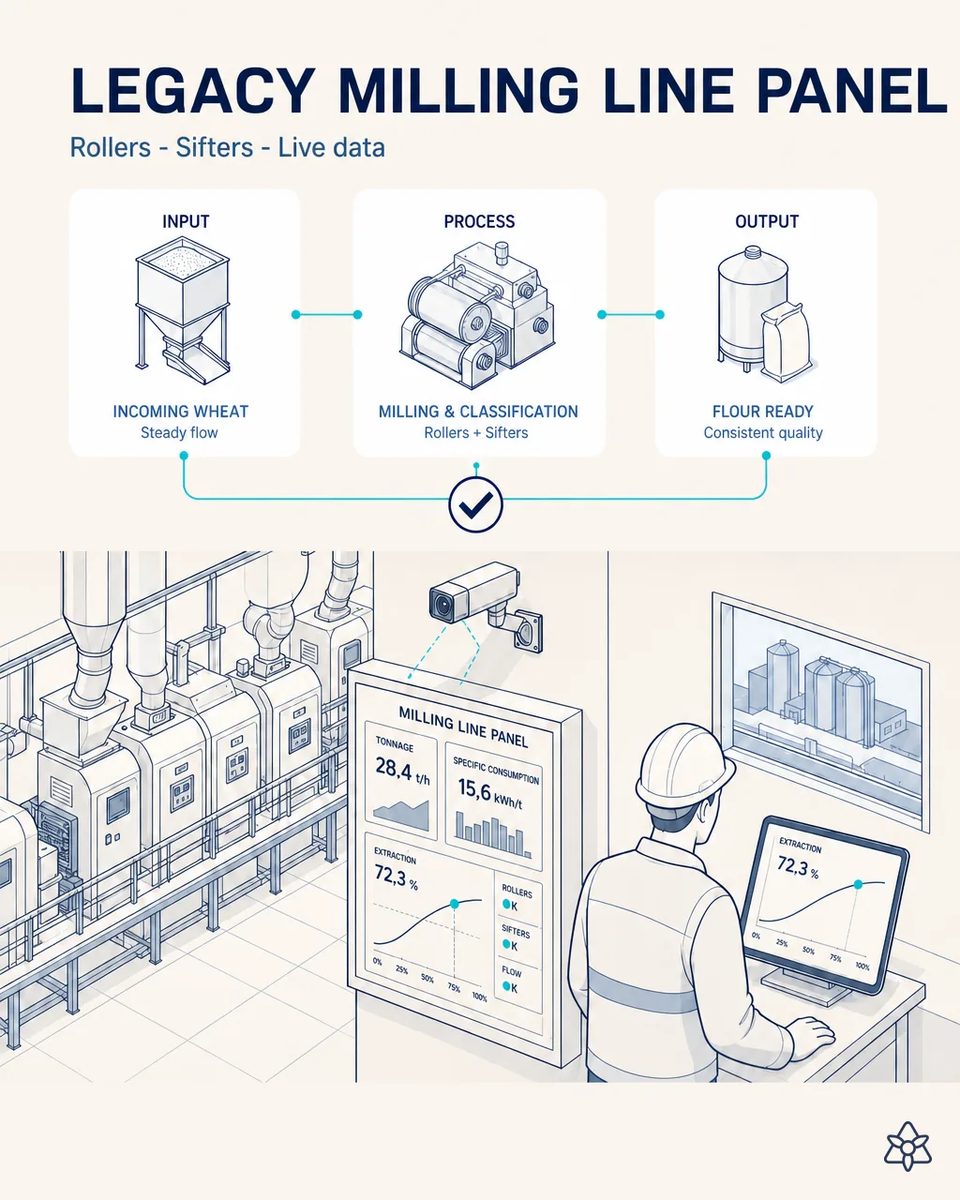
A flour mill's milling line is often 15-25 years old with a control panel isolated from the network. With iLEAN Connect, an external camera pointed at the panel digitizes its performance without touching the original panel.
The data that explains extraction dies on a screen every shift.
The milling line's panel concentrates the data the mill supervisor would need to correlate extraction, power draw and resulting flour quality. Today that data dies on the screen because nobody transcribes it shift after shift.
- Many milling lines run for 15 to 25 years on a control panel that was never connected to the network, and the manufacturer no longer supports opening it. Replacing it means a new control system, weeks of downtime and a project nobody wants to sign.
- That panel concentrates what the mill supervisor needs: tonnage per hour, extraction rate, specific power draw of the roller mill bank and the status of the plansifters. It is exactly the data needed to understand why one batch yields more flour than another.
- Nobody transcribes it shift after shift, so the figure disappears when the screen refreshes.
- Without that series, nobody can say why extraction dropped two points last week: a worn roll, a change in wheat hardness or a conditioning time cut short. Each of those has a different fix, and choosing the wrong one costs another week of yield.
Connect in photo mode on the panel — read from outside, nothing opened.
Connect photo mode over the panel. A fixed industrial camera plus OCR with a grounded LLM interprets every reading, structures the time series per batch and cross-references it against the ERP to know which blend was being processed at each moment.
The camera does not integrate with the panel's PLC, opens no ports and requires no line stop to install. On a line where replacing the control system means weeks of downtime, that is what makes the case approvable. It is the cheapest way to get a time series out of a machine that was never designed to give one.
Today's milling panel versus the panel being read
| Aspect | Today | With iLEAN Connect |
|---|---|---|
| Extraction rate | Seen on screen, then lost | Time series per batch |
| Specific power draw (kWh/t) | Read only at shift end | Recorded continuously |
| Extraction vs. blend correlation | Impossible | Crossed with the ERP blend |
| Root cause of a yield drop | An opinion | Analysis per batch in minutes |
| The panel and its PLC | — | Untouched, no ports opened |
| Replacing the control system | In the capex plan | Indefinitely deferrable |
From zero extraction-quality correlation, to root-cause analysis per batch in minutes. Replacing the control panel becomes indefinitely deferrable.
Impact estimate — to be validated with your numbers.
The block below is an estimate to be validated against your plant's actual data. We put it forward so the committee has an order of magnitude; we refine it during the assessment.
- Estimated payback 5-10 months.
- Avoided capex of a new control panel, which can be deferred indefinitely. The old panel keeps doing its job; it simply stops being a dead end for data.
- Extraction yield improved through the correlation between blend, conditioning and roller mill settings that is impossible today. Even one point of extraction, on the tonnage of a mill, is a figure finance understands.
- And root-cause analysis per batch in minutes instead of a discussion in the morning meeting.
Estimated payback of 5-10 months, avoiding the CAPEX of a new control panel and improving extraction yield through data correlation. Estimate to validate.
And the fair question from the production manager
"Can a camera really read a 20-year-old panel reliably?" — reading a fixed-layout screen with values in known positions is an anchored task, where the best models drop below 1.5% error [1]. And nothing is decided on one frame: the series is built over thousands of readings, and any value outside the physical range of the line is discarded instead of stored. If the camera is knocked out of position, the system reports it instead of reading the wrong field.
[1] OpenAI paper "Why Language Models Hallucinate", 2025 — on the reliability of AI in anchored tasks.
What people ask about reading the milling panel
Do we have to stop the milling line to install it?
No. The camera is mounted on a bracket in front of the panel and connects to the local network; the line keeps running during installation. A typical installation takes a morning, including framing and calibration of the readings.
Which values can it capture?
Whatever the panel shows: tonnage, extraction, power draw of each passage, plansifter alarms and hopper levels. Which ones are stored is decided with your mill supervisor. Adding a new value later is a configuration change, not a new project.
How does it know which blend was being milled?
It crosses the timestamp of each reading with the ERP and with the blend sheet of that batch, so every point of the series carries its wheat lots. That is what lets you compare how two blends behaved on the same roller mill settings.
Does flour dust affect the camera?
The housing is sealed for dusty environments and the system detects a degraded image and reports it instead of reading wrong values. A cleaning routine for the lens is added to the existing housekeeping of the floor.
Can it detect roll wear before extraction falls?
That is where the series shows its value: a power draw creeping up at the same tonnage is a trend visible weeks before the yield loss. Maintenance can then plan the roll change for the next scheduled stop instead of reacting.
More cases from this series
- Lab data, from spreadsheet to ERP with no transcriptioniLEAN reads the quality lab's spreadsheet and pushes it validated into the ERP, saving up to 80% on…
- Wheat receiving, from double-keying to one tapA photo of the delivery note and analysis report: iLEAN pushes it to the ERP with the silo already…
- What the mill supervisor notices no longer gets lostA headset and Connect voice mode capture what the mill supervisor observes while walking the floor,…
- The packaging line and the ERP stop typing separatelyiLEAN stitches the automatic packaging and palletizing line to the ERP, replacing nothing, and ends…
- The wheat supplier alert, handled at zero lagiLEAN reads a wheat supplier's alert at zero lag, cross-checks it against the planned blend and suggests…
- Humans in command: the blend is validated before the ERPNothing iLEAN captures enters the central system without the mill supervisor confirming it with two taps.
Tell us which machine in your mill still keeps its data on a screen.
We work on your plant's real data, not ours. Assessment with no commitment.
Request estimated ROI within 48h ‹ See all cases of flour milling See food industry