Wheat receiving, from double-keying to one tap
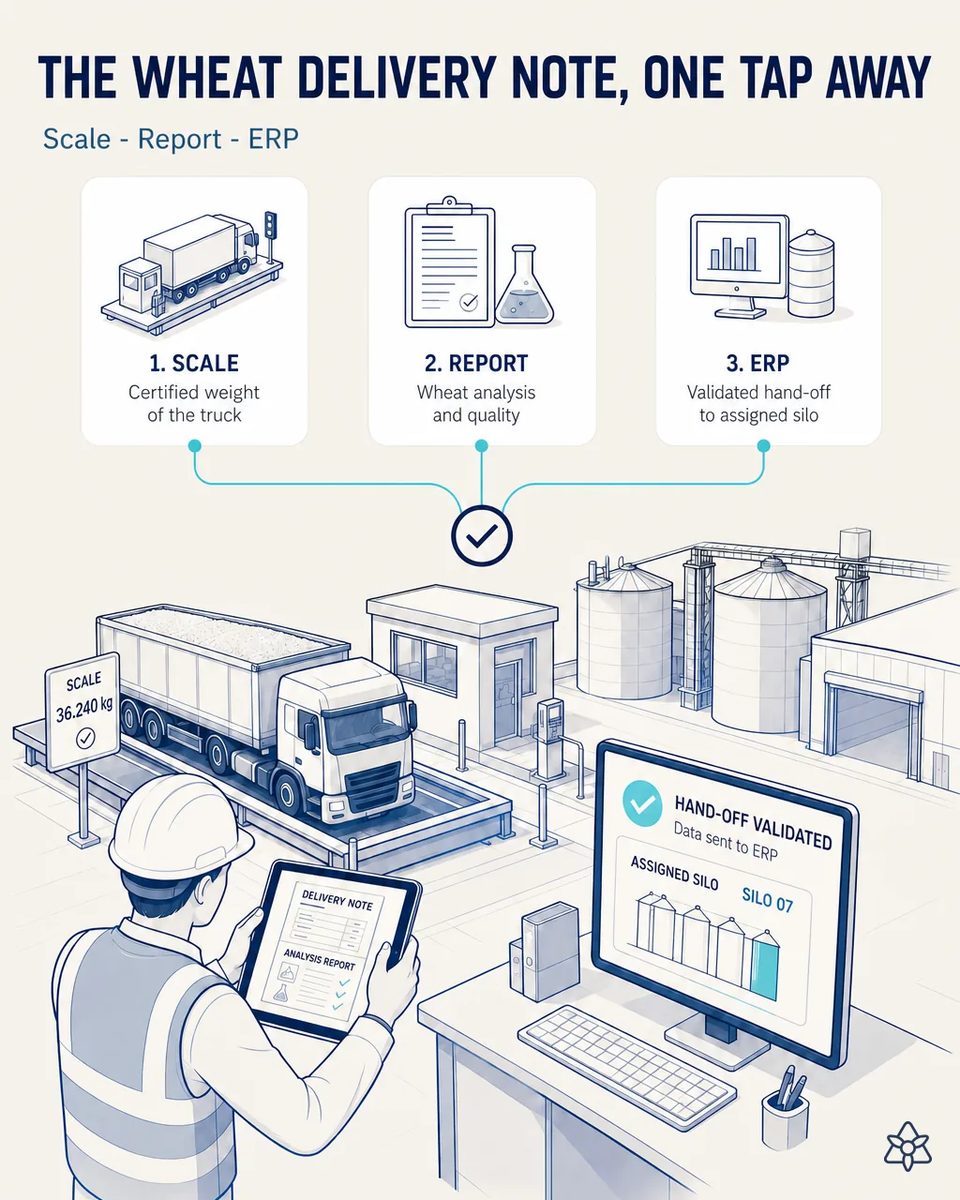
The wheat truck arrives with a delivery note and an analysis report. Today the receiving supervisor signs and types it line by line into the ERP. With iLEAN, one photo is enough and the data crosses validated, silo already assigned.
Every wheat truck is typed twice, with the driver waiting.
Every wheat receipt causes double-keying under time pressure from the driver, with the risk of poorly recorded lot-to-silo traceability.
- Each truck arrives with a delivery note and a wheat analysis report: protein, moisture, test weight, impurities, origin and, increasingly, mycotoxin results. Each cooperative and trader uses its own layout, often half printed and half handwritten.
- The receiving supervisor signs, and then types it all line by line into the ERP, with the driver waiting at the weighbridge.
- At harvest that means 20 to 40 minutes of double-keying per truck, and queues that cost demurrage.
- Under that pressure the silo assignment gets recorded badly or late, and lot-to-silo traceability — the base of everything downstream — takes days to rebuild. When a customer asks where the wheat in a batch came from, the answer should take minutes.
Connect in photo mode on the delivery note — one tap and the silo is assigned.
Connect photo of the delivery note plus the analysis report (OCR + grounded LLM) extracts protein, moisture, test weight, impurities and origin. The receiving supervisor validates with one tap; Connect pushes it to the ERP via API with the silo assignment.
Receiving is where the mill's traceability starts. If the lot enters the right silo with its analysis attached, everything downstream — blend, batch, bagging — inherits it. If it enters wrong, nothing downstream can fix it. That is why we usually start the traceability chain here.
Wheat receiving today versus receiving by photo
| Aspect | Today | With iLEAN Connect |
|---|---|---|
| Time per truck at intake | 20-40 min of double-keying | Validation in seconds |
| Test weight and impurities | Retyped from the report | Extracted from the photo |
| Silo assignment | Noted by hand, sometimes late | Pushed to the ERP with the lot |
| Lot-to-silo traceability | Rebuilt in days | Reconstructible in minutes |
| Driver demurrage at harvest | Queue at the weighbridge | Removed |
| Receiving module licenses | Several users typing | 50-70% fewer |
From 20-40 minutes of double-keying per truck, to validation in seconds. Lot-to-silo traceability reconstructible in minutes instead of days.
Impact estimate — to be validated with your numbers.
The block below is an estimate to be validated against your plant's actual data. We put it forward so the committee has an order of magnitude; we refine it during the assessment.
- Estimated payback 3-6 months.
- Estimated savings of 50 to 70% on receiving-module licenses. The users who only held a license to type delivery notes no longer need it.
- The end of driver demurrage caused by double-keying at the weighbridge. At harvest, when trucks queue, that is where the minutes add up most.
- And full grain-to-silo-to-lot traceability by photo, reconstructible in minutes instead of days.
Estimated savings of 50 to 70% on receiving-module licenses, plus the end of driver demurrage and full grain-to-silo-to-lot traceability by photo. Payback 3-6 months. Estimate to validate.
And the fair question from the production manager
"Every cooperative uses a different delivery note — will it cope?" — the layout changes, but the fields do not: lot, weight, protein, moisture, test weight. Locating known fields on a document is an anchored task, where the best models drop below 1.5% error [1]. And the receiving supervisor confirms with one tap before the data and the silo assignment reach the ERP. If a field is unreadable on the photo, it is flagged on the tablet rather than filled with a guess. The original photos stay attached to the lot as evidence for any later dispute with the supplier.
[1] OpenAI paper "Why Language Models Hallucinate", 2025 — on the reliability of AI in anchored tasks.
What people ask about wheat receiving by photo
Does it work with delivery notes from many different suppliers?
Yes. It does not need a template per supplier; it identifies the fields by their meaning, whatever the layout of each cooperative or trader. Handwritten additions on a printed note are read as well. A new supplier's first delivery note is read the same day it arrives.
Can it read the in-house analysis done at intake?
Yes. The intake sample's protein, moisture and test weight can be photographed or read from the analyzer's printout and tied to the same truck. The intake result and the supplier's report can then be compared automatically.
Who decides which silo the wheat goes into?
The receiving supervisor, as today. iLEAN proposes the silo based on the lot profile and current stocks, and the person confirms. The proposal takes into account the protein and test weight already stored in each silo.
What about mycotoxin results?
They are extracted and stored with the lot. A value above the contract limit is flagged before the truck unloads. The receiving supervisor decides whether to accept, divert or reject the load. The decision is stored with the lot, so the reason for any rejection stays on record.
Does it cope with harvest peaks?
That is where it pays most: the time saved per truck multiplies by the queue, and the queue is what generates demurrage. Outside harvest, the same flow keeps every receipt clean with less pressure. And the weighbridge stops being the place where traceability is lost.
More cases from this series
- Lab data, from spreadsheet to ERP with no transcriptioniLEAN reads the quality lab's spreadsheet and pushes it validated into the ERP, saving up to 80% on…
- What the mill supervisor notices no longer gets lostA headset and Connect voice mode capture what the mill supervisor observes while walking the floor,…
- The packaging line and the ERP stop typing separatelyiLEAN stitches the automatic packaging and palletizing line to the ERP, replacing nothing, and ends…
- The mill's control panel, untouched, now talksAn external camera reads the milling line's control panel without touching it: tonnage, extraction and…
- The wheat supplier alert, handled at zero lagiLEAN reads a wheat supplier's alert at zero lag, cross-checks it against the planned blend and suggests…
- Humans in command: the blend is validated before the ERPNothing iLEAN captures enters the central system without the mill supervisor confirming it with two taps.
Tell us how long a wheat truck spends at your weighbridge during harvest.
We work on your plant's real data, not ours. Assessment with no commitment.
Request estimated ROI within 48h ‹ See all cases of flour milling See food industry