The camera rejects the bad seal before packing
At the line's real pace, the human eye tires and lets poorly sealed pieces through. An Edge camera over the forming-sealing line infers in milliseconds per piece and rejects it before it reaches packing.
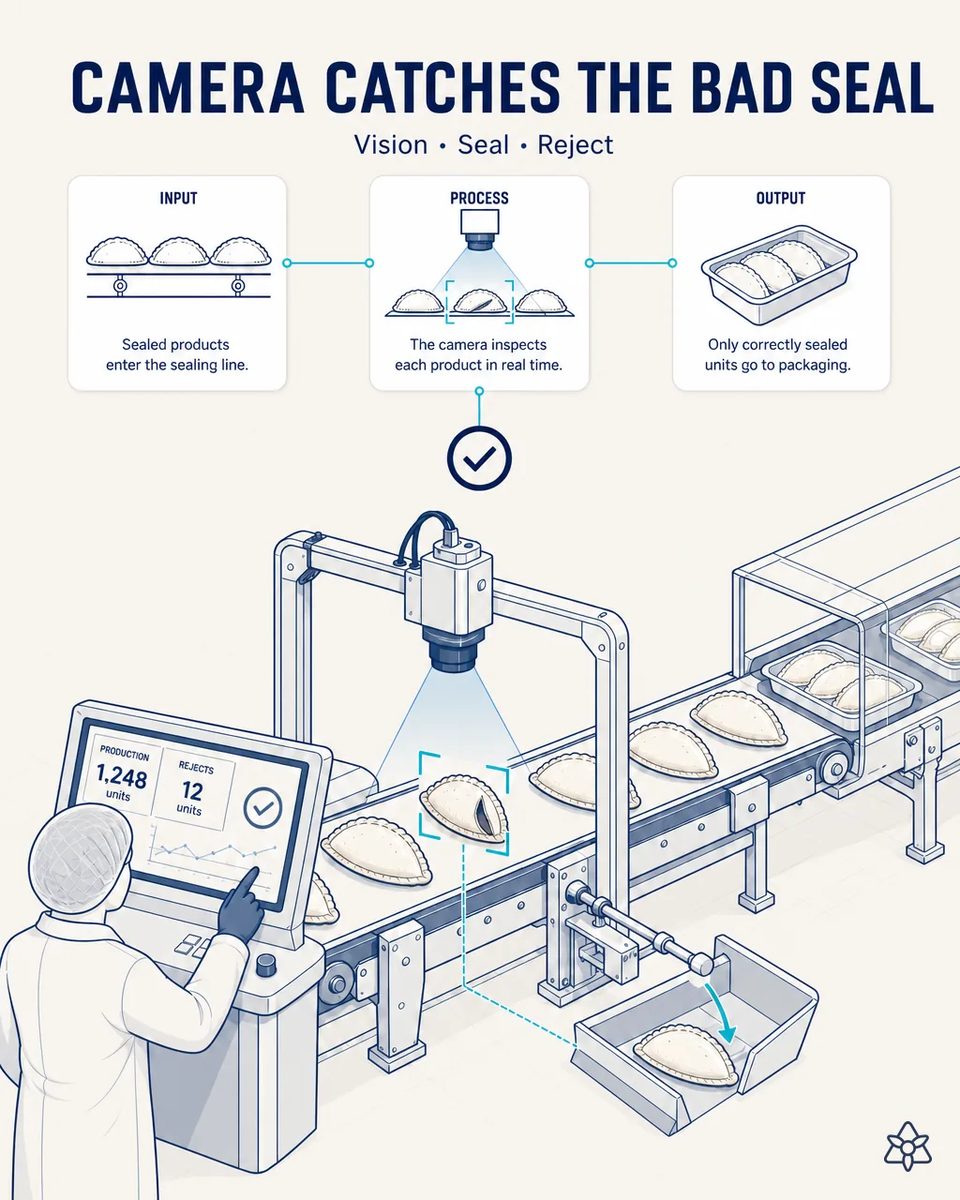
The human eye cannot hold up at the line's real pace.
100% human visual control is impossible at real line speed, more so with several filling formulas rotating through the shift, each behaving differently when sealed. Sampling-based inspection leaves gaps that end in complaints or a full tray return from the customer.
- A badly closed crimp is not always visible: an empanada with the edge barely open passes visual control, bursts in the tunnel oven or opens during freezing and stains the rest of the tray.
- 100% human visual control is impossible at real line speed, and fatigue does the rest from the third hour of the shift: the judgment applied to piece number one thousand is not the one applied to piece number fifty.
- With several filling formulas rotating in the same shift, each behaves differently when sealed: the wetter filling escapes through the edge and the colder one keeps the dough from bonding. What the operator learned to look for with one recipe stops serving them with the next.
- Sampling-based inspection leaves gaps that end in a complaint or a full tray return from the customer, which is where the cost multiplies: you do not lose one empanada, you lose the pack, the film, the process and the trust of the chain that bought it.
Edge — piece-by-piece classification in milliseconds, before packing.
Edge: local CNN vision over the forming-sealing line, no cloud dependency. The model, trained on real examples of each formula, infers in milliseconds and rejects the defective piece before packing.
Inference is local, on the line itself, with no dependency on the plant network or the cloud. At the pace of a forming machine that is not a technical detail: it is the difference between rejecting the bad piece in the next meter of conveyor and finding it at the customer, two weeks later, with a whole tray compromised.
Today's inspection versus Edge vision
| Aspect | Visual inspection | With iLEAN Edge |
|---|---|---|
| Coverage | Sampling and fatigue | 100% of pieces, constant |
| A barely open crimp | Slips through | Classified piece by piece |
| Point of detection | The customer or final inspection | The conveyor, before packing |
| Several formulas in a shift | Each one fools you differently | One model per active formula |
| Tray stained by one piece | Lost whole | Never gets formed |
| Edge cases | Decided by haste | Escalated to a person |
Partial sampling → 100% piece inspection. Sealing-defect complaints → drastic reduction.
Impact estimate — to be validated with your numbers.
The block below is an estimate to be validated against your plant's actual data. We put it forward so the committee has an order of magnitude; we refine it during the assessment.
- Estimated payback 5-12 months, depending on your current sealing scrap ratio.
- From partial sampling to 100% inspection of the pieces leaving the forming machine.
- A drastic reduction in complaints and returns for sealing defects, which is what the retail chain actually measures you on.
- And the tray that used to be lost whole because one single piece opened during freezing stops reaching packing.
Estimated payback 5-12 months depending on current scrap ratio. *Estimate to validate*.
And the fair question from the production manager
“What if it rejects good empanadas?” — the false positive is the real risk of any vision system, which is why the model is trained on good and bad pieces from your specific formulas and with the lighting of that station, not on a generic model. Edge cases are not simply rejected: they are escalated for a person to decide, and every decision feeds back into training. Classification is an anchored task, where the best models drop below 1.5% error [1].
[1] OpenAI paper "Why Language Models Hallucinate", 2025 — on the reliability of AI in anchored tasks.
What people ask about seal vision
Can it keep up with the forming machine's pace?
Yes: inference resolves in milliseconds per piece on the line's own Edge device, with no dependency on the plant network or the cloud. At the units per minute of a real forming machine, that locality is not a luxury, it is the requirement.
Does it tell a badly closed crimp from a normal variation in the dough?
That is the hard part, which is why it is trained on real pieces from your line. Sheeted sweet dough never gives two identical edges, so the model learns the acceptable margin of your recipe and your cutter, not a catalog ideal.
How many pieces does training need?
Fewer than feared, because the catalog of sealing defects is short and repetitive: open edge, escaped filling, double fold, disc off-center in the cutter. What matters is that the pieces come from your formulas and your lighting.
Does it also catch filling peeking out of the edge?
Yes, and it is one of the defects that slips through most, because at a glance it looks like a trace of flour and then stains the tray during freezing. It is also the one that most often signals a doser running ahead of the sealing tooling.
Does the same camera serve several formulas?
Yes, switching the model according to the formula active in the order. That is the norm in a plant alternating in-house brand and private label in the same shift.
More cases from this series
- Photo of the production order at batch start-upHow an empanada plant gets the production order and filling sheet into the central system in zero…
- Photo of the delivery note, no typing while the cold chain waitsPhoto of the delivery note and the raw-material labels: full traceability without sacrificing cold-chain…
- The forming machine panel, read without touching itAn external camera reads the aging forming-and-sealing machine's panel without touching it, correlating…
- The line lead dictates while walkingThe line lead of an empanada plant dictates incidents while walking, through an earpiece, and gets…
- The modified-atmosphere packer, stitched to the ERPThe modified-atmosphere packer is stitched to the ERP: batch, date, and allergens flow automatically, no…
- The quality spreadsheet stops being retyped by handThe quality lab's spreadsheet flows straight into the ERP after validation, with no manual retyping and…
Tell us what share of your scrap is sealing scrap today.
We work on your plant's real data, not ours. Assessment with no commitment.
Request estimated ROI within 48h ‹ See all cases of empanada plants See food industry